Model Ops (MLOps) in Banking – Scaling from 10 to 1000 Models

For the modern financial institution, the challenge is no longer “if” AI should be adopted, but how to manage its exponential growth. Transitioning from a handful of bespoke models to an enterprise-wide fleet of 1,000+ models require a fundamental shift from manual experimentation to a scalable framework of Machine Learning Operations (MLOps). In an industry where trust is the primary currency, scaling Banking AI demands a balance between fintech-style agility and rigorous regulatory compliance.

The Regulatory Paradox of Speed and Governance

As banks scale their AI model management capabilities, they hit a regulatory ceiling. Global mandates, such as the US Fed’s SR 11-7, Europe’s DORA and AI Act, and Singapore’s MAS FEAT principles, require exhaustive documentation, bias mitigation, and effective challenges for every model used in critical decision-making. For compliance teams working through SR 11-7 model governance requirements, SR 11-7 model override governance best practices provides a practical audit-ready framework.

The stakes for failure are high. Technical debt and legacy infrastructure remain significant hurdles, as less than 15% of financial institutionscurrently have the IT infrastructure required to support model deployment, and fewer than half of the models developed ever reach production. The vulnerability of these manual systems was underscored during the COVID-19 pandemic, when 35% of banksreported negative model performance because they could not update their models quickly enough to account for sudden market shifts.

Without automated Machine Learning Operations, models succumb to “concept drift”—where the statistical properties of the target variable change over time—leading to inaccurate credit scoring or failed fraud detection. Industrialized MLOps bridges this gap by automating data lineage and versioning, ensuring that exhaustive compliance documentation is a byproduct of the pipeline rather than a manual hurdle. This shift is already reflected in practice, with leading institutions achieving significant gains in validation speed and governance efficiency, as highlighted in Anaptyss’ work on third-party credit risk model validation and broader approaches to scaling model operations in enterprise environments.

What Prevents Banks from Scaling Beyond Pilot AI Programs

Traditional banks often struggle to scale because of legacy “waterfall” development cycles and fragmented data systems, where data is often siloed across multiple disconnected departmental repositories. . This creates the “model handoff problem,” where promising prototypes from data scientists fail to transition into production due to infrastructure misalignments. As generative AI adds a new category of model risk, model risk management for generative AI in banking has emerged as a parallel governance priority.

To reach the 1,000-model milestone, institutions must evolve through four maturity levels:

How Leading Banks Are Accelerating AI Deployment at Scale

Scaling Machine Learning Operations is not merely a theoretical goal; it is a proven competitive advantage.

a. NatWest Group

Transformed its deployment cycle by building a scalable platform on AWS, reducing the “idea-to-value” time from 40 weeks down to just 16 weeks and cutting environment setup time from 35–40 days to 1–2 days.

b. Credit Risk Excellence

One leading institution achieved 40% faster validation of third-party credit risk models by implementing advanced model operations.

c. Mortgage Lifecycle Automation

In document-heavy sectors like mortgage processing, AI-driven frameworks now handle over 200 document types with 95% accuracy and 75% straight-through processing automation.

Three Foundations of Enterprise-Scale MLOps in Banking

For technical leaders, the roadmap to 1,000 models involves three critical pillars:

1. Centralized Feature Store

Ensure consistent feature engineering across all banking channels to maintain a coherent customer experience.

2. Automated Fairness Testing

Implement automated assessments to detect and prevent discriminatory outcomes in protected attributes, essential for credit and lending models.

3. Model Observability

Move beyond basic accuracy metrics to monitor for “concept drift” and business impact, particularly in volatile markets where historical data may no longer apply.

Mastering the Balance for Future Growth

Scaling from 10 to 1,000 models is as much a governance challenge as an engineering one. Anaptyss helps financial institutions bridge this gap through ANAan AI Operating Layer that embeds 14+ specialized agents for model monitoring, validation support, and compliance documentation within an enterprise-grade Zero Data Copy architecture. The result is model governance that is continuous, auditable, and aligned with SR 11-7, DORA, and EU AI Act requirements from day one. These capabilities are further reinforced by Anaptyss Model Risk Management services, enabling institutions to strengthen governance, validation, and ongoing model lifecycle controls as AI adoption scales.


Credit Portfolio Management in a High-Interest-Rate Environment

Credit Portfolio Management

Financial institutions are contending with a “higher-for-longer” interest rate regime that has fundamentally altered the mechanics of Credit Portfolio Management. Rising rates have increased borrowing costs and compressed yields while raising default risk, particularly on variable- and floating-rate instruments. To maintain resilience, banks must transition from traditional “buy-and-hold” models to Active Credit Portfolio Management (ACPM), a dynamic methodology that emphasizes continual monitoring and tactical rebalancing to optimize risk-return outcomes.

Why High Interest Rates Demand a New Approach to CPM

A high-rate environment introduces significant volatility into Interest Rate Risk Management for Banks, as fluctuations directly impact the valuation of fixed-income assets and the repayment capacity of borrowers. The 2025 IACPM Principles and Practices in Credit Portfolio Management Global Survey found that 96% of banks prioritize regulatory capital as their most important metric, reflecting the continued pressure to maintain capital adequacy amid economic uncertainty and the finalization of Basel III rules. Effective CPM has thus become central to strengthening balance-sheet resilience and using capital more efficiently.

Critical Risk Factors Affecting Credit Portfolios

The shift in the interest rate cycle exposes several vulnerabilities within existing frameworks:

a. Concentration Risk

Overexposure to similar instruments, geographies, or products increases the vulnerability of the portfolio during economic downturns. Current geopolitical disruptions and shifting supply chains are further reshaping these sectoral exposures.

b. Credit Quality Deterioration

Rising rates affect a borrower’s stability and repayment capacity. High delinquency rates can strain a bank’s capital reserves, making it difficult to meet regulatory requirements like Basel III.

c. Refinancing and Liquidity Pressures

As loans mature, borrowers face significantly higher costs to refinance, which increases default probabilities.

d. Market and Sector Volatility

Geopolitical instability and economic uncertainty require close oversight of how external factors impact credit risk at a granular level.

e. Data Fragmentation and Limited Portfolio Visibility

The volume and variety of traditional and alternative data make it hard to sustain the accuracy and timeliness real-time risk assessment demands.

Strategies for Effective Credit Portfolio Management

To manage these risks, leading banks are adopting six strategies:

a. Dynamic Portfolio Rebalancing

Unlike static management, ACPM involves frequent tactical shifts, including repricing loans, restructuring credit terms, and adjusting sectoral or geographic exposures based on the current risk outlook.

b. Advanced Credit Risk Transfer (CRT)

Banks are increasingly using market tools to mitigate risk and reduce capital requirements. Significant Risk Transfer (SRT) synthetic securitizations have seen a surge in importance, particularly in EMEA and the Americas, to support new business growth while managing capital constraints.

c. Enhanced Distribution and Syndication

Institutions are moving toward “originate-to-distribute” models. Industry data shows that the average weight of importance for “True Loan Sales, Syndications, and funded sub-participations” rose significantly from 1.41 in 2023 to 2.08 in 2025 (on a 3-point scale).

d. AI-Driven Early Warning Systems (EWS)

Leveraging machine learning to identify at-risk accounts allows for preventative action before defaults materialize. Incorporating real-time news data can capture changes in financial health, reputation, or ESG issues that serve as early indicators of credit deterioration.

e. ESG and Sustainability Integration

Incorporating Environmental, Social, and Governance (ESG) factors helps identify sustainable investment opportunities that are less susceptible to environmental risks and regulatory shifts.

f. Optimizing RWA via Advanced Analytics

Banks are focusing on Loan Portfolio Risk Management through Risk-Weighted Asset (RWA) optimization to ensure assets are aligned with profitability goals and stringent regulatory capital requirements.

The Role of Technology in Modern Credit Portfolio Management

To combat the “capacity crisis” in manual risk oversight, Credit Portfolio Risk Management is being transformed by AI and automation.

Anaptyss accelerates this transformation through its Digital Knowledge Operations™ (DKO) framework. Tools like CovenAce™ use contract intelligence to automate covenant extraction and tracking from complex loan agreements, while the Factum accelerator transforms operational data into real-time BI dashboards for actionable intelligence.

Building Resilient Credit Portfolios for the Future

The transition to a high-rate environment is a catalyst for the CPM function to become more integral to a bank’s risk governance and strategy. By blending core credit competencies with intelligent digital solutions, institutions can move from reactive compliance to proactive, intelligent risk control. Engineering resilience for 2026 and beyond requires a “zero-gap” approach that integrates domain expertise, scalable talent, and advanced technology to safeguard asset quality while improving returns across Commercial Loan Portfolio Management.

Continuous Control Assurance – Why Internal Audit’s Periodic Model Is Broken

A global bank’s compliance team recently spent four weeks reconstructing audit evidence for a regulatory exam—evidence a continuous assurance system would have generated automatically, in real time. Traditional assurance models built around periodic reviews, manual walkthroughs, and retrospective testing are struggling to keep pace with modern enterprise risk.

As regulatory expectations increase and transaction volumes grow, organizations require assurance models capable of operating continuously rather than periodically. This shift reflects the broader future of risk management and internal controls, where assurance becomes continuous rather than episodic.
Continuous Control Assurance (CCA) enables enterprises to continuously validate controls, evaluate evidence, and identify operational anomalies in near real time.

According to the National Institute of Standards and Technology (NIST), continuous monitoring is essential for maintaining ongoing awareness of security vulnerabilities and operational risk in dynamic enterprise environments.

The Core Constraint Behind Traditional Internal Audit

The biggest challenge facing Internal Audit today is scalability.
Most assurance functions still rely heavily on manual testing, fragmented evidence collection, and reviewer-dependent interpretation. As regulatory expectations and operational complexity grow, this model becomes increasingly difficult to sustain.

Sampling Risk

Traditional audits often test only a subset of transactions, limiting visibility into the broader control environment and increasing the risk of missed exceptions or control failures.

The Findings Gap

Control failures are often identified weeks or months after occurrence, delaying remediation and contributing to recurring findings across audit cycles.

Capacity Drain

Manual walkthroughs, evidence collection, and repetitive documentation consume significant audit capacity, reducing the time available for strategic risk evaluation and governance priorities.

Why Traditional Assurance Models Are Failing Boards

Boards today expect faster visibility into risk, stronger evidence quality, and greater confidence that controls are working continuously, not just during periodic reviews. In highly regulated environments, traditional assurance cycles are struggling to keep pace with the speed of operational and regulatory change.

Defining the Continuous Control Assurance Model

Continuous Control Assurance (CCA) shifts assurance from periodic testing to continuous validation. Instead of reviewing controls only during scheduled audit cycles, organizations continuously evaluate control effectiveness, transactional activity, policy adherence, and operational anomalies across enterprise systems.
The objective is not simply faster audits, but a more resilient assurance model capable of maintaining ongoing visibility into risk exposure and control performance.

Continuous Monitoring vs Continuous Auditing

While often used interchangeably, Continuous Monitoring and Continuous Auditing serve distinct roles within the assurance ecosystem.

Continuous Monitoring Continuous Auditing
Performed by operational or compliance teams Performed independently by Internal Audit
Focuses on day-to-day control execution Focuses on evaluating control effectiveness
Identifies issues during operational activity Validates whether controls remain reliable over time
Supports immediate remediation Supports assurance and governance reporting
Embedded within business operations Maintains independent assurance responsibilities

Policy-Aware AI Workers and Real-Time Assurance

Modern CCA environments increasingly use policy-aware AI systems that can evaluate transactions, validate evidence against controls, identify anomalies, and detect control drift in near real time.
By continuously evaluating operational activity against enterprise policies and regulatory requirements, organizations gain faster visibility into potential risk exposure and control failures before they escalate into larger findings.

Automating Audit-Ready Evidence Collection

Traditional evidence collection remains one of the most time-intensive aspects of assurance operations.
CCA streamlines this process by continuously generating testing records, evidence mappings, transaction logs, and policy references as operational events occur. This creates audit-ready documentation continuously instead of recreating evidence manually during review cycles.

The Architecture of Trusted AI for Internal Audit

For regulated enterprises, trust is foundational to AI adoption within Internal Audit and Risk functions. Assurance systems must be designed around transparency, explainability, traceability, and governance alignment to ensure defensible and reliable outcomes.

Transparency, Explainability, and Accountability

AI-driven assurance systems must produce outputs that are explainable and traceable. Organizations need visibility into how conclusions were generated, which evidence was evaluated, and how exceptions were identified. This is essential for maintaining confidence in assurance outcomes across audit, risk, and regulatory functions.

Secure Enterprise AI Deployment

For banks and regulated institutions, assurance infrastructure cannot rely on uncontrolled public AI environments. Enterprise assurance platforms must operate within enterprise-controlled infrastructure such as private cloud or on-premises deployments to maintain security, compliance, and data residency requirements.

Full IT Governance and Data Integrity

Security and IT teams play a critical role in validating assurance infrastructure before deployment. This includes encryption validation, access governance, infrastructure reviews, and enterprise security approvals to ensure data integrity and regulatory alignment.

Tamper-Evident Logs for SOX Compliance

Traceability is essential for SOX and regulated assurance environments. Tamper-evident logs help organizations maintain defensible evidence chains by recording testing activity, policy references, evidence access, and remediation actions across assurance workflows.

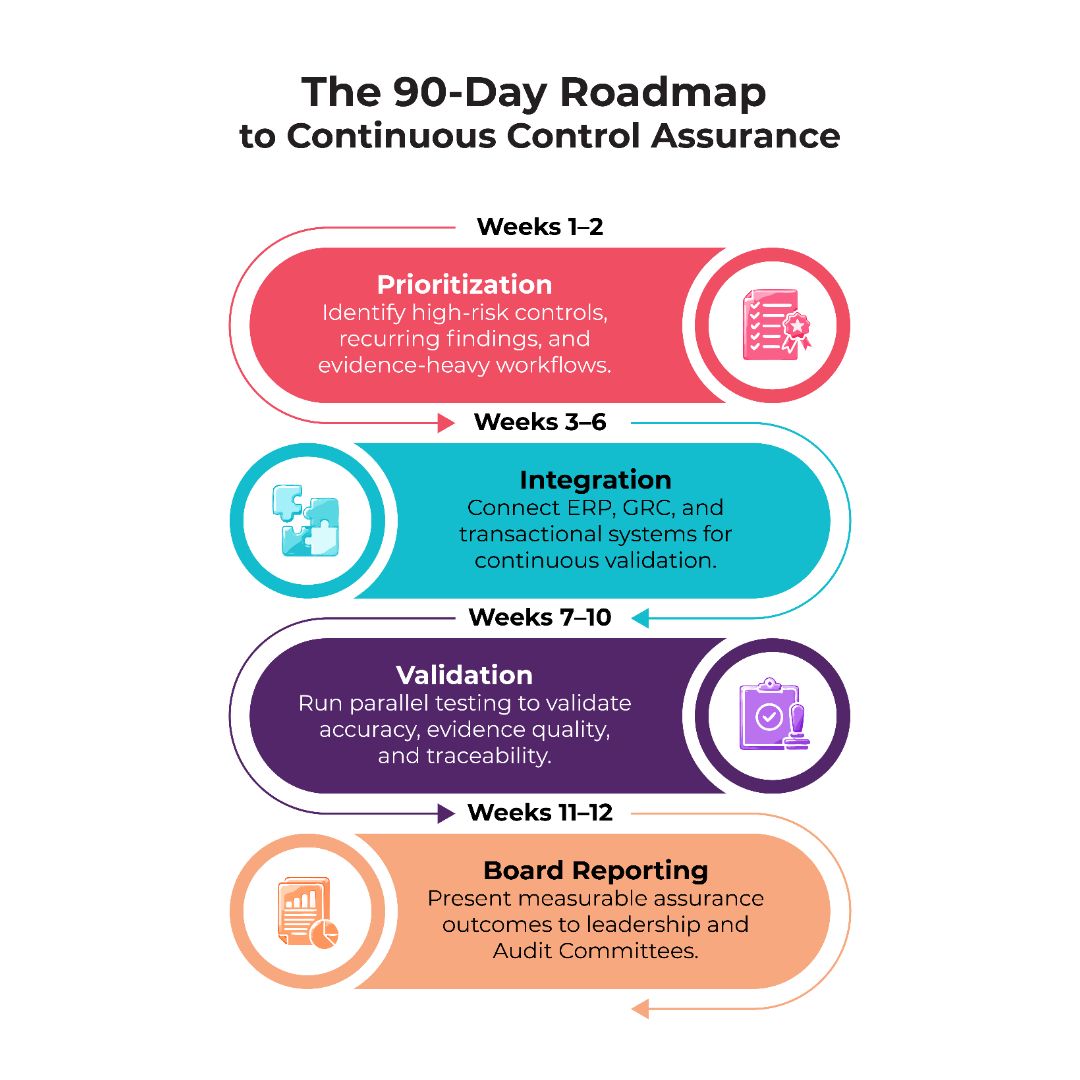
90 Day Roadmap To Continuous Control Assurance

Governance and the Human Factor in AI-Powered Audit

As AI adoption grows within Internal Audit and Risk functions, governance remains critical to maintaining trust, accountability, and regulatory alignment.
Organizations increasingly require leaders who understand both enterprise risk management and AI governance as assurance environments become more technology-driven.

Programs such as ISACA’s Advanced in AI Risk™ (AAIR™) are emerging as important benchmarks for professionals managing AI risk and governance in regulated environments.

By reducing repetitive activities such as evidence collection and documentation workflows, auditors gain greater capacity to focus on strategic risk analysis, control evaluation, and governance priorities.

What Changes When Assurance Becomes Continuous

Continuous Control Assurance marks a shift from periodic audit cycles to continuous validation of controls and evidence. It reduces reliance on manual sampling and improves the speed, consistency, and reliability of assurance across enterprise environments.

As assurance becomes continuous, organizations gain stronger visibility into control effectiveness and greater readiness for regulatory examinations. This evolution is closely aligned with Continuous Controls Monitoring in banking, where real-time visibility replaces retrospective assurance cycles.

ANA, a purpose-built continuous assurance capability designed for regulated enterprise environments, supports this shift by helping operationalize continuous control monitoring and evidence validation within existing enterprise systems—bridging the gap between concept and execution.

Continuous Control Monitoring (CCM) in Banking – How AI Enables Real-Time Risk Detection

In 2026, BFSI operations are moving faster than traditional risk systems were ever designed to handle. Real-time transactions, digital banking, and tighter regulations have changed the baseline. Yet many institutions still depend on periodic audits and sample-based control testing to track risk. That creates blind spots—issues often surface only after the damage is done.

The scale of the problem is also rising. Global cybercriminal activity is projected to reach $12.2 trillion annually by 2031, highlighting how embedded and expensive digital risk has become. At the same time, agentic AI in risk and fraud detection is emerging as a powerful capability, enabling organizations to identify anomalies, investigate threats, and respond to risks with greater speed and accuracy.

This is why Continuous Control Monitoring (CCM), powered by AI, is gaining ground—shifting control validation from periodic checks to continuous, real-time visibility.

Moving From Periodic Audits to Continuous Assurance

Traditional monitoring models are reactive by design. Controls are reviewed periodically, evidence is collected manually, and issues are often identified only after operational failures or audit cycles occur.
CCM changes this model completely by enabling continuous validation across transactions, workflows, approvals, user access environments, and compliance processes in real time.

Traditional Monitoring AI-Driven CCM
Periodic audits Continuous monitoring
Sample-based testing Full-data validation
Manual evidence collection Automated evidence validation
Delayed issue detection Real-time alerts
Reactive remediation Predictive monitoring
High operational overhead Intelligent automation

As BFSI operations become more distributed and data-intensive, continuous visibility is rapidly becoming essential for effective governance.

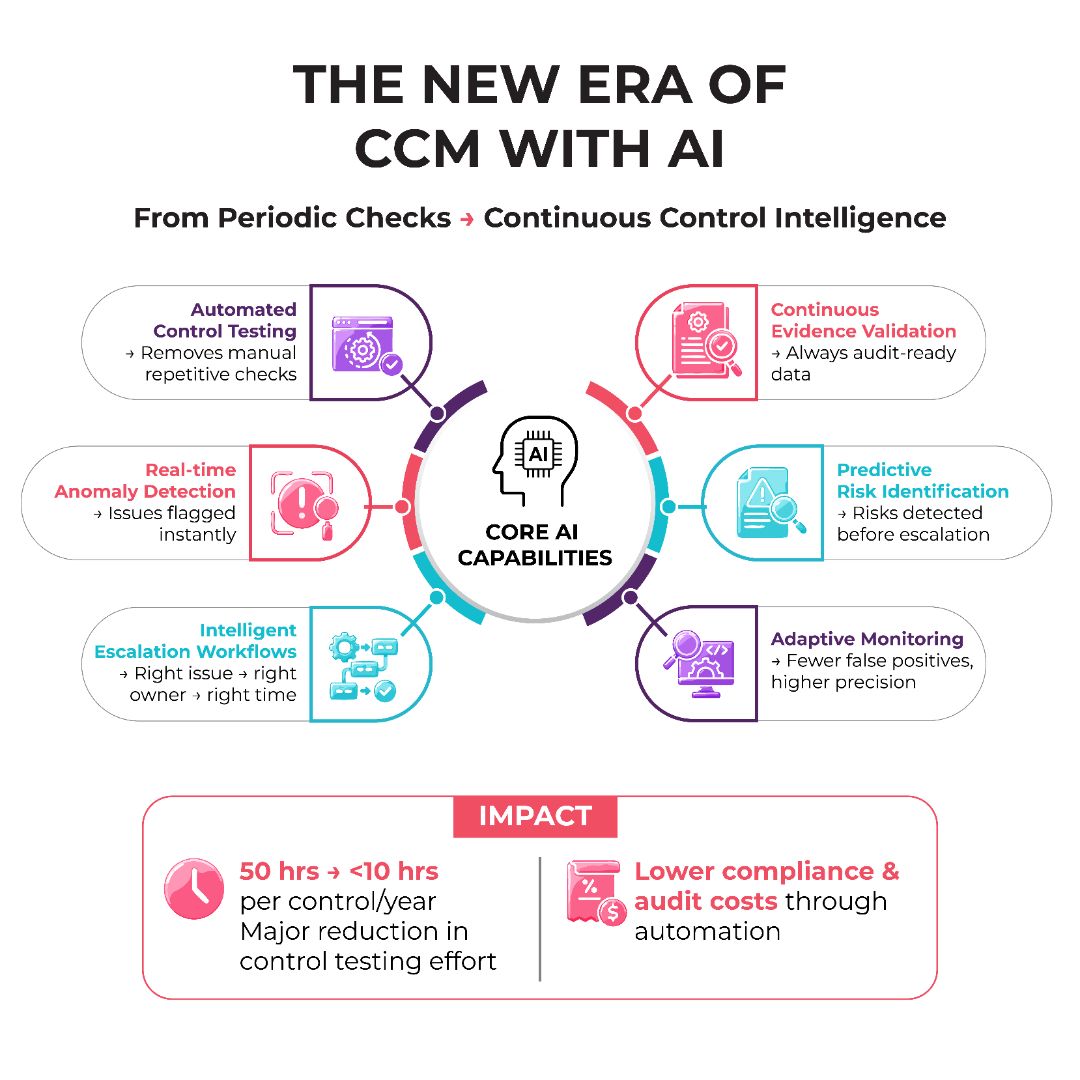
The New Era of CCM with AI

High-Impact CCM Use Cases Across BFSI

The value of AI-driven CCM becomes especially visible in high-risk BFSI environments where operational resilience and governance visibility must coexist. Agentic AI in risk and fraud detection is further enhancing CCM by enabling autonomous monitoring and intelligent response workflows across financial operations.

AML and Transaction Monitoring

Continuous monitoring enables faster identification of suspicious transaction patterns, anomalies, compliance breaches, and risks through transaction monitoring for AML across high-volume financial environments.

User Access and Segregation of Duties (SoD)

AI-driven monitoring continuously validates access controls, privilege changes, and segregation conflicts to reduce internal risk exposure.

Fraud Detection

Real-time behavioral monitoring improves the ability to identify unusual operational or transactional activity before they escalate into material incidents

Audit Readiness and Compliance Visibility

Automated evidence collection and continuous validation improve documentation consistency, reporting accuracy, and examination readiness.

Operational Risk Monitoring

Continuous visibility across workflows and operational controls enables earlier identification of failures, process gaps, and governance exceptions.

Implementing CCM – Four Foundational Priorities

Effective Continuous Control Monitoring requires more than standalone automation—it demands the fusion of intelligent monitoring with domain expertise and scalable operational support.

This is enabled through DKO™ (Digital Knowledge Operations), which integrates intelligent digital solutions and deep BFSI consulting expertise into a unified governance framework.

To successfully implement AI-driven CCM, financial institutions should focus on four key areas:

Prioritize High-Risk Environments

Start with high-impact domains such as AML compliance, transaction monitoring, fraud detection, and user access controls to build early operational visibility and measurable risk reduction.

Leverage Real-Time Intelligence

Solutions such as Factum provide real-time analytics, dashboards, and monitoring visibility across compliance and operational environments, enabling faster issue detection and governance response.

Ensure Regulatory Alignment

CCM frameworks should support continuous reporting, audit readiness, and alignment with evolving regulatory expectations across banking and financial services environments. For a deeper look at how CCM helps mitigate compliance, cybersecurity, and operational risks, explore our Continuous Controls Monitoring whitepaper.

Adopt a Phased Deployment Model

Rather than attempting enterprise-wide transformation immediately, institutions should begin with targeted business functions, refine monitoring rules, and scale progressively across operational environments.

While AI significantly improves monitoring speed, scale, and anomaly detection, governance decisions and exception handling still require human expertise and operational judgment. The most effective CCM environments combine AI-driven automation with domain-led governance and structured decision-making.

The Future of Intelligent Governance

BFSI organizations are steadily moving toward continuous, intelligence-led governance, in which control visibility is embedded directly into operations rather than reviewed periodically.

AI-driven Continuous Control Monitoring (CCM) is accelerating this shift by improving real-time visibility, strengthening risk detection, and enabling faster, more consistent responses across control environments—resulting in stronger resilience and operational efficiency.

At Anaptyss, this transformation is already enabled through the DKO™ framework, supported by AI accelerators like ANA that bring real-time intelligence and visibility into enterprise control ecosystems. Its impact can be seen across complex control environments, including a U.S. regional bank’s RCSA transformation involving 200+ key control assessments.

Why Data Residency Will Define the Future of AI in Banking Controls

The banking industry is navigating a high-stakes tension. On one side sits the undeniable pressure to integrate generative and agentic AI for everything from fraud detection to customer engagement. On the other is an increasingly aggressive global regulatory landscape that views data as a matter of national security.

As financial institutions move beyond pilot programs into production-scale AI, data residency—the physical and legal location of data—is no longer a “check-the-box” compliance formality. It has become the foundational control that determines whether an AI strategy can be approved, deployed at scale, or faces costly regulatory intervention.

Why Data Residency Is Becoming a Strategic Banking Control

Data residency is now a core control requirement in US banking AI programs, as AI moves into production use across fraud, credit, and compliance workflows. Regulators and auditors are increasingly focused on whether banks can prove where data is processed, how it moves across cloud environments, and whether those flows are fully traceable in hindsight. With rising reliance on hyperscale cloud platforms and jurisdictional exposure under frameworks like the CLOUD Act, data location has become a direct factor in audit defensibility. As a result, CROs are treating data residency as a precondition for approving production AI systems, not an infrastructure detail.

The Sovereignty Crisis in Global Banking AI

As banks scale AI across borders, they are running into a structural issue: data is governed differently depending on where it is stored, processed, and accessed. This creates a sovereignty challenge that goes beyond infrastructure design and directly impacts regulatory exposure and audit outcomes.

Data Residency vs Data Sovereignty

The distinction between residency and sovereignty is now central to how banks evaluate AI risk.

Concept Definition Control Focus Banking Implication
Data Residency Where data is physically stored or processed Infrastructure location Determines hosting and deployment choices
Data Sovereignty Which legal jurisdiction governs the data Legal + regulatory authority Determines compliance exposure and access rights

The CLOUD Act, GDPR, and Cross-Border Risk

Cross-border data laws are creating overlapping and sometimes conflicting obligations for global banks.

Regulation Primary Jurisdiction Key Control Impact
CLOUD Act United States Enables lawful access to data held by US-based providers, regardless of storage location
GDPR European Union Restricts processing and transfer of personal data outside approved jurisdictions
Emerging AI regulations (EU AI Act) EU Adds requirements for explainability, traceability, and data governance in AI systems

Digital sovereignty is becoming a control requirement, not a geopolitical concept. For banking AI programs, this means that architectural decisions about where models run, where data is stored, and how inference results are logged are now regulatory considerations, not just engineering choices.

In practice, it directly determines whether AI systems can be approved, audited, and scaled across regions without regulatory friction.

How Global AI Regulations Are Reshaping Banking Controls

AI regulation is becoming increasingly fragmented by jurisdiction, forcing banks to design control frameworks around regional requirements rather than global standards.

The Brussels Effect and the EU AI Act

The EU is setting global expectations through its risk-based AI regulation, often referred to as the “Brussels Effect.” The EU AI Act requires high-risk AI systems—such as credit scoring and fraud detection—to be explainable, auditable, and transparent. This effectively raises the baseline for AI governance, even for banks operating outside the EU but serving global markets.

DORA and Cloud Concentration Risk

The Digital Operational Resilience Act (DORA) shifts focus from system performance to infrastructure dependency. Banks must now manage and demonstrate resilience against cloud concentration risk, making reliance on a single provider or tightly coupled services a regulated control concern.

Data Localization in India and China

India and China enforce strict data localization through regulations like DPDPA and PIPL, requiring certain data to remain within national borders. This limits centralized AI architectures and forces banks to adopt region-specific data and control designs.

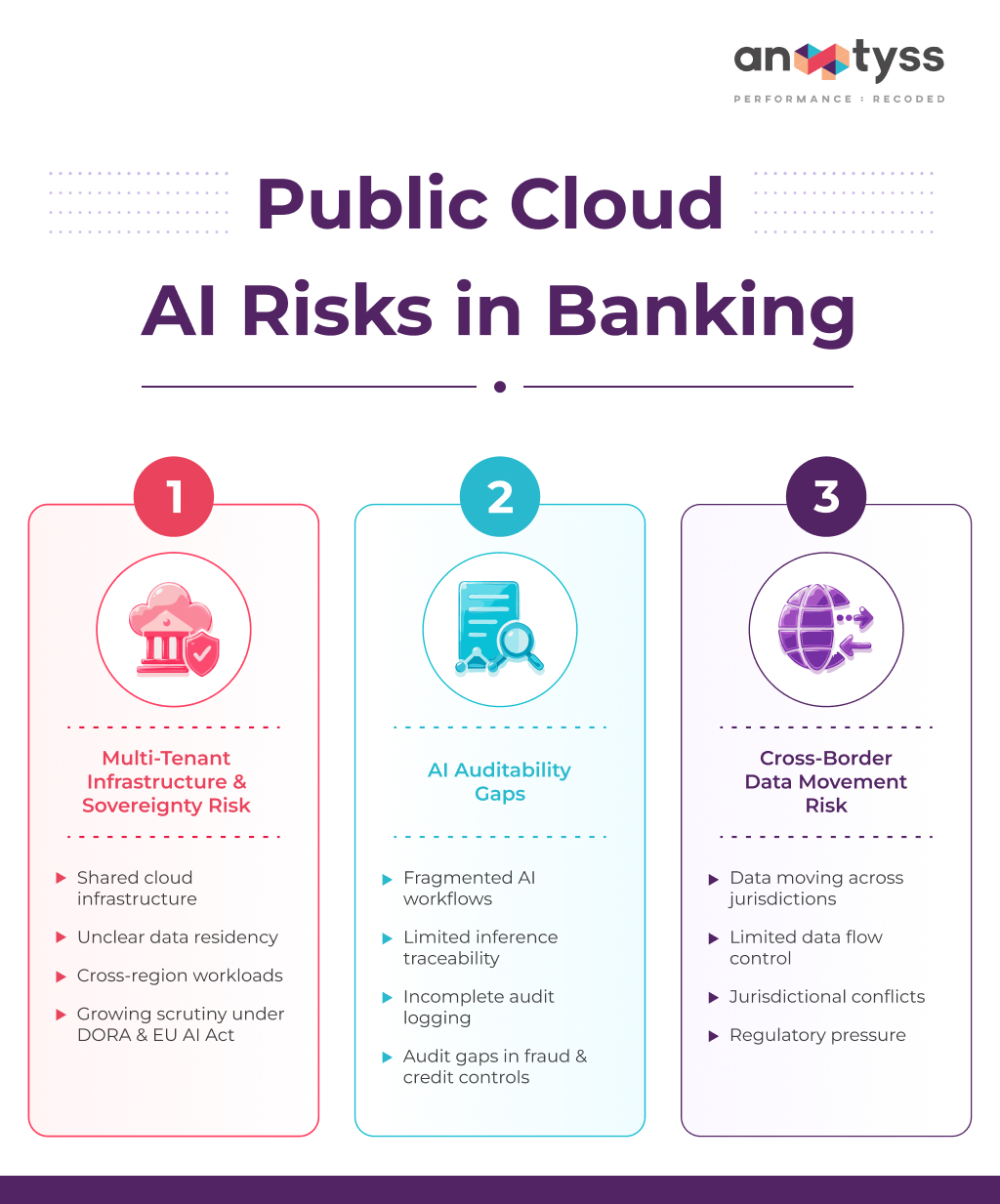
Public Cloud AI Risks in Banking

Conclusion – From Compliance Burden to Competitive Edge

The future of banking AI will be defined by infrastructure trust. As AI becomes embedded in core risk and compliance workflows, banks need confidence not just in outputs, but in where data is processed and how it is governed.

Data residency sits at the center of this shift, ensuring AI systems operate within defined jurisdictions, align with regulatory expectations, and remain defensible in audits and approvals.

In this environment, control becomes the real differentiator in scaling AI responsibly.

ANA is built to support this model, enabling AI-assisted control testing and assurance within secure, governed enterprise environments where data, model inference, and oversight remain fully within bank-defined boundaries and governance frameworks.

Agentic AI in Internal Audit: Practical Use Cases, Governance Boundaries, and Operational Reality

Traditional internal audit was built for a slower moving risk environment, one defined by annual or semi-annual reviews, manual testing, and retrospective reporting. But in today’s enterprise landscape, where risks emerge and evolve in real time, point-in-time assurance models are no longer enough. Agentic AI represents the next evolution of internal audit: intelligent systems capable of sensing risk, initiating workflows, and executing assurance activities within human-defined governance boundaries. Unlike basic AI co-pilots that generate summaries or surface information on demand, these systems operate as digital teammates, enabling audit functions to move beyond reactive oversight toward continuous, intelligence-driven assurance.

From Periodic Audit to Continuous, AI-Assisted Control Assurance

To understand the shift enabled by Agentic AI, it helps to compare the traditional periodic audit model with the emerging AI-assisted approach that is transforming core audit and control assurance activities.

Dimension Traditional Internal Audit AI-Assisted Control Assurance
Audit Model Periodic, cycle-based reviews Continuous, always-on assurance
Testing Approach Sample-based testing Full population analysis with AI assistance
Risk Detection Retrospective identification of issues Near real-time anomaly detection and escalation
Evidence Collection Manual coordination of DRLs AI-assisted generation and mapping of required evidence
Control Monitoring Point-in-time assessment Continuous control tracking and drift detection
Auditor Role Execution-heavy and documentation-driven Review, validation, and orchestration of AI-assisted workflows
Response Lag Weeks or months after occurrence Near real-time visibility into emerging risk

Practical Use Cases for Continuous Assurance

Agentic AI is enabling a shift from periodic audit execution to AI-assisted, continuous control assurance. The focus is not automation alone, but improving coverage, speed, and consistency in core audit activities under human supervision.

1. Risk and Control Matrices (RCMs) in Minutes

AI-assisted systems can interpret process documentation, walkthrough notes, and policy artifacts to help identify risks, map controls, and define testing frequencies. This reduces manual effort in RCM preparation while improving standardization across audits.

2. Full Population Testing

Instead of relying on sample-based approaches, audit teams can evaluate 100% of transactions across key processes such as approvals, reconciliations, and user activity. This improves assurance coverage and reduces the likelihood of missed exceptions.

3. Automated Document Request Lists (DRLs)

AI-assisted workflows can generate structured DRLs based on control objectives and testing requirements, identifying the exact evidence needed for validation, including approvals, reconciliations, logs, and supporting artifacts.

4. Intelligent Anomaly Detection

Modern monitoring models can detect behavioral and transactional deviations that fall outside traditional rule-based thresholds. This includes unusual approval patterns, timing anomalies, or inconsistent user behavior that may indicate elevated risk.

5. The Audit Function That Never Sleeps

Continuous monitoring enables near real-time visibility into control environments, helping identify control drift and emerging risks earlier in the audit cycle and supporting faster, more targeted remediation.

Governance Boundaries for Agentic AI

As AI scales in assurance, governance defines safe use. In regulated environments, human oversight remains essential for accountability and audit quality.

1. The Human-in-the-Loop Mandate

AI-assisted assurance systems can accelerate testing, monitoring, and analysis, but final judgment must remain with the auditor. Human-in-the-loop (HITL) governance ensures that risk interpretation, escalation decisions, and control conclusions remain subject to human review and accountability.

2. The Intern Analogy

Many organizations increasingly treat AI systems like digital interns, capable of processing information quickly, but still prone to hallucinations, context gaps, or flawed interpretations. Like any junior resource, AI outputs require supervision, validation, and auditor oversight before decisions are finalized.

3. The Explainability Requirement

In regulated industries, AI outputs must be explainable and traceable. Frameworks such as NIST AI RMF and ISO 42001 increasingly emphasize transparency, audit trails, and model governance, requiring organizations to document how systems reach conclusions and what data informs decision-making.

4. Governance Frameworks and COSO Alignment

Successful implementation requires AI governance to align with established internal control frameworks, such as COSO. This includes clear accountability structures, risk evaluation procedures, ethical usage guidelines, and continuous monitoring of model performance within assurance workflows.

5. Data Quality as a Risk Multiplier

AI systems amplify the quality of the data they consume. Incomplete, inconsistent, or poorly governed data can introduce systemic assurance risks at scale. Strong data governance, validation controls, and data quality monitoring therefore become foundational to responsible AI-assisted control assurance.

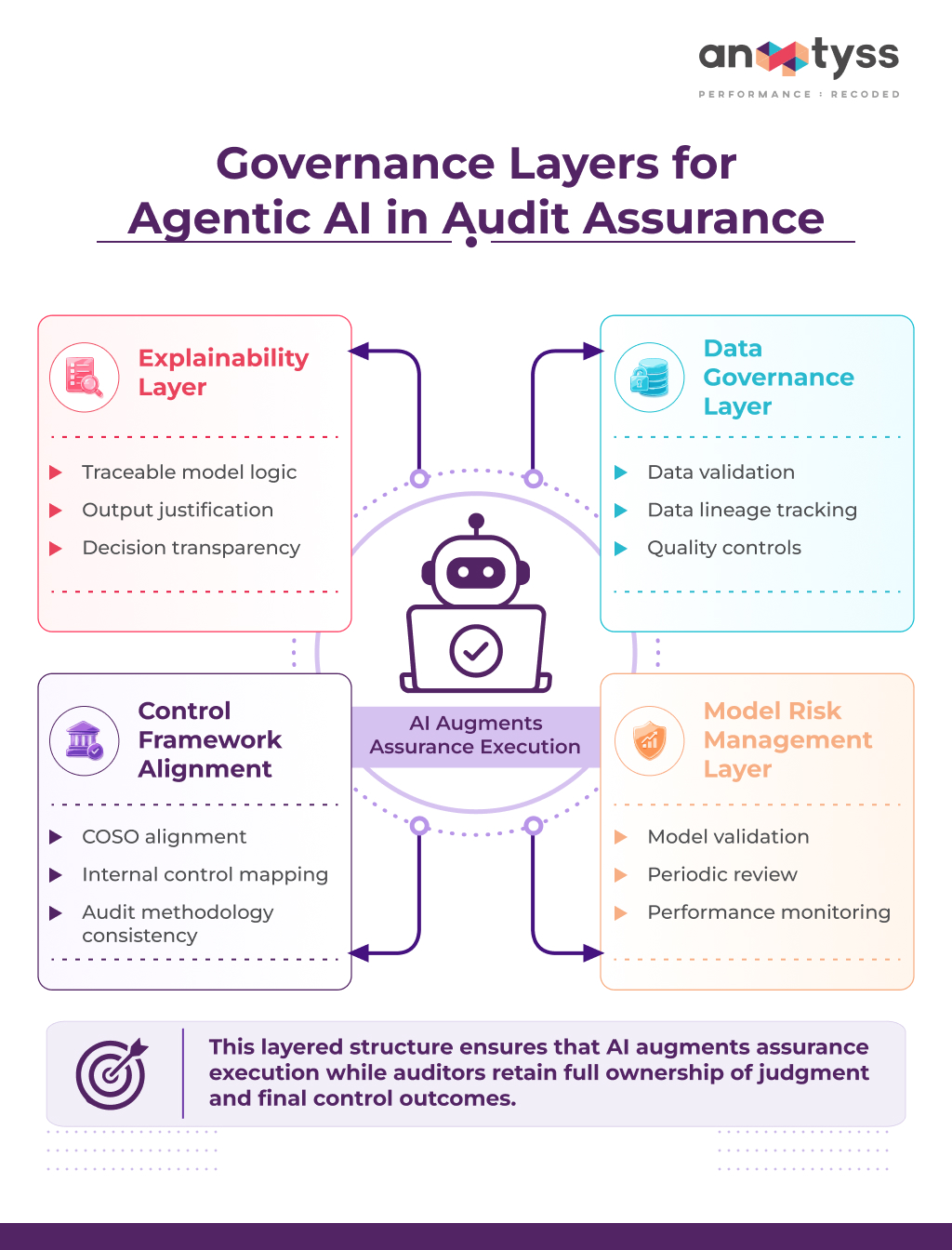
Governance Layers for Agentic AI in Audit Assurance

The Operational Reality of Agentic AI Implementation

Adopting AI-assisted assurance is not a plug-and-play shift. In regulated environments, success depends as much on governance, architecture, and workforce readiness as it does on the underlying technology.

1. Secure Deployment in Regulated Banking

For financial institutions, deployment design is often the primary constraint. Sensitive audit and customer data cannot sit outside controlled environments. This is driving a clear preference for secure, client-contained architectures where AI-assisted control assurance operates within enterprise infrastructure and remains subject to internal security and compliance oversight.

2. The Skills Gap

The challenge is less about tooling and more about interpretation. As audit becomes more AI-assisted, teams need stronger data literacy and judgment skills to validate outputs, challenge anomalies, and guide AI-driven workflows. The auditor’s role shifts toward supervision, review, and orchestration rather than execution alone.

3. A Crawl-Walk-Run Approach

Most organizations benefit from a phased adoption model. In the crawl phase, AI assists with documentation, DRL generation, and initial anomaly flagging all under close human review. The walk phase introduces AI-assisted testing across broader control populations, with auditors validating outputs before conclusions are drawn. In the run phase, continuous monitoring and near-real-time risk visibility become operational, supported by mature governance frameworks and data quality controls.

4. Economic Reality

Organizations that pair AI adoption with strong change management and governance maturity consistently achieve better audit scalability, faster cycle times, and improved risk visibility across the enterprise.

Conclusion – The Strategic Navigator

Internal audit is moving from retrospective reporting to continuous, AI-assisted assurance where risk is visible as it emerges rather than after the fact. For CAEs, the shift is less about automation and more about rethinking how assurance is delivered, with AI supporting execution and auditors retaining full accountability within clear human-in-the-loop governance. ANA is built for this model, an AI-assisted control assurance platform for regulated enterprises, designed to strengthen testing, streamline evidence workflows, and enable continuous assurance within client-controlled, secure environments.

Data Mesh Architecture – A Prerequisite for Agentic AI

Across BFSI and other data-intensive industries, organizations are rapidly investing in AI, automation, and intelligent decision systems. The ambition is to move toward systems that can act, adapt, and decide in real time.

However, this ambition confronts a fundamental structural constraint.

Most of these AI initiatives are being built on top of data architectures that were never designed for autonomy. Traditional data platforms—data lakes and warehouses—were optimized for reporting and analytics, not for real-time, distributed intelligence.

This creates a fundamental mismatch.

Before organizations can scale agentic AI, they must address a more foundational question.
Is their data architecture built for autonomy, or is it still optimized for centralized control?

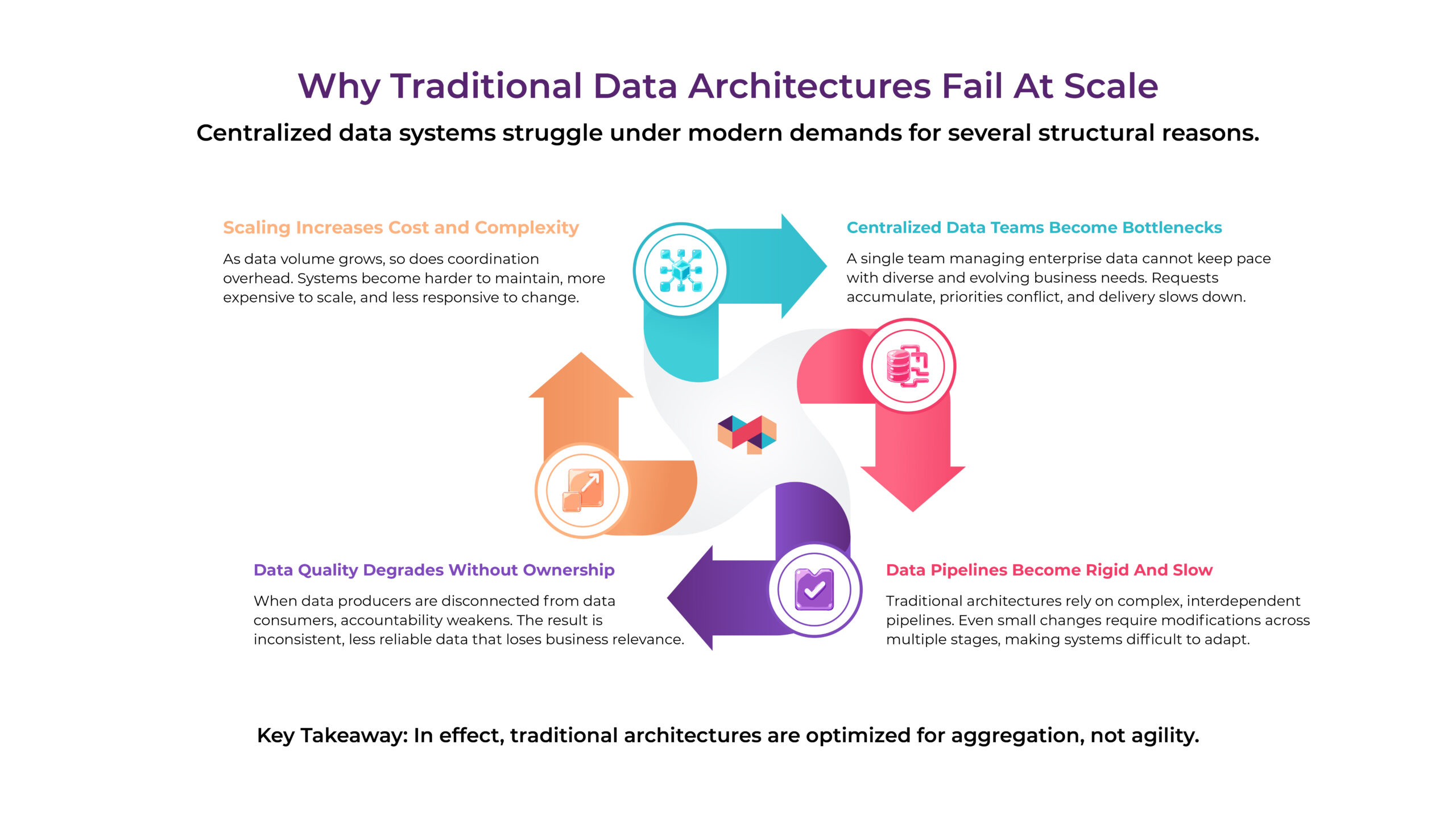
Traditional data Architecture Fails at Scale

The Origin of Data Mesh and Its Foundational Shift

Data Mesh was introduced in 2019 by Zhamak Dehghani at Thoughtworks as a response to the growing failure of centralized data architectures. At a fundamental level, data mesh is a domain-driven approach that shifts data ownership from a centralized team to individual business domains, enabling teams to manage and share data as a product.

As organizations scaled, data became more complex and business-critical, but the operating model stayed the same—a central team managing ingestion, transformation, and access for the entire enterprise. This created bottlenecks, reduced responsiveness, and eroded data quality over time.

The real issue was not just technical, but structural. Data was centralized, while the business operated in distributed domains.

Data Mesh emerged from this gap. It shifts data ownership to domain teams and redefines data as a product that is designed for usability and consumption, not just storage and processing. In doing so, it aligns data architecture with how organizations function—through independent units that generate, understand, and use data in different ways.

The Core Principles of Data Mesh Architecture

Four foundational data mesh principles redefine both architecture and operating model.

Domain Oriented Decentralization

Data ownership is aligned with business domains such as lending, payments, or customer operations. Teams closest to the data are responsible for managing and serving it.

Data As A Product

Each dataset is treated as a product with defined consumers. It must be:

This ensures usability, reliability, and long-term value.

Self Service Data Infrastructure

A shared platform provides the tools needed to build and manage data products. This enables domain teams to operate independently without duplicating infrastructure efforts.

Federated Computational Governance

Governance is applied through a combination of centralized standards and centralized enforcement. Policies around access, security, and quality are embedded into the system and enforced programmatically.

How Data Mesh Differs From Traditional Architectures

Traditional Architecture Data Mesh Architecture
Centralized data ownership Domain-based data ownership
Data handled via pipelines Data treated as a product
Heavy reliance on central platform Self-service data infrastructure
Top-down governance Federated governance
Control-driven operating model Ownership-driven operating model

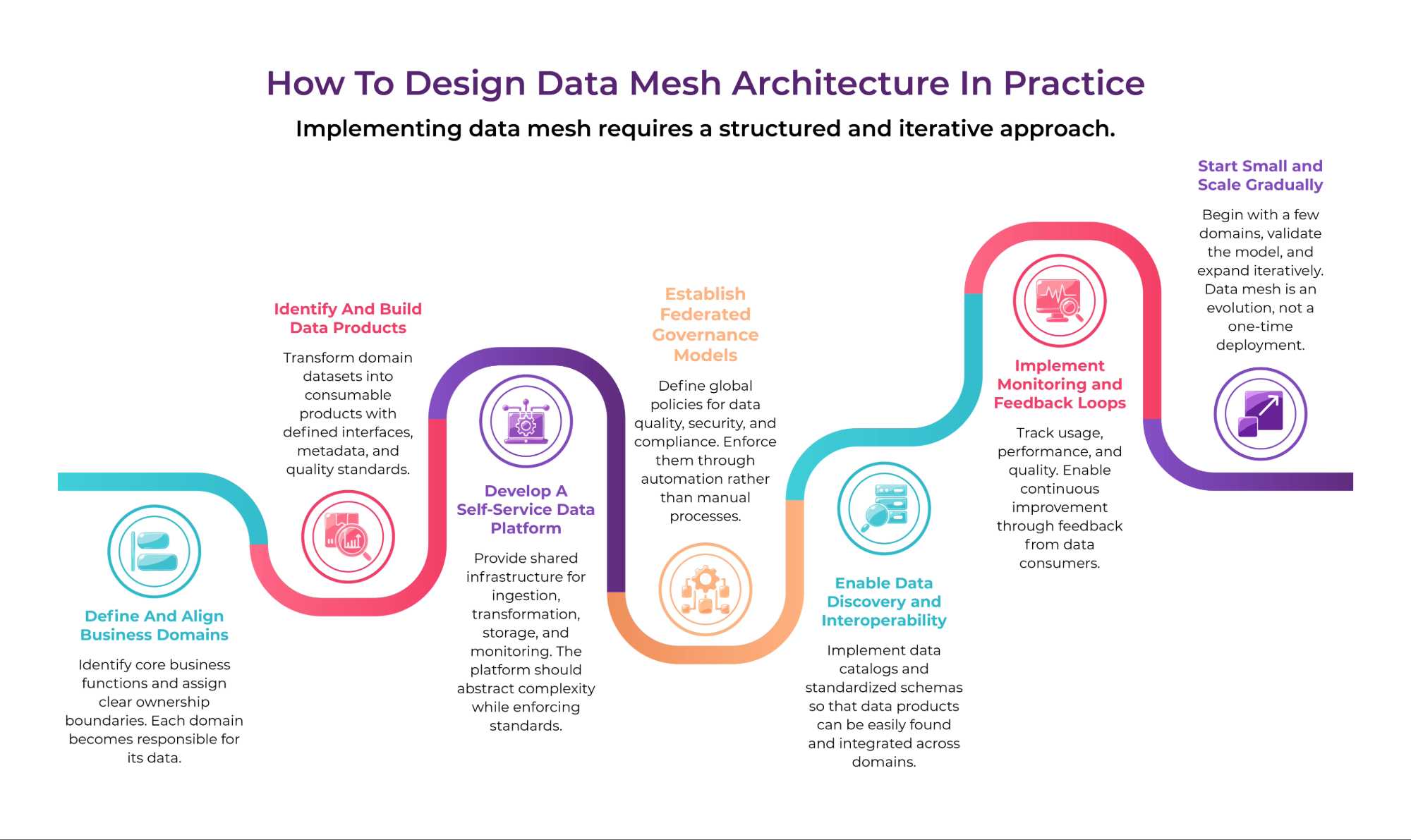
Design-Data-Mesh-Architecture (1)

Benefits Of Data Mesh Architecture in Modern Enterprises

Faster And More Relevant Data Access

Domain ownership enables quicker access to context-rich data without dependency on central teams.

Improved Data Quality and Accountability

Clear ownership ensures data is actively maintained, validated, and aligned with business meaning.

Scalable And Flexible Architecture

Decentralization allows systems to scale independently and adapt faster to changing business needs.

Stronger Business Alignment

Data is organized around domains, making it more usable, relevant, and actionable for decision-making.

Challenges And Trade Offs Of Data Mesh

Organizational And Cultural Shift

Transitioning to domain ownership requires changes in mindset, roles, and operating models.

Governance Complexity At Scale

Maintaining consistency across domains requires strong federated governance and standards.

Infrastructure And Investment Overhead

Building self-service platforms and enabling domain teams demands upfront effort and cost.

Risk Of Fragmentation Without Discipline

Without clear standards, decentralization can lead to inconsistency and reduced interoperability.

Data Mesh Vs Data Fabric

The debate around data fabric vs data mesh often creates confusion, as both address data challenges but in very different ways.

Aspect Data Fabric Data Mesh
Core Focus Data integration and connectivity Data ownership and architectural restructuring
Approach Connects existing systems without major structural change Redesigns how data is owned, managed, and served
Ownership Model Retains centralized or existing ownership Decentralized, domain-based ownership
Primary Goal Provide a unified view of data Enable scalable, domain-driven data management
Implementation Layer Technology layer on top of existing infrastructure Organizational and architectural shift
Simple View Connects data Reorganizes data

Why Data Mesh Becomes Foundational for Agentic AI

Agentic AI systems represent a shift from passive analytics to autonomous decision-making, where systems can act, trigger workflows, and continuously learn from outcomes. This shift significantly raises the bar for data.

These systems depend on real-time access to high-quality data, strong domain context, and built-in governance for traceability and control. Research from Gartner consistently highlights data latency, quality, and fragmentation as key barriers to scaling intelligent systems.

Traditional architectures struggle to meet these needs due to centralized pipelines and disconnected ownership models.

Data Mesh addresses this gap by decentralizing ownership, enabling real-time access from domain sources, and preserving business context within the data. Its federated governance model further ensures that autonomy is balanced with compliance and control.

As a result, Data Mesh aligns closely with the architectural requirements of Agentic AI, making it a strong foundation for building scalable and trustworthy autonomous systems.

Conclusion

Data mesh is not a mandatory architecture for every organization today. Most financial institutions will continue to operate hybrid models as they evolve beyond centralized systems.

However, the direction is clear. As data complexity increases and AI systems become more autonomous, organizations are moving toward decentralized ownership, real-time access, and product-oriented data thinking.

Across financial institutions, this shift is already visible. The focus is not on adopting data mesh in its purest form, but on building data foundations that can support continuous, intelligent decisioning.

Ultimately, the ability to scale agentic AI will depend on how well data architecture aligns with business domains, governance, and execution models.

At Anaptyss, this transformation is approached through a structured, domain-led model that brings together data, AI, and operating frameworks to enable truly decision-ready enterprises, delivered through DKO™.

Frequently Asked Questions

  1. When should an organization consider moving to data mesh?

An organization should consider a transition when its centralized data team becomes a significant operational bottleneck, unable to handle analytical questions from management and product owners with the necessary speed. This often manifests as data engineers spending excessive time fixing broken pipelines caused by operational changes rather than delivering business value. A move to data mesh is most viable once an organization has already adopted domain-driven design and microservices, as these autonomous teams are best positioned to own their domain data. Ultimately, the shift is necessary when centralized, monolithic architectures fail to scale alongside the organization’s growth.

  1. Is data mesh suitable for small or mid-sized organizations?

Generally, no. Data mesh is an architectural solution designed for large-scale complexity. There are specific prerequisites for adoption: you should have a modularized software system and a significant number—typically at least five—of independent domain teams already running systems in production. For smaller organizations, the administrative and technical overhead of building a self-serve platform and managing federated governance often outweighs the benefits. In these instances, a more integrated monolithic platform remains more efficient until the company reaches a scale where centralization actively inhibits agility.

  1. What is the biggest challenge in implementing data mesh?

The primary hurdle is the profound cultural and organizational shift required to decentralize data ownership. Transitioning from a “push-and-ingest” model to a “serve-and-pull” framework requires domain teams to accept full accountability for their data products, which can be a difficult mindset change for those accustomed to a centralized team managing all data assets. Additionally, establishing federated governance requires a delicate balance between giving domains autonomy and enforcing global standards for security, interoperability, and compliance. Success depends on top management providing a clear vision and high-trust environment.

  1. Can data mesh work with existing data lakes and warehouses?

Yes, a data mesh is not a replacement for these technologies but rather a new paradigm for how they are utilized. Existing traditional storage systems can power a data mesh by shifting their use from central monolithic repositories to decentralized storage used by individual domain teams for their specific data products. For example, a domain team might use a BigQuery dataset or S3 bucket as their “output port” to serve cleaned and processed analytical data. The critical change is organizational: the underlying infrastructure must support distributed ownership rather than central control.

  1. How do you measure success in a data mesh model?

Success is measured through operational agility, product quality, and ecosystem growth. Key performance indicators include the lead time for creating new data products and the frequency with which these products are discovered and consumed by other domains. From a quality perspective, success is defined by a domain team’s ability to meet their Service-Level Objectives (SLOs) regarding data freshness, accuracy, and availability. Finally, success is evident when the “mesh” begins to form itself—where teams independently integrate multiple upstream data products to generate comprehensive reports and new insights.

From 20 Days to 5: The Operational Economics of AI-Led RCSA Execution

In the high-stakes environment of enterprise banking, Risk and Control Self-Assessments (RCSAs) remain a critical part of operational risk management. However, for many institutions, the process is still heavily manual, resource-intensive, and time-consuming — often taking 3 to 6 weeks to complete — with some complex assessments extending beyond eight weeks — while diverting risk, audit, and operational teams away from higher-value responsibilities.

As regulatory expectations continue to evolve, traditional RCSA execution models are becoming harder to scale efficiently.

At ANA, we help financial institutions accelerate review cycles, standardize control assessments, and improve risk visibility through AI-assisted, human-in-the-loop workflows. The result is a faster, more consistent, and operationally efficient approach to control assurance.

The Hidden Costs of Traditional RCSA

Traditional RCSA processes are often resource-intensive, slow, and difficult to scale across large banking environments. Manual coordination, repeated reviews, and inconsistent documentation create operational inefficiencies that impact both risk teams and business functions.

Resource Intensity and Hidden Labor Costs

RCSA execution requires significant involvement from operational leads, risk teams, and control owners. Repeated assessment cycles pull high-value personnel away from core responsibilities, creating substantial hidden labor costs across the enterprise.

The Review Bottleneck

Manual reviews often move through multiple rounds of validation and clarification before completion. These delays slow down control testing, extend remediation timelines, and increase compliance pressure.

Inconsistency and Subjectivity in Control Assessments

Control narratives frequently differ across teams and business units, creating ambiguity during testing and increasing subjectivity in assessment outcomes.

The Problem of Stale Risk Data

Because traditional RCSA cycles take weeks to complete, risk assessments are often outdated by the time they are finalized — limiting the organization’s ability to respond quickly to emerging risks and control gaps.

The Role of Secure Enterprise AI in Banking

In banking, AI adoption depends heavily on security, governance, and compliance readiness. Banks manage highly sensitive customer and operational data under strict regulatory requirements, making strong security, privacy, auditability, and human oversight essential for enterprise AI deployment.

In-Environment AI Deployment

ANA is deployed within bank-controlled environments, allowing institutions to maintain oversight over infrastructure, security policies, and enterprise data access. This helps ensure that sensitive information remains within approved internal systems and governance boundaries.

Aligning AI with Regulatory and Compliance Standards

Enterprise AI platforms must align with broader banking compliance requirements, including auditability, data protection, and internal governance frameworks. Supporting standards such as SOC 2 and PCI DSS helps institutions operationalize AI more confidently within regulated environments.

Contextualizing AI with Internal SOPs and Risk Drivers

ANA can be contextualized using internal SOPs, enterprise policies, and organization-specific risk drivers instead of relying only on generic public data. This enables more relevant assessments, improved consistency, and stronger alignment with internal control environments.

The Operational Economics of AI-Assisted RCSA

By moving toward AI-assisted RCSA execution, banks can achieve measurable operational improvements across risk and control functions — without compromising governance or human oversight.

Efficiency Through Faster Review Cycles

AI-assisted workflows can help reduce RCSA execution timelines by nearly 40%, accelerating review cycles and lowering the repetitive manual burden placed on internal audit, risk, and operational teams.

Improving Accuracy and Reducing Human Error

Large-scale manual assessments often lead to reviewer fatigue and inconsistencies in control evaluations. Standardized, AI-assisted reviews help reduce the “reviewer fatigue gap” — the accumulated inattention from processing large volumes of repetitive content — that commonly contributes to errors in manual assessment processes.

Achieving Near-Real-Time Risk Visibility

Shorter execution cycles allow institutions to maintain a more current view of operational risks, control gaps, and compliance exposure.

This enables teams to respond more proactively to emerging risks and control gaps instead of relying on assessment data that may already be outdated by the time reviews are completed.

Traditional vs AI-Assisted RCSA Execution

Area Traditional RCSA AI-Assisted RCSA
Execution Timeline 3–6 weeks Approximately 5 days
Review Process Multiple manual review cycles Accelerated HITL workflows
Control Narratives Inconsistent across teams Standardized using structured frameworks
Testing Coverage Limited sampling-based reviews Expanded evidence analysis
Reviewer Workload High repetitive effort Reduced manual burden
Risk Visibility Delayed and periodic Faster and more current visibility
Assessment Consistency Varies across business units More standardized evaluations

Conclusion: From Manual Effort to AI-Assisted Control Assurance

The shift from a 20-day RCSA cycle to a 5-day execution model is about improving the responsiveness and scalability of enterprise risk management.

As regulatory expectations increase and control environments grow more complex, institutions need control assurance frameworks that can deliver faster assessments without increasing operational burden or compromising governance.

With ANA, financial institutions can accelerate RCSA execution through AI-assisted, human-in-the-loop workflows that improve review efficiency and provide more current risk visibility across the enterprise.

The Control Testing Capacity Problem — And How AI Resolves It

The traditional internal audit model is facing an existential capacity crisis. For years, financial institutions have relied on manual, sample-based testing, which is a “defensive” posture increasingly insufficient against the modern “whirlwind” of regulatory complexity and digital risk. When control assurance runs on periodic snapshots rather than continuous testing, design gaps and effectiveness failures surface only at the next cycle, often months after they emerged.

By then, the institutional knowledge of what changed has dispersed across reviewers, and examination readiness must be rebuilt from scratch. The question is no longer whether AI belongs in control assurance, but how to embed it without losing the governance, traceability, and human accountability that regulators demand. That is the gap ANA (AI-Native Assurance) is built to close.

The Core Constraint Behind Sampling-Based Audits

Manual control testing is not slow because people are slow. It is slow because the work is cognitive, i.e., interpreting what a control is meant to do, judging whether evidence supports its design, assessing whether it operates effectively over a period. Sampling exists because cognitive bandwidth is finite. Adding headcount does not resolve this, institutional knowledge stays locked in individual reviewers, and consistency degrades the moment a reviewer rotates.

ANA addresses the constraint directly.

Instead of sampling controls and reviewers carrying the interpretive load, ANA executes the cognitive work of control testing, walkthrough documentation, evidence validation, test of design, test of effectiveness, and surfaces every output with reasoning, sources, and lineage for human sign-off.

How ANA Resolves the Capacity Constraint

ANA resolves the capacity problem by shifting the auditor’s role from manual execution to orchestration and governance. Unlike basic automation that merely scripts tasks, Agentic AI executes complete, multi-step workflows end-to-end, with adaptive-learning capabilities for continuous assurance.

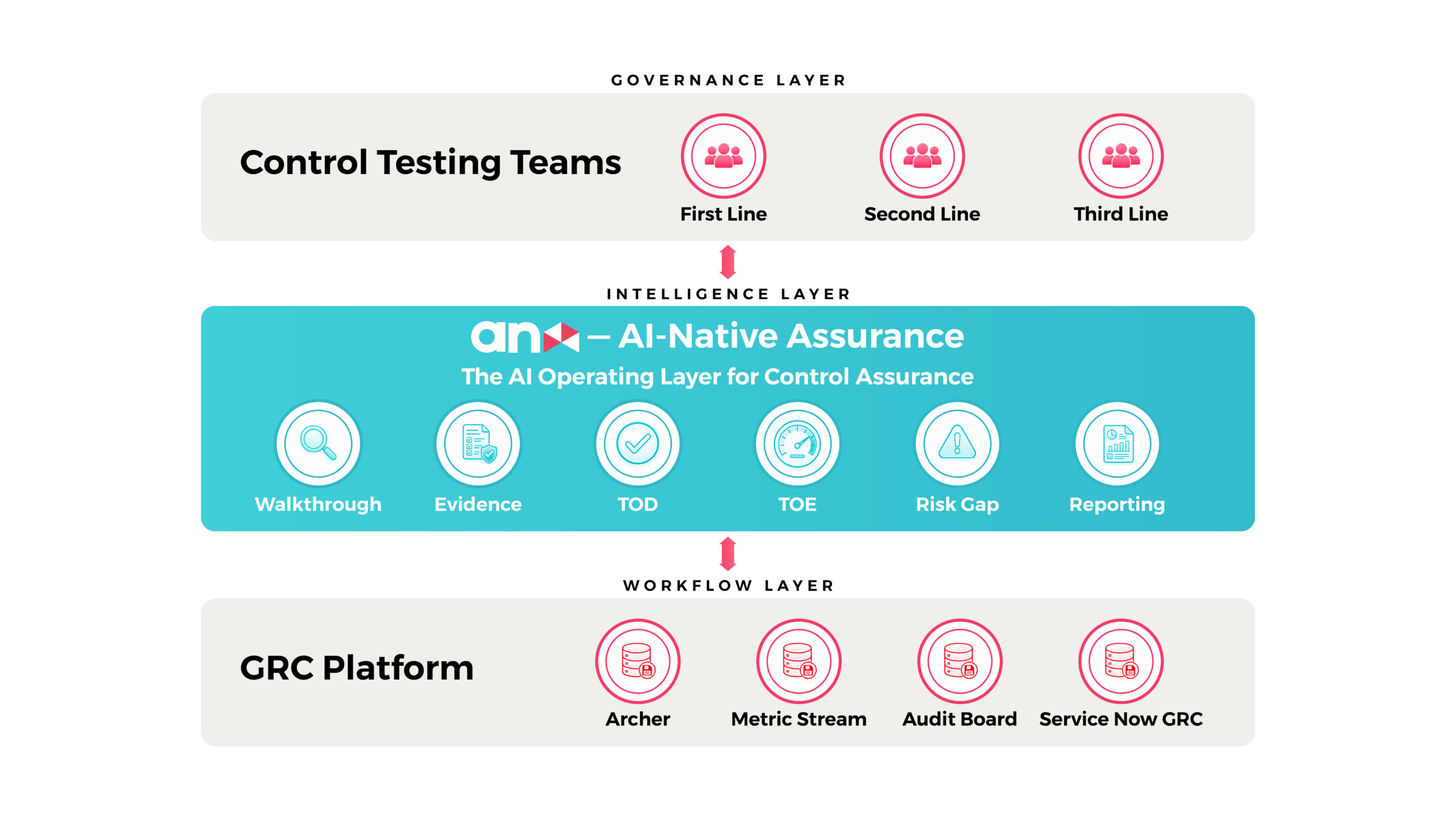
ANA The AI Operating layer between GRC Tools and the Teams

1. Complete Control Population Coverage

ANA tests every in-scope control every cycle, not a sample. RCSA programs that historically tested 30–40% of controls per cycle move to 100%.

2. Continuous Control Monitoring

Instead of testing each control once per year, ANA runs design and effectiveness assessments on a rolling cadence, surfacing degradation between formal cycles.

3. Cross-System Correlation

ANA identifies dependencies between controls across business lines and frameworks (SOX, ICFR, RCSA), surfacing risk linkages a single-reviewer view would miss.

4. Predictive Control Failure Detection

ANA retains validated reviewer feedback as institutional knowledge, so each cycle benefits from the last. Patterns of control weakness, repeated TOD failures, evidence gaps, override frequency, become inputs to the next cycle’s risk prioritization.

Why Continuous Assurance Changes Everything

AI-powered controls move organizations from scarcity to abundance, directly improving the bottom line.
Research
highlights 80% faster anomaly detection and 60% fewer undetected failures. On average, automating only 25% of internal controls reduces external audit fees by 27%, while professionals using AI can support 55% more processes. ANA enables this “more with more” strategy by providing 100% real-time coverage within your secure network, allowing you to scale governance without increasing headcount.

The ANA Advantage

In regulated financial environments, capability alone is insufficient. Any AI system used in audit and controls must meet a higher standard of governance, traceability, and security. ANA is designed specifically for this constraint environment, operating within the client’s own infrastructure to ensure full data control and regulatory alignment.

1. Explainability and Auditability

Every AI-driven test is fully traceable. ANA generates structured audit evidence that includes decision logic, applied control rules, data sources, and timestamps. This ensures that outputs are not only accurate but also defensible in regulatory review.

2. In-Environment Deployment

ANA operates entirely within the organization’s-controlled environment, ensuring that sensitive financial and operational data never leaves the enterprise perimeter. This allows security and IT teams to maintain full
governance over data flows and system interactions.

3. Regulatory Mapping and Coverage Integrity

Each automated control test is mapped directly to established frameworks such as SOX, COSO, RCSA, and IIA standards. This ensures that automation does not create gaps in compliance coverage but instead strengthens alignment with existing audit requirements.

4. Human-in-the-Loop Governance

ANA does not replace audit judgment. It enhances it by escalating exceptions, highlighting risk clusters, and allowing human reviewers to validate outcomes where necessary. This preserves human accountability while expanding scale of coverage.

Conclusion

The control testing capacity challenge is not a resourcing issue. It is a structural limitation of sampling-based assurance in a regulatory environment that has moved past quarterly cycles. AI removes that constraint by enabling full population testing, continuous monitoring, and cross-system risk detection.

With ANA, audit shifts from periodic verification to continuous assurance. Instead of looking backward in cycles, organizations gain real-time visibility into control health. That is the real shift, from constrained audit capacity to continuous, scalable confidence.

How to Scale AI in Insurance – Overcoming Legacy Challenges with Agentic Strategies

The global insurance sector has reached a digital tipping point. Driven by macroeconomic volatility, shifting consumer expectations, and emerging risks like climate change and cyber threats, the mandate for modernization is no longer optional. In fact, over 75% of players in the insurance sector have initiated digital transitions, witnessing up to 90% performance improvements in specific operational areas.

However, there is a stark difference between experimenting with Artificial Intelligence (AI) and achieving enterprise-wide adoption. While the industry recognizes that generative AI and automation can revolutionize everything from underwriting to claims management, carriers frequently stall during implementation.

To transition from legacy operations to an “AI-first” enterprise, insurance leaders must understand the structural bottlenecks hindering adoption and deploy a highly strategic implementation playbook.

Key Challenges in AI Adoption

Achieving sustainable ROI from AI initiatives requires insurers to navigate several entrenched, systemic challenges.

  1. Crippling Legacy Technology Debt

The most significant barrier to AI adoption is the reliance on rigid, outdated core systems. Legacy policy administration and billing platforms create fragmented ecosystems that delay policy issuance, limit scalability, and notoriously yield low straight-through processing (STP) rates. When IT infrastructure is siloed, deploying advanced, real-time AI solutions becomes an uphill battle.

  1. Data Fragmentation and Quality

AI is only as effective as the data feeding it. Insurers possess vast amounts of data, but it is often unstructured—locked in handwritten claims notes, attending physician statements (APS), and disparate medical reports. Without a cohesive data strategy, carriers struggle to extract actionable insights, ultimately limiting the effectiveness of predictive analytics and automated decision-making.

  1. Algorithmic Risk and Regulatory Compliance

As insurers deploy machine learning for dynamic pricing and risk evaluation, they face intense regulatory scrutiny. Models must be transparent and unbiased to prevent algorithmic redlining and ensure ethical AI usage. Navigating complex compliance landscapes, such as IFRS 17 transitions and regional data privacy laws, adds a heavy layer of governance to AI deployments.

  1. The Talent Deficit and Change Management

The insurance industry is battling a severe war for talent, particularly in specialized fields like underwriting, actuarial sciences, and data analytics. Transitioning to an AI-driven model requires a cultural shift, blending an aging workforce’s deep institutional knowledge with the digital-first expectations of a new generation.

Strategies for Scalable Transformation

To overcome these hurdles, carriers must abandon piecemeal IT projects in favor of a cohesive, enterprise-wide strategy.

Establish a Cloud-Native, Unified Data Layer

Before AI can be effectively deployed, insurers must modernize their core systems. Transitioning to cloud-native platforms and API-driven architectures eliminates data silos and provides a single, 360-degree view of operations and customers. By leveraging automated data migration tools and utilizing data democratization strategies, insurers can ensure that clean, actionable insights are accessible across underwriting, claims, and finance.

Embrace a “Human-in-the-Loop” Bionic Operating Model

The future of insurance is not the replacement of human experts; it is the augmentation of them. Insurers should adopt a “bionic” framework that strikes the perfect balance between AI-driven hyperautomation and human ingenuity. For instance, AI can automate routine application intake, document extraction, and initial risk scoring, creating the capacity for human underwriters to focus on complex risk evaluation and strategic relationship management.

Deploy Agentic AI Ecosystems

Moving beyond basic Robotic Process Automation (RPA), insurers must look toward Agentic AI. This involves deploying a hybrid digital workforce where intelligent, autonomous agents collaborate to execute tasks across the value chain. Whether it is automating First Notice of Loss (FNOL) triage, executing subrogation analytics, or proactively identifying fraud, Agentic AI streamlines complex decision-making while operating within strictly embedded ethical guardrails.

Build a Dedicated Center of Excellence (CoE)

Successful implementation requires dedicated governance. Insurers should establish technology and analytics Centers of Excellence (CoE) to benchmark performance, audit competency, and continuously monitor AI models. This structured approach ensures that AI initiatives remain aligned with strategic business outcomes, reducing project failure rates and accelerating speed-to-market for new products.

The Path Forward

The insurance carrier of the future will not be defined by its historical legacy, but by its adaptability. By confronting structural technology debt and adopting a measured, human-in-the-loop implementation strategy, insurers can leverage AI to drive profitable growth, enhance operational resilience, and deliver the seamless experiences today’s policyholders expect.

The transition to an AI-first operating model is no longer just a technology initiative—it is a strategic business mandate. Anaptyss partners with BFSI leaders to cut through legacy complexity and operationalize AI at scale.

DKO™
Life@Anaptyss
Careers