The Future of AI-Driven Insurance and Managed Digital Solutions

As insurers face mounting pressure to reduce operational costs while improving claims responsiveness, traditional process-heavy operating models are becoming increasingly unsustainable. Differentiation in insurance no longer stems from pricing alone. It is increasingly defined by how efficiently and seamlessly an insurer operates.

The AI in insurance industry is undergoing a structural shift from paper-heavy, manual processes to intelligent, automated workflows, and the future of insurance lies at the intersection of advanced Artificial Intelligence (AI) and insurance digital transformation. By combining domain expertise, digital solutions, and operational rigor, insurers are beginning to fundamentally reimagine how they serve policyholders and run their core functions.

Rising Customer Expectations for Speed, Personalization and Transparency

Customer expectations have changed faster than most insurance operations.  Today’s policyholders expect experiences comparable to banking and e-commerce—fast, transparent, and digital-first. The traditional claims process, however, still struggles to meet these expectations. Delays, fragmented communication, and limited visibility into claim status continue to create friction at critical moments.  This gap is not just experiential.

This directly affects retention and long-term customer value. According to a McKinsey analysis, the claims experience is the single most important driver of customer satisfaction and loyalty in insurance, making it a critical battleground for insurers. As expectations evolve, insurers are being pushed toward a model where claims are initiated, processed, and settled digitally, with minimal friction and near real-time responsiveness.

The Evolution of AI in Insurance toward Intelligent and Real-Time Decisioning

To meet these demands, insurers are turning to AI not as an incremental improvement, but as a core operational capability within the broader AI in insurance industry.  Traditional systems are effective at handling structured inputs, but insurance workflows are inherently unstructured. Claims involve handwritten reports, images, documents, and contextual data that do not fit neatly into predefined templates.

This is where generative AI in insurance creates real value. Using Natural Language Processing and Computer Vision, AI systems can interpret and process this unstructured data in ways that were previously not scalable. According to McKinsey, AI could automate up to 25% of claims processing activities, significantly reducing manual effort and cycle times. In auto insurance specifically, this shift is most visible.

Damage assessment, which traditionally depended on physical inspections, can now begin at the moment of first notice of loss. Images submitted through mobile devices can be analyzed instantly, allowing early-stage decisions on severity, repairability, and next steps.  The result is not just faster processing, but a fundamentally different operating model driven by AI in insurance underwriting and claims intelligence.
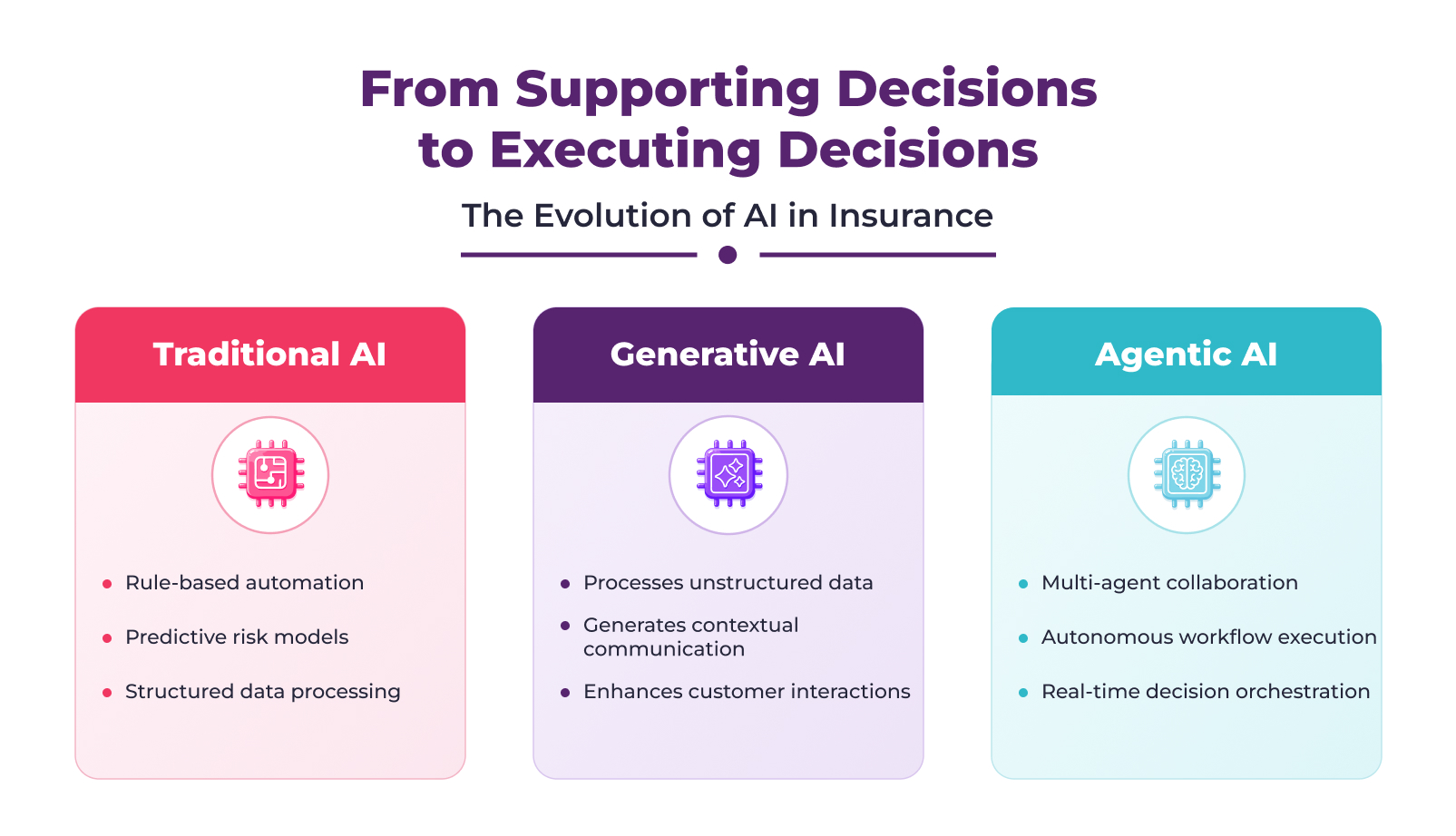
Evolution of AI in Insurance

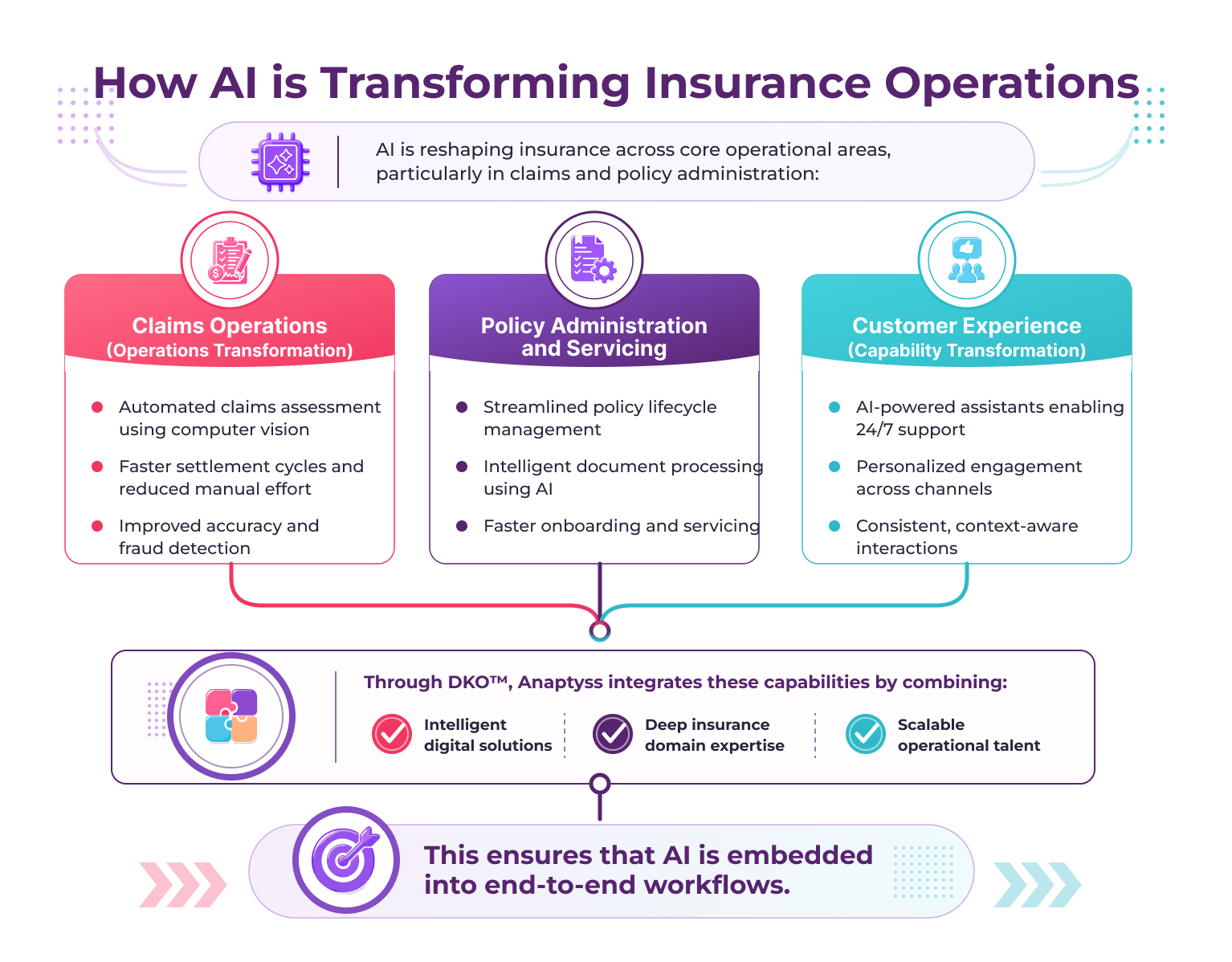
How AI is Transforming Insurance Operations

How AI Is Shifting Insurance from Reactive to Predictive Models

This shift reflects the broader future of insurance, where insurers move from reactive models to predictive, data-driven ecosystems powered by agentic AI in insurance.

Traditional Insurance (Reactive) AI-Driven Insurance (Predictive)
Assess → Process → Pay Predict → Prevent → Personalize
Responds after an event occurs Anticipates risks before they occur
Manual, process-heavy workflows Automated, real-time decisioning
Limited visibility into risk Continuous monitoring using live data
Static pricing models Dynamic, behavior-based pricing

AI in Fraud Detection and Risk Control

Fraud detection is another area where AI in insurance is reshaping operations. Rule-based systems have historically struggled to keep pace with evolving fraud patterns. AI, by contrast, can analyze large volumes of data across claims, identifying anomalies and patterns that would be difficult to detect manually.

The Coalition Against Insurance Fraud estimates that fraud costs the U.S. insurance industry over $300 billion annually — a figure that underscores the operational and financial stakes for insurers. Advances in image analysis further strengthen this capability. Systems can now detect inconsistencies in visual data, flag reused or manipulated images, and identify signs of pre-existing damage. This becomes especially important as insurers move toward digital-first, self-service claims journeys.  The objective is not just faster claims processing but ensuring that speed does not come at the cost of control.

The Strategic Role of Managed Digital Services

While the potential of AI within the insurance industry is clear, operationalizing it at scale is significantly more complex.

Poor data quality, fragmented legacy systems, and limited specialized expertise continue to slow or derail insurance digital transformation initiatives. Gartner identifies poor data quality as one of the leading reasons AI programs fail to deliver measurable business outcomes.

Managed digital services now play a strategic role in helping insurers operationalize AI effectively across core business functions. The challenge is no longer deploying isolated automation tools, but integrating AI into complex operational environments while maintaining consistency, compliance, and scalability.

Anaptyss integrates AI directly into core insurance workflows while managing the operational complexity required for scale. This spans policy administration, claims processing, customer support, and data management, including areas such as AI in health insurance and broader risk ecosystems.

Successful transformation requires more than layering new technologies onto inefficient legacy processes. It requires redesigning workflows where AI, operations, and domain expertise function as a unified operational system. This enables insurers to move beyond fragmented automation initiatives toward integrated, end-to-end digital operations that improve efficiency, responsiveness, and customer experience.

Navigating Regulation with Explainable AI

As AI becomes more embedded in decision-making, regulatory expectations are evolving in parallel.  Insurers are increasingly required to ensure that AI-driven decisions across claims, underwriting, pricing, and fraud detection remain transparent, auditable, and explainable. As AI adoption accelerates within the insurance industry, model risk management principles such as SR 11-7 are becoming increasingly relevant, particularly around governance, bias monitoring, decision traceability, and audit trail requirements. Regulatory expectations now extend beyond compliance alone, requiring insurers to balance AI autonomy with accountability and enterprise-grade oversight.

This makes Explainable AI a critical component of any transformation strategy within the future of insurance.  Explainability enables insurers to clearly articulate how decisions are made, both for internal governance and for external stakeholders, including regulators and customers. It also enables systematic identification and mitigation of bias, ensuring that automation does not introduce unintended risk into outcomes.

Conclusion

Insurance operations are at an inflection point. What has historically been manual, fragmented, and resource-intensive is evolving into intelligent, integrated, and increasingly real-time operational frameworks. This shift reflects the growing role of AI in insurance and insurance digital transformation in aligning operational capabilities with changing customer expectations. AI and managed digital services are no longer optional enhancements.

They have become core to how insurers build resilience, efficiency, and competitive advantage in the future of insurance. Anaptyss helps insurers simplify and scale digital transformation by integrating domain expertise, advanced technologies, and operational excellence. From AI-driven claims processing to end-to-end managed services, we enable insurers to build more efficient, customer-centric, and resilient operations.


Reducing Lending Costs in 2026 with AI-Powered Intelligent Document Processing

It costs, on average, $11,600 to originate a single mortgage. That number has climbed 35% in three years and the primary driver is not interest rates or market volatility. It is what happens behind the scenes. The indexing, the re-keying, the “stare and compare” workflows that still consume a disproportionate share of every lending operation’s time, budget, and headcount.

Financial institutions process an estimated 800 million document pages annually. Most arrive in unstructured formats that legacy OCR systems cannot reliably parse, pushing the burden onto human teams who spend their days copying data between screens instead of making credit decisions.

This is not a niche problem. Personnel expenses account for 67% of total production costs for lenders. And yet much of that labor is being consumed by tasks that AI can now handle in seconds. Here’s what’s actually happening and what leading institutions are doing about it.

Five Operational Costs You Are Probably Underestimating

Manual document processing does not just slow things down, it compounds across every stage of the lending lifecycle.

Why the Pressure Is Higher in 2026

Three converging forces are making this problem harder to ignore.

  1. An estimated 85% of enterprise data is now unstructured. As income documentation, bank statements, and identity verification expand in variety and volume, the gap between what OCR can handle and what teams actually receive keeps widening.
  2. Compliance scrutiny is intensifying. Regulators want consistent borrower data and complete transaction records — a bar that manual workflows simply cannot reliably clear.
  3. The competition has moved. Institutions that have already automated document workflows are operating with structurally lower cost bases. this is a compounding advantage that becomes harder to close with every passing quarter.

What AI-Driven Document Processing Actually Does

Modern Intelligent Document Processing (IDP) goes well beyond template-matching OCR. By combining machine learning, pattern recognition, and contextual data interpretation, it reads unstructured documents the way a skilled analyst would — without the fatigue, the errors, or the headcount.

A 2024 McKinsey report found that 52% of financial institutions have made generative AI a deployment priority — not a research exercise. A Deloitte automation study showed nearly three-quarters of respondents have already embedded automation into core business processes. The technology has crossed from experimental to operational.

The results at scale are measurable. An Everest Group analysis found mature automation programs generating capacity equivalent to 500–2,000 FTEs. Banking institutions have seen 38% faster process turnarounds and a 20% reduction in annual operational costs post-deployment. One mortgage lender reported a 61% reduction in defect escape rates after implementing ML-based document extraction.

Index AI Is Purpose-Built for Lending Operations

Traditional automation tools were not designed for the complexity of post-closing packages, trailing documents, or multi-format servicing requests. Index AI is.

Developed by Anaptyss, Index AI is an AI-powered document classification and indexing solution built specifically for high-volume financial document workflows. It automatically ingests, classifies, and routes unstructured content, turning raw document stacks into workflow-ready intelligence without manual intervention.

For lending and servicing operations, this translates directly to,

Five Key Actions for Banks and Lenders to Prepare for the Colorado AI Act (SB 24-205)

If your institution uses AI or machine learning to make credit decisions, June 30, 2026 is a deadline you cannot afford to miss. Colorado’s SB 24-205, the first US state law specifically governing high-risk AI systems in financial services, takes full effect on that date. It creates real compliance requirements for lenders, including impact assessments, bias audits, vendor accountability, and consumer disclosures. Non-compliance may lead to enforcement by the Colorado Attorney General.

The business case for getting ahead of it is straightforward. Institutions that build the right AI governance infrastructure now will be better positioned not just for Colorado, but for the wave of state-level AI legislation that is already moving through legislatures across the country.

Is Your Bank or Financial Institution in Scope?

The law applies to any lending institution or bank that deploys an AI system to make or substantially factor into a consequential decision about a consumer’s access to, or the cost or terms of, financial or lending services. In lending, that covers a wide range of models, from credit scoring, automated underwriting, risk-based pricing, pre-approval tools to account management models that change credit lines or terms.

There is a conditional exemption for federally regulated banks and credit unions. If your institution is subject to examination by a federal or state prudential regulator and that regulator’s guidance is substantially equivalent to SB 24-205, including requirements to audit AI systems for bias, you may qualify.

But this is not a blanket pass.

An SR 11-7 program that was built around traditional statistical models and has not been extended to address algorithmic fairness, explainability, and disparate impact will not be sufficient. For a closer look at where banks typically carry gaps, see our post on evolving model risks and strategies for banks.

Non-bank lenders, fintechs, and smaller state-chartered institutions without substantive prudential AI oversight are squarely in scope with no exemption pathway.

The Four Obligations That Matter Most

SB 24-205 creates four core obligations that financial institutions must implement when using AI in credit decisions.

1. Annual Impact Assessments

Deployers must conduct a formal impact assessment for each high-risk AI system before deployment, annually thereafter, and after any significant modification. The assessment must document the system’s purpose, data inputs, known limitations, foreseeable risks of algorithmic discrimination, and mitigation measures. Records must be retained for at least three years. This is the most operationally intensive requirement of the law — and the one most institutions are least prepared for. Our post on 5 key strategies to audit model and AI risk in finance outlines a practical approach to building this process.

2. Bias and Fairness Testing

Institutions must demonstrate that each in-scope AI system does not produce outcomes that discriminate against consumers on the basis of protected characteristics. That requires running disparate impact analyses across race, gender, age, national origin, and related proxies and documenting the results, including any remediation steps taken. Our strategic roadmap for mitigating algorithmic risk in AI credit scoring covers the testing methodology in detail, and our whitepaper on Model Risk Management in Financial Services lays out the governance framework that supports it.

3. Consumer Disclosures and the Right to Appeal

When an AI system drives or substantially contributes to an adverse credit decision, the affected consumer must be notified — including that AI was used, what data was relied upon, and how it contributed to the outcome. Consumers must also have the opportunity to correct inaccurate data and, where technically feasible, to request human review. This requires coordination between model risk, compliance, legal, and customer service before the deadline.

4. Public Disclosure Statement

Deployers must publish a statement on their website summarizing the types of high-risk AI systems they use and describing how algorithmic discrimination risk is managed. This is table stakes for reputational credibility as AI governance scrutiny grows.

Getting Your Vendors in Order

For institutions using third-party credit scoring or underwriting models, the vendor is the developer under SB 24-205 — and you are the deployer. That means you are legally responsible for ensuring your vendor can support a compliant impact assessment. Vendors must provide documentation of training data, intended uses, known limitations, and discrimination risk. If they cannot, your deployment is not defensible. Now is the time to issue vendor questionnaires and update contract language. For a real-world example of how structured third-party model governance delivers results, see our success story on 40% faster validation of third-party credit risk models.

How SR 11-7 Helps — and Where It Falls Short

Banks operating under SR 11-7 have a head start. Documentation of model purpose and limitations, independent validation, ongoing performance monitoring, and governance around model changes all transfer directly to SB 24-205 obligations. But SR 11-7 does not explicitly require disparate impact testing across protected classes, consumer-facing disclosures, or annual impact assessments framed around fairness. Institutions that want to rely on the prudential regulator exemption need to close those gaps — not just assert that SR 11-7 is in place. See our overview of SR 11-7 best practices for model governance and our post on how leading banks validate AI and ML models differently for guidance on where the bar is moving.

Five Steps to Take Before June 30

These five steps provide a practical roadmap for lenders to align AI-driven credit decisions with SB 24-205 requirements.

1. Build Your AI System Inventory

Catalog every model used in credit origination, underwriting, pricing, and account management. Identify which meet the SB 24-205 definition of a high-risk AI system. Many institutions will find systems in production that have never been formally governed.

2. Run Bias and Fairness Audits

Test each in-scope model for disparate impact across protected class proxies and document the results. Where significant disparities exist, document mitigation steps in the impact assessment.

3. Complete Impact Assessments

Develop a standardized template covering purpose, data inputs, known limitations, discrimination risk, mitigation, and monitoring. Conduct the first assessment before June 30. Establish a calendar for annual re-assessments.

4. Update Vendor Contracts

Send SB 24-205 documentation requests to third-party model vendors. For new contracts, require explicit representations on impact assessment support, 90-day notification of discovered discrimination risks, and ongoing disclosure maintenance.

5. Build Disclosure and Appeal Workflows

Align adverse action notices to satisfy both Reg B and SB 24-205. Establish a human review process for AI-assisted decisions. Publish the required public disclosure statement before the deadline.

Conclusion

Colorado is the first mover, not the last. Multiple US states have active AI accountability legislation in progress, and the CFPB has made explainability in credit decisions an ongoing examination focus. The governance infrastructure you build now — model inventory, bias testing, impact assessments, vendor accountability — is the same infrastructure that will serve you as this regulatory landscape consolidates. Institutions that treat SB 24-205 as a one-state compliance exercise will be rebuilding from scratch every time a new state law takes effect. Those that treat it as the foundation of a durable AI governance practice will have a structural advantage. For a broader view of where AI is reshaping credit risk governance across US banking, see our post on how AI is reshaping credit risk analytics and compliance in US banks.

Also, Explore our Model Risk Management capabilities, see how we delivered 40% faster third-party credit model validation, and learn how we drove $400K in annual savings through ML-based credit scoring improvements for a US lender.

Ready to assess your readiness?


Model Risk Management for Generative AI in Banks and Financial Institutions

The global financial sector is undergoing a structural transformation driven by rapid advances in artificial intelligence (AI), particularly generative AI (GenAI). Financial institutions are moving beyond experimental pilots and deploying AI into core operational functions including fraud detection, credit underwriting, risk management, and regulatory compliance.

The economic potential is substantial. Industry research suggests that generative AI could contribute up to $340 billion annually to the banking sector through productivity gains and operational efficiencies.

Recent data highlights the pace of adoption,

However, scaling AI introduces a new challenge: governing the risks associated with generative AI models through modern model risk management frameworks.

The Generative AI Governance Gap

As financial institutions move from experimentation to enterprise deployment, governance challenges are emerging.

Industry surveys estimate that 30% of financial institutions cite limited staff capabilities as a primary bottleneck to scaling AI, while 27% point to foundational problems with data quality and availability.

Most alarmingly, only 12% of Chief Risk Officers (CROs) describe their AI governance and approval frameworks as “highly developed”.

Traditional Model Risk Management (MRM) guidance such as the Federal Reserve’s SR 11-7 and OCC 2011-12 were originally designed for deterministic statistical models that operate on structured data and produce predictable outputs.

Generative AI fundamentally challenges these legacy paradigms. GenAI systems, particularly Large Language Models (LLMs), process vast mountains of unstructured data, produce non-deterministic (probabilistic) outputs, and operate as highly complex “black boxes”.

This creates new categories of risk including hallucinated outputs, data leakage, embedded bias, and operational vulnerabilities.

These risks are especially concerning as institutions deploy agentic AI systems in banking operations, where AI models can autonomously execute multi-step decisions.

The Evolving Regulatory Posture

Regulators worldwide are moving from exploratory AI guidance toward enforceable governance expectations.

In the United States, the Treasury Department introduced the Financial Services AI Risk Management Framework (FS AI RMF), developed with participation from more than 100 financial institutions. The framework outlines over 230 control objectives aligned with the NIST AI Risk Management Framework.

Meanwhile, the Financial Industry Regulatory Authority (FINRA) has identified AI governance, recordkeeping, and cyber-enabled fraud as key regulatory priorities for 2026.

Globally, the EU AI Act is setting a strict precedent. AI systems used in financial services for creditworthiness evaluation or risk assessment are classified as high-risk applications. Institutions deploying these systems must implement strict controls around:

These regulatory expectations reinforce the importance of modernizing model risk management strategies in banks.

Modernizing the MRM Playbook for Generative AI

To safely scale AI adoption, financial institutions must treat AI risk as an enterprise governance issue rather than a purely technical concern.

1. Board-Level Oversight and Cross-Functional Accountability

Effective AI governance begins with leadership. Boards and executive management must align AI deployment with enterprise risk appetite and maintain visibility into the organization’s AI landscape.

Institutions should structure governance around the traditional Three Lines of Defense model.

Organizations must also address the growing risk of shadow AI, where employees use unapproved AI tools outside established governance frameworks.

2. Redefining Conceptual Soundness and Model Validation

Validating generative AI systems requires techniques that go beyond traditional back-testing methods.

Independent validation teams must evaluate,

Advanced validation practices include,

These capabilities are becoming critical as generative AI expands across fraud detection, credit analytics, and financial crime compliance systems.

3. Strengthening Third-Party Risk Management

Most banks rely on third-party AI providers through cloud-based Model-as-a-Service platforms. This introduces new supply-chain risks.

Financial institutions must implement enhanced vendor risk management practices including,

4. Continuous Monitoring and Human-in-the-Loop Safeguards

Generative AI models evolve dynamically and respond to changing inputs. As a result, point-in-time validation is no longer sufficient.

Institutions must implement continuous monitoring systems capable of detecting,

In high-risk applications, human oversight remains essential. A human-in-the-loop framework ensures that AI augments expert decision-making rather than replacing fiduciary judgment.

Conclusion

The era of unbounded AI experimentation in financial services is ending. As generative AI becomes embedded in critical functions such as credit risk, fraud detection, and compliance, institutions must balance innovation with disciplined governance.

Model Risk Management is no longer just a regulatory requirement—it is the foundation for safe and scalable AI adoption. Financial institutions that modernize their governance frameworks today will be best positioned to capture the value of generative AI while maintaining regulatory confidence and customer trust.

Frameworks such as PrAIxis™, the AI execution and governance framework developed by Anaptyss, help financial institutions operationalize responsible AI by aligning model governance, regulatory compliance, and operational intelligence.

Why “Human-in-the-Loop” is a Security Risk (And Why Banking Needs “Human-on-the-Loop”)

As a financial executive, you are navigating a profound technological shift. The integration of computational intelligence into financial services has moved from reactive, rule-based heuristics to highly autonomous “Agentic AI” systems capable of planning, utilizing tools, and executing complex, multi-step workflows. To govern this unprecedented power, the financial sector has traditionally relied on a foundational safety net: the “Human-in-the-Loop” (HITL) architecture. Under this model, human approval or intervention is a mandatory requirement before an automated system can execute a high-stakes decision, such as freezing an account, blocking a transaction, or granting credit.

On paper, this governance model satisfies regulators, reassures stakeholders, and feels inherently safe. However, the uncomfortable reality is that in today’s hyper-connected, high-frequency financial environment, the rigid HITL model has become a systemic vulnerability. While financial threats and transactions move at the speed of light, human cognition remains bound by biological constraints. For modern financial institutions, inserting a human into every automated decision loop is no longer a reliable safeguard—it is a dangerous bottleneck. To achieve true resilience, scalability, and security, banks must transition to a “Human-on-the-Loop” (HOTL) architecture.

Understanding the Pain Points of HITL

The traditional HITL model requires active human participation during the operational cycle. The process cannot continue until an analyst or officer approves, corrects, or rejects the machine’s proposal. While designed to ensure ethical alignment and contextual judgment, this approach introduces severe friction into your daily operations.

From a leadership perspective, you are likely already witnessing the symptoms of a broken HITL framework: skyrocketing compliance costs, bloated operational teams, delayed customer onboarding, and a rising turnover rate among your cybersecurity and fraud analysts. These operational headaches are symptoms of a deeper, systemic security risk caused by forcing human operators to keep pace with machine-speed environments.

When humans are required to review thousands of security and fraud alerts daily, the sheer volume leads to alert fatigue and cognitive exhaustion. From a risk perspective, this fatigue is a tactical vulnerability. Attackers intentionally trigger floods of low-level alerts to bury a high-stakes intrusion, knowing that a fatigued human in the loop is statistically likely to dismiss the genuine threat.

Why “Human-in-the-Loop” Has Become a Security Liability

The widespread assumption that HITL is a non-negotiable standard for safety is increasingly viewed as a relic of legacy systems. In practice, relying on human gatekeepers introduces psychological and operational risks that adversarial actors readily exploit.

1. The Latency Bottleneck and Machine-Speed Attacks In the financial sector, where billions move in milliseconds, the time delay introduced by human cognition is a critical liability. Modern cyber adversaries use automated systems to execute reconnaissance and exploits in fractions of a second. When an offensive AI agent targets your network, a human defender manually reviewing an alert is not a safeguard—they are a fatal bottleneck. System latency is inherently high when it is human-dependent, whereas automated defenses operate at machine speed.

2. Automation Bias and the “Rubber-Stamping” Phenomenon When confronted with hyper-efficient machines, humans naturally develop “automation bias”—a tendency to over-rely on automated outputs and ignore their own intuition. In financial HITL systems, this frequently results in “rubber-stamping,” where a human reviewer hastily approves an AI’s recommendation without a meaningful assessment of the underlying logic. When the human merely rubber-stamps decisions, the institution achieves a false sense of security while actually abdicating true risk management.

3. The “Liability Sponge” Effect In many HITL architectures, the human operator functions as a “moral crumple zone” or “liability sponge”. The system is designed so that the human absorbs the legal and moral liability when the overall system malfunctions, even if the human had no meaningful ability or time to process the vast amounts of data required to make a better decision. This setup protects the technological system at the expense of the human operator, failing to actually improve the quality of the decision.

4. The MABA-MABA Trap This dynamic is a manifestation of the “MABA-MABA trap” (Men Are Better At/Machines Are Better At). This design flaw occurs when policymakers attempt to fix algorithmic shortcomings by inserting humans into tasks they are ill-equipped to handle—such as scanning millions of log entries or assessing high-frequency trading anomalies.

5. Susceptibility to Generative AI Social Engineering As Large Language Models (LLMs) become adept at generating highly personalized, multi-turn deceptive content, humans are increasingly the weakest link. Scammers now use sophisticated psychological tactics—such as impersonation, urgency, and fear—to bypass a human’s suspicion. A machine evaluating a “crime script” can flag the scammer’s behavioral escalation mathematically and apply hard-coded policy blocks. A human in the loop, however, is highly susceptible to emotional manipulation, creating a window of opportunity for attackers to successfully execute fraud.

Elevating to “Human-on-the-Loop” (HOTL)

The inherent risks of the HITL model necessitate a strategic pivot to “Human-on-the-Loop” (HOTL) architectures. In a HOTL setup, the AI system operates autonomously within strict, predefined constraints, while humans act as strategic supervisors. The human oversees the automated process from above, monitoring performance dashboards and intervening only by exception when anomalies or high-risk thresholds are breached.

This represents a critical shift in the human’s role: from an operational Gatekeeper (pre-decision, mandatory intervention) to a strategic Supervisor (post-decision, selective intervention).

The Strategic Business Case for HOTL in Banking

For financial leaders, adopting a HOTL framework is not merely a technical upgrade; it is a strategic business imperative that aligns directly with operational efficiency, risk mitigation, and regulatory compliance.

1. Machine-Speed Defense and Uninterrupted Scalability HOTL allows your agentic AI to neutralize threats in milliseconds—such as instantly dropping malicious network connections or freezing a compromised account—without waiting for human instruction. This autonomous response buys your security teams crucial time to investigate the aftermath. Furthermore, HOTL systems can effortlessly handle massive spikes in transaction volumes, making them particularly effective in large-scale environments where real-time human intervention for every decision would limit efficiency and scalability.

2. Elimination of Alert Fatigue By allowing AI to independently handle routine noise and low-risk decisions, HOTL drastically reduces the cognitive load on your workforce. Analysts are freed from the mundane task of clearing false positives and can instead focus their expertise on high-level strategy, complex exception handling, and resolving high-stakes ethical gray zones where human judgment remains essential.

3. Future-Proofing Regulatory Compliance and Liability Regulators worldwide increasingly demand real-time, auditable oversight. Under frameworks like the EU AI Act and ISO 42001, organizations must demonstrate “Meaningful Human Control” (MHC). While it might seem that HITL is the only way to achieve this, poorly designed HITL systems where humans lack the time or context to make real judgments will fail the MHC test. Conversely, a robust HOTL model provides detailed audit logs, traceability, and built-in escalation paths, proving exactly how and why an autonomous decision was made. HOTL systems satisfy regulators by ensuring that human operators are consistently active, constantly monitoring, and empowered to halt the system the instant a risk demands it.

Designing the Future of Financial Ecosystems

The future of financial services will not reward organizations that rely on human friction to manage risk. It will reward those that build systems capable of scaling safely with trust built directly into the architecture. In practice, the most effective strategy is a hybrid approach: utilizing HOTL for scalable, high-volume processes and reserving targeted HITL only for the highest-impact, highest-risk decisions.

Transitioning to this model requires shifting your workforce from tactical clickers to “Orchestrators” and governance architects who define policies, manage agentic fleets, and monitor system health.

By elevating humans on the loop, your institution can protect its customers, secure its assets, and maintain the stability of its operations against machine-speed adversaries—turning your compliance and risk frameworks into a distinct competitive advantage.


How Insurers Can Prevent “Algorithmic Redlining” with Ethical AI

Artificial intelligence is transforming insurance at an unprecedented pace. From underwriting and claims automation to fraud detection and customer engagement, AI is reshaping how insurers assess risk and deliver services. Yet alongside these gains lies a critical ethical challenge, which is ensuring that AI does not quietly reproduce the discriminatory patterns the industry has spent decades trying to eliminate.

What we, as one who is working closely with insurers modernize their operations and data ecosystems, see consistently is that AI can either strengthen fairness and transparency—or unintentionally encode historical bias at scale. The difference lies in how responsibly it is designed, governed, and deployed.

This is the emerging challenge of algorithmic redlining.

From Visible Redlining to Invisible Algorithmic Bias

Traditional redlining was explicit. Insurers denied coverage or charged higher premiums based on geographic areas closely tied to race or income. The practice was eventually outlawed—but its structural effects remain embedded in historical data.

Modern AI systems can recreate similar outcomes through indirect means. Even when protected attributes are excluded, models rely on variables that correlate with them: location, property characteristics, credit behavior, purchasing patterns, or historical claims.

This creates proxy discrimination, which is a well-documented risk in insurance pricing models, where removing protected attributes does not prevent the model from inferring them indirectly through correlated variables. Insurers increasingly rely on advanced data analytics in underwriting and claims management to improve precision, but without careful governance these same tools can amplify structural bias.

When such patterns shape pricing or coverage decisions, the outcome may resemble traditional redlining—even if no explicit discrimination exists in the model design.

Research consistently shows that biased data inputs can produce discriminatory outcomes even when algorithms are technically well specified, especially when social inequalities are reflected in the training data itself.

The mechanism is subtle—but the impact is real.

Why Insurance is Particularly Vulnerable

Several structural features make insurance especially exposed to algorithmic bias:

1. Heavy reliance on historical data

Insurance models treat past loss experience as predictive of future risk. But historical data reflects decades of uneven infrastructure, environmental exposure, and economic disparity. Without corrective measures, models simply learn those patterns.

2. Proxy-rich data environments

Granular geolocation, credit-based scoring, and behavioral data are powerful predictors—but also strongly correlated with protected characteristics. Eliminating explicit demographic data does not eliminate bias.

3. Model complexity and opacity

Advanced machine-learning systems can be difficult to interpret. When decision logic becomes opaque, identifying unfair impacts becomes harder for insurers, regulators, and customers alike. This is why many institutions are strengthening AI model validation and oversight frameworks to ensure automated decision systems remain transparent and accountable.

4. Climate-driven segmentation pressures

Rising catastrophe risk is forcing insurers to refine risk segmentation. Between 2002 and 2022 alone, climate-related insured weather losses reached approximately $600 billion globally, with climate-attributed losses growing faster than overall insured losses.

As catastrophe models become central to underwriting, entire regions risk becoming economically uninsurable—creating what some describe as climate-driven “bluelining.”

This is not theoretical. Global natural catastrophe losses reached $318 billion in 2024, with a majority remaining uninsured, highlighting widening protection gaps.

When risk segmentation intensifies without fairness safeguards, exclusion can become structural.

The Paradox of AI in Insurance

AI is not inherently discriminatory—it is inherently optimizing.

In fact, insurers are rapidly scaling AI adoption because the economic upside is significant. Generative AI alone could unlock $50–70 billion in additional insurance revenue through productivity gains and enhanced customer operations.

Machine-learning underwriting is already improving risk-assessment accuracy, and predictive analytics has boosted fraud detection rates by over 20% in some implementations.

Yet optimization without ethical constraints can amplify inequities embedded in data. This is why ethical AI is no longer just a compliance issue—it is a strategic necessity.

What Responsible AI in Insurance Requires

Across regulators, academics, and industry bodies, several core principles are converging:

a. Non-discrimination

Models must not create unjustified disparities in pricing, coverage, or claims outcomes across protected or proxy-linked groups.

b. Transparency and Explainability

Customers and regulators must understand the drivers of significant decisions.

c. Accountability

Clear ownership must exist for model design, monitoring, and remediation.

d. Proportionality

Data intensity and model complexity must match decision impact.

e. Human Oversight

Automated decisions cannot be final where outcomes materially affect customers.

These are not abstract ideals. They must be embedded into operational processes.

How Anaptyss helps insurers operationalize fairness

Avoiding algorithmic redlining requires more than model audits—it requires operational governance across the insurance lifecycle. A structured approach to identifying and mitigating algorithmic risk across decision systems is essential for sustaining fairness at scale.

1. Data and feature governance embedded in operations

We standardize and improve data flowing through underwriting, claims, and policy servicing—identifying high-risk proxies, normalizing historical datasets, and implementing reusable control frameworks across product lines.

2. AI-enabled workflows designed for transparency

Our digital accelerators—RPA, intelligent data extraction, and analytics dashboards—operate inside business processes. Model outputs are surfaced with clear risk drivers, enabling underwriters and claims teams to review and override decisions when fairness concerns arise.

3. Continuous monitoring through performance analytics

We provide real-time visibility into premiums, denial rates, and claims outcomes across geographies and segments—helping insurers detect emerging disparities before they become systemic.

4. Human-in-the-loop managed services

Because we operate as an extension of insurer operations, we embed structured review, escalation, and feedback loops into daily workflows—turning ethical intent into measurable practice.

Conclusion

The future of insurance will be data-driven—but trust-dependent.

Unintended bias in AI systems already poses reputational and legal risks, including litigation over discriminatory model outcomes. At the same time, regulators worldwide are tightening scrutiny around model governance, fairness, and explainability.

Insurers that treat AI ethics as strategic infrastructure—not compliance overhead—will gain lasting advantage: stronger customer trust, better regulatory relationships, and more sustainable growth.

The question is no longer whether insurers will use AI. They already do. The real question is whether their models will reinforce historical inequities—or help build a more resilient and inclusive insurance system.

Ready to Operationalize Ethical AI in Your Insurance Business?

Deepfake Defense – Securing Voice Biometrics in Financial Services Authentication

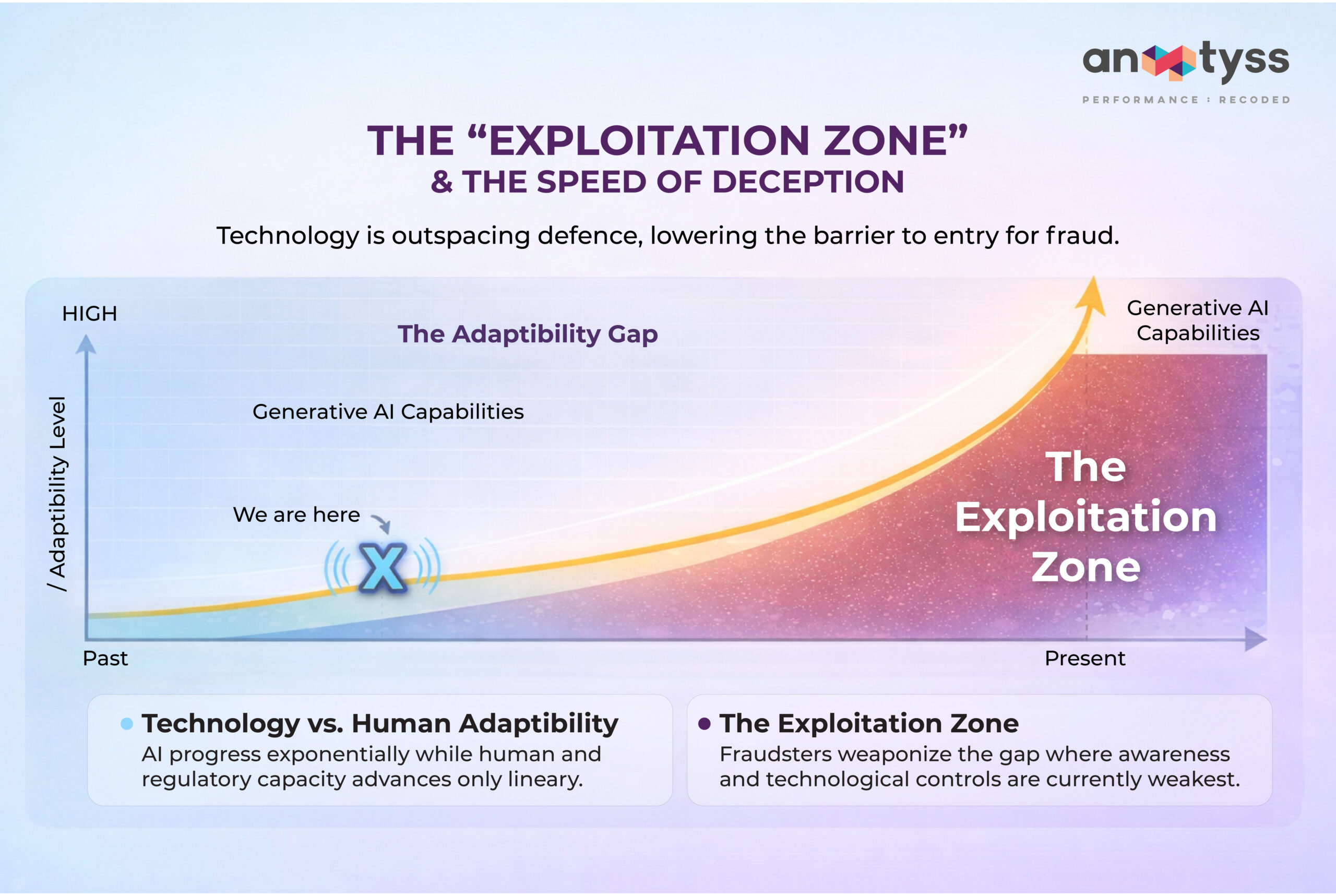
For decades, the financial services industry relied on the premise that biometric markers—fingerprints, facial geometry, and vocal characteristics—were immutable and unforgeable. That assumption has collapsed. We are currently navigating what security strategists term the “Exploitation Zone”—a widening chasm between the exponential advancement of generative AI and the linear adaptation of institutional defense mechanisms.

The threat is no longer theoretical. For instance, in early 2024, a finance professional at a multinational firm was deceived into wiring $25.6 million to fraudsters. The employee was not tricked by a simple phishing email, he was manipulated during a live video conference where the company’s CFO and several colleagues appeared and spoke. They were all deepfakes, generated using public audio and video footage.

This incident, alongside the earlier $35 million heist involving a cloned voice of a company director in the UAE, signals a paradigm shift. For financial institutions, sensory evidence like seeing a face or hearing a known voice can no longer be considered sufficient proof of identity.

The Democratization of Deception

The Exploration Zone Deepfakes

Historically, high-fidelity voice cloning required Hollywood-level budgets and hours of studio-quality audio. Today, the barrier to entry has vanished. Generative AI tools, some available for free or as little as $5 a month, can clone a voice with startling accuracy using as little as three seconds of audio,. This audio can be scraped from a LinkedIn video, a recorded webinar, or a voicemail greeting.

Modern synthesis architectures, such as flow-matching and hierarchical neural codecs, have moved beyond the robotic, disjointed speech of early text-to-speech systems. Today’s AI models, including Dia2 and Maya1, incorporate streaming context awareness and emotional expression. They can replicate the cadence, intonation, and even the “micro-pauses” of human speech, effectively bypassing the human ear’s ability to detect fraud. Studies indicate that human listeners perceive AI-generated voices as “real” approximately 80% of the time.

Consequently, the attack surface for banks has expanded dramatically. Fraud attempts in the financial services sector rose by 21% between 2024 and 2025, with one in every twenty verification attempts now identified as fraudulent.

The Failure of Legacy Biometrics

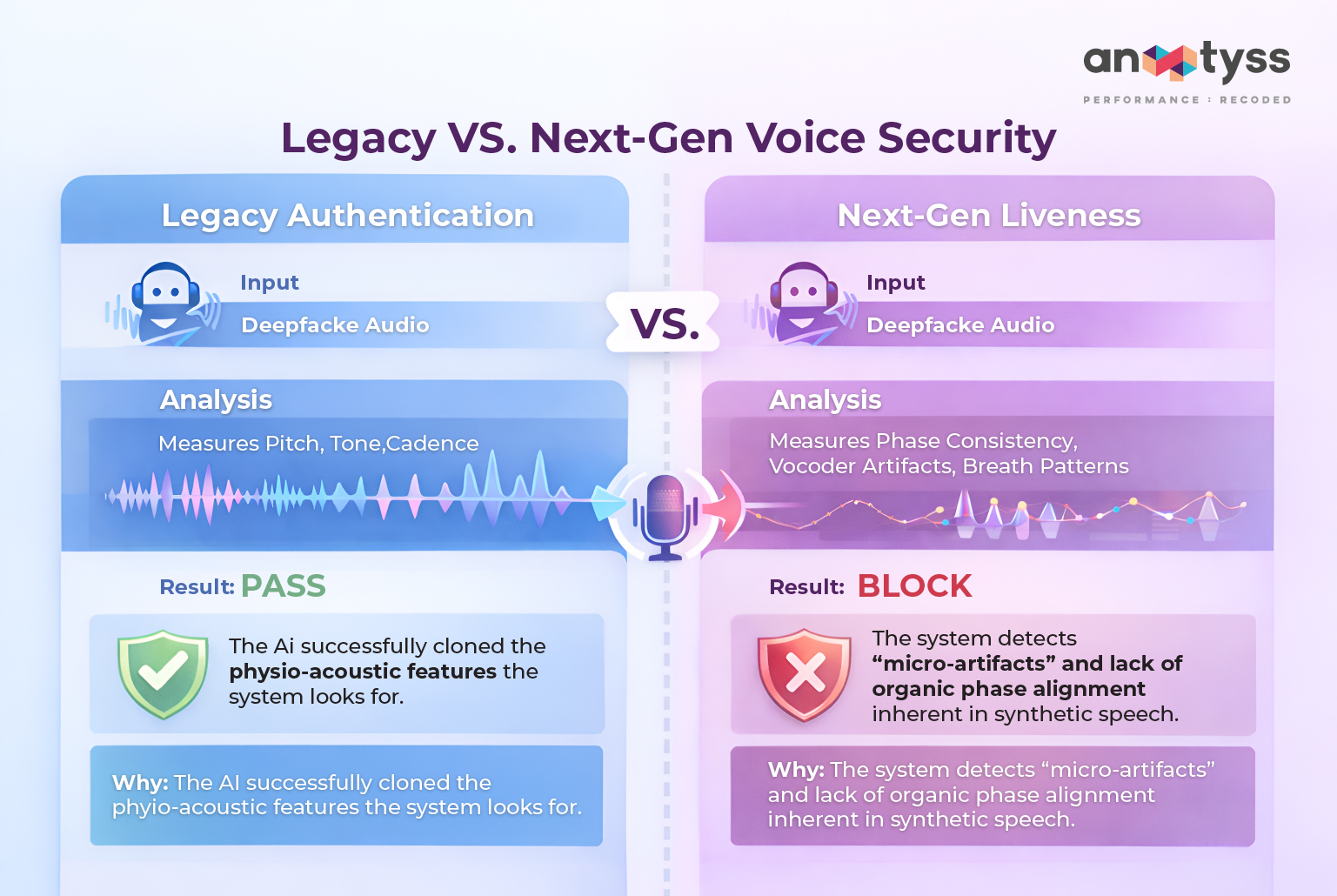
For years, financial institutions have promoted voice authentication as a secure, frictionless alternative to passwords. Customers were told, “My voice is my password.” However, legacy voice biometric systems primarily analyze physical characteristics—pitch, tone, and the spectral envelope of the vocal tract.

The vulnerability lies in the fact that generative AI creates a digital twin that possesses these exact mathematical characteristics. If a security system is designed to ask, “Does this sound like the customer?”, an AI clone will result in a positive match. The system fails because it is asking the wrong question. In an era of generative AI, the critical question is no longer “Who is speaking?” but “Is a human speaking?”.

Legacy vs next gen voice security

Without robust “liveness detection,” voiceprints are susceptible to replay attacks and real-time voice conversion, where a fraudster speaks into a microphone and the software instantly translates their words into the victim’s voice.

The Regulatory Mandate is to Move Beyond Single-Factor

The regulatory environment in the United States is rapidly pivoting to address these vulnerabilities. The Federal Financial Institutions Examination Council (FFIEC) issued guidance in 2021 explicitly stating that single-factor authentication is inadequate for high-risk transactions. Relying solely on a voiceprint (an “inherence” factor) creates a single point of failure.

The FFIEC advises that financial institutions must implement layered security and multi-factor authentication (MFA) for users accessing high-risk systems or moving funds. This aligns with broader cybersecurity frameworks which emphasize that if one gate is breached (e.g., a voice clone tricks the IVR), subsequent gates must remain locked.

Strategic Defense – A Layered Architecture

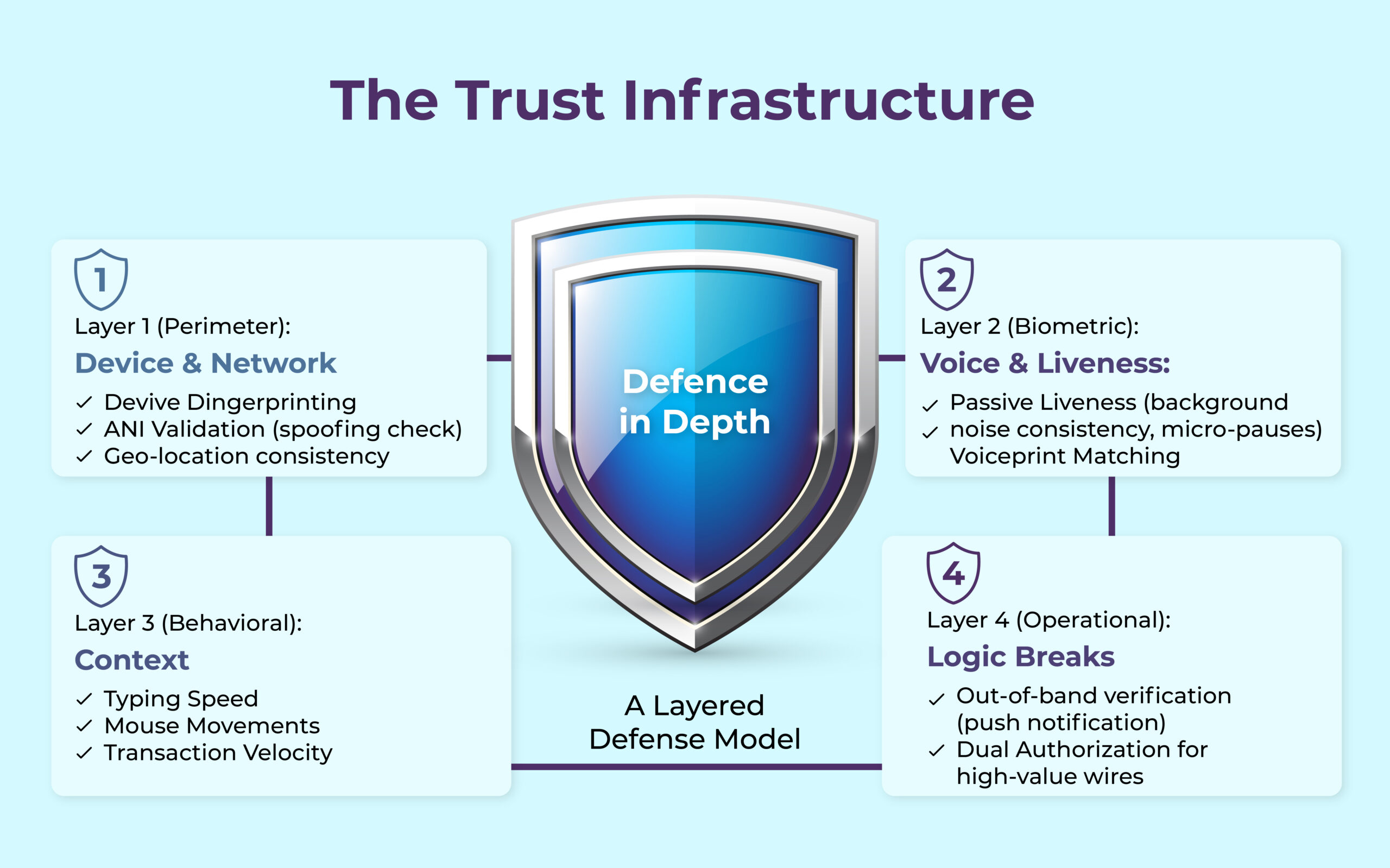
To mitigate the risk of deepfake fraud, financial leaders must transition from simple verification to a comprehensive “Trust Infrastructure”. This requires a defense-in-depth strategy comprising three pillars: Technology, Context, and Operations.

1. Technological Defense: Liveness Detection

Voice biometrics must be upgraded to include liveness detection. This technology analyzes the audio signal for artifacts that human ears miss—such as synthetic phase inconsistencies, the absence of organic breath patterns, or the specific digital signatures left by neural vocoders,.

2. Contextual Defense: Behavioral and Device Signals

Identity must be triangulated. Even if the voice is a perfect match, the surrounding context provides the “tell.”

3. Operational Defense: Process Breaks

For high-value interactions—such as wire transfers or changing authorized users—technology should be the floor, not the ceiling.

The Trust Infrastructure

Conclusion

The “Exploitation Zone” will persist as long as technology outpaces adaptation. However, financial institutions are not helpless. By treating deepfakes not as a technological novelty but as a systemic risk management challenge, banks can harden their defenses.

The era of trusting sensory evidence is over. The future of banking security relies on “Zero Trust” principles applied to identity: verify every signal, assume breach, and validate liveness. By integrating real-time deepfake detection with robust MFA and strict operational governance, financial institutions can protect their assets and their reputation in an age where seeing and hearing is no longer believing.

Why Your ‘Fraud Detection’ is Failing – The Case for Behavioral Biometrics

The traditional banking security model—predicated on validating static credentials and devices—is functionally obsolete in the face of industrialized cybercrime and generative AI. Financial institutions must pivot from point-in-time identity checks to continuous intent verification. Behavioral biometrics offers the only viable path to securing the digital journey by analyzing how a user interacts, not just what they know, reducing fraud losses while dramatically lowering false positive rates.

In this blog, we outline the structural weaknesses in legacy fraud controls, explain how behavioral biometrics shifts security from static identity checks to continuous intent verification, and provide a practical roadmap for financial institutions to adopt this model.

Why Traditional Banking Fraud Controls and Static Authentication Are Failing

If you occupy the C-suite of a financial institution today, you are likely managing a costly paradox: investment in identity access management (IAM) and fraud prevention tools has never been higher, yet fraud losses continue to accelerate. Global e-commerce fraud losses alone were projected to exceed USD 6.4 billion in 2024, driven by sophisticated account takeover (ATO) and synthetic identity attacks.

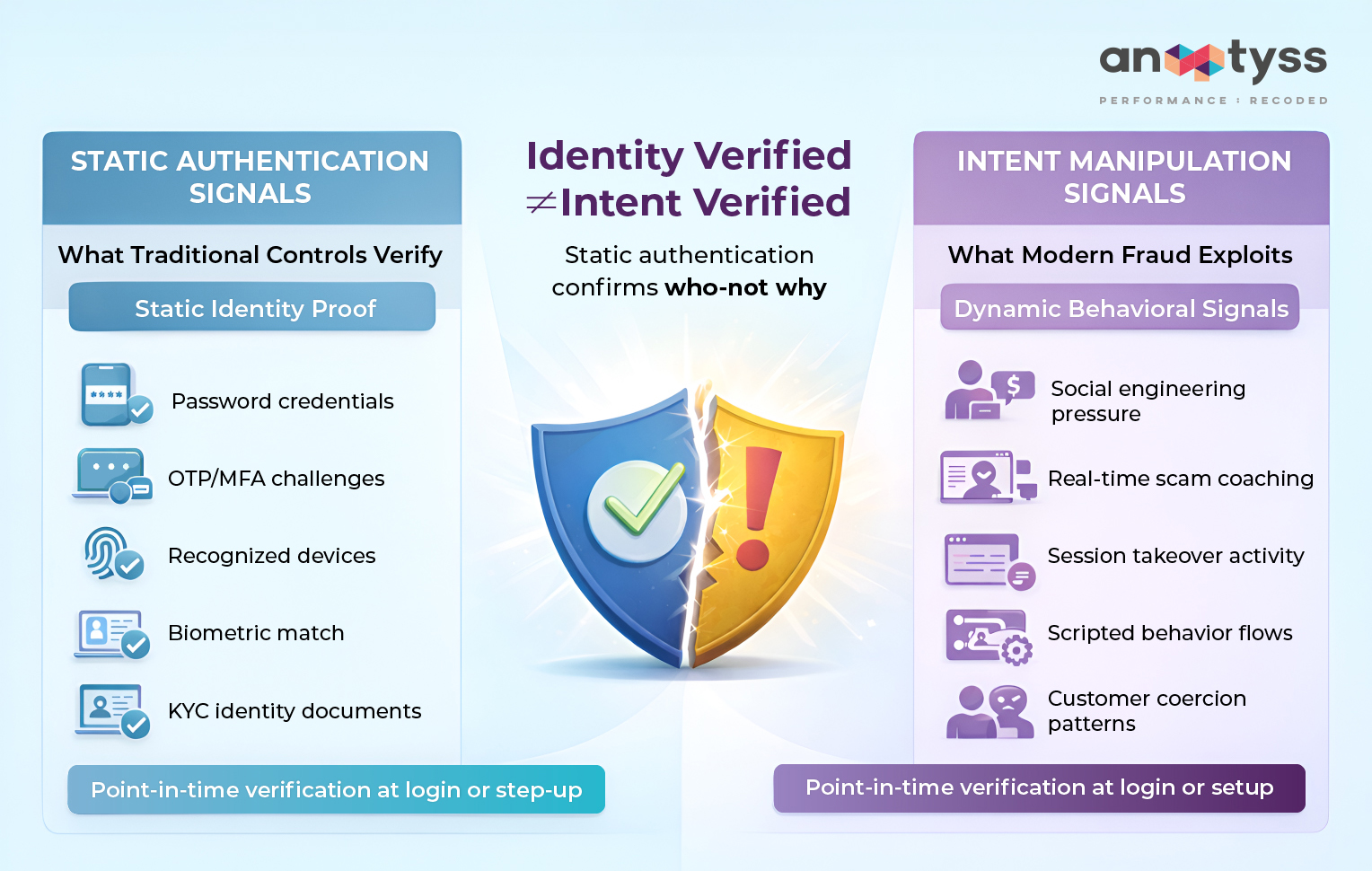
The uncomfortable truth is that your current “fraud detection” stack is failing because it was designed to validate the authenticity of data (passwords, OTPs, device IDs), whereas modern threat actors excel at manipulating the authenticity of intent.

1. Authorized Push Payment (APP) and Social Engineering Fraud Are Bypassing Bank Controls
The most pervasive threats today—Authorized Push Payment (APP) fraud and sophisticated vishing (voice phishing)—bypass traditional firewalls entirely. In these scenarios, the customer is socially engineered into authorizing the transaction themselves. Legacy systems see a valid device, a correct password, and a valid biometric login (like a fingerprint). They approve the transaction because they cannot detect the hesitation, the erratic mouse movements, or the “coercion signals” that indicate a human under duress.

2. Why Multi-Factor Authentication (MFA) Alone No Longer Stops Modern Fraud
MFA was intended to be the silver bullet, but it has become a speed bump. Attackers now use real-time relay attacks and OTP interception bots to bypass these controls. Furthermore, relying heavily on MFA creates significant customer friction. Rules-based systems often treat every user the same, ignoring behavioral context, which results in 98% of Anti-Money Laundering (AML) alerts being false positives—a massive drain on operational resources.

3. The Synthetic Identity Blind Spot
Synthetic identity fraud—where criminals combine real (stolen) SSNs with fabricated names and addresses—is designed to bypass “Know Your Customer” (KYC) checks. These “Frankenstein” identities have no prior bad history and often spend months building legitimate credit scores before a “bust-out” occurs. Static checks welcome them as new growth; they lack the behavioral nuance to see them as bots or scripts.

What Is Behavioral Biometrics in Banking Fraud Detection?

Behavioral biometrics represents a fundamental shift from asking “Who are you?” to asking “Are you acting like yourself—right now?”.

Unlike physiological biometrics (fingerprints, face ID), which are static and can be stolen or spoofed, behavioral biometrics analyze the dynamic, subconscious rhythms of human interaction with a device. These patterns are born from muscle memory and cognitive habits, making them exceptionally difficult for bots or fraudsters to replicate continuously.

Identity Verified is not Intent verified

How Behavioral Biometrics Detects Fraud Through User Interaction Patterns

Behavioral Biometrics vs Rule-Based Fraud Detection Systems

Below is a detailed comparison of how behavioral biometrics handles specific, high-value threat vectors compared to traditional rule-based systems.

Threat Scenario Legacy Detection Response Behavioral Biometrics Response
Account Takeover (ATO) FAIL | Attacker enters valid credentials. System sees a correct password and recognized device (via spoofing). Access granted. DETECT | The system notes the typing rhythm is 40% slower than the user’s baseline and mouse movements are erratic.
Action – Step-up auth or block.
Social Engineering (Vishing) FAIL | The victim logs in and enters a valid OTP under duress. The transaction is technically “authorized.” DETECT | The system detects “coercion signals”—mouse shaking, long pauses before clicking “Submit,” and unusual navigation flow.
Action – Delay transaction for review.
Synthetic Identity Onboarding FAIL | Applicant passes credit bureau checks because the synthetic ID has a valid (stolen) SSN and good credit history. DETECT | The applicant uses “copy-paste” shortcuts for personal data (name/address) or navigates the form with robotic fluency.
Action – Flag for manual KYC review.
Remote Access Tools (RATs) FAIL | The device fingerprint matches the customer’s known laptop. DETECT | The system identifies that mouse and keyboard inputs are injecting directly into the OS, bypassing physical hardware drivers.
Action – Terminate session.

The business impact extends beyond fraud prevention. By using behavioral signals to continuously authenticate users in the background, banks can reduce reliance on intrusive step-up challenges (like OTPs) for low-risk sessions. This “passive” security reduces customer friction and abandonment rates. Furthermore, advanced behavioral models have shown classification accuracy rates as high as 99.24% in separating genuine users from impostors, significantly reducing the operational cost of false positive investigations.

Behavioral Biometrics Implementation Risks

While the technology is transformative, C-suite leaders must navigate significant implementation hurdles regarding privacy, data governance, and algorithmic bias.

1. The Privacy Challenge (GDPR & Compliance)
Behavioral data is highly sensitive. Under the General Data Protection Regulation (GDPR) in the EU and similar laws globally (like Brazil’s LGPD), biometric data used for identification is classified as “special category” data. Processing this data without a lawful basis can lead to massive fines.

Therefore, you must establish a clear lawful basis, often “substantial public interest” (fraud prevention) or explicit consent. Data must be minimized—collecting only what is necessary—and ideally processed using “privacy-preserving” architectures that encrypt behavioral templates so they cannot be reverse-engineered to reveal user identity.

2. The “Cold Start” Problem
Behavioral biometrics rely on a baseline profile. How do you protect a new customer (or a new device) that has no history?

The solution is Hybrid modeling. In the absence of an individual profile, the system compares the user’s behavior against “general population norms” or “cohort models”. For example, no human types at 1,000 characters per minute; flagging this requires no personal history, only a generic understanding of human physiological limits.

3. Algorithmic Bias and Fairness
There is a documented risk that biometric algorithms may perform differently across demographic groups (age, gender, ethnicity), potentially leading to higher false rejection rates for certain customers. To overcome this, ask your vendors for “fairness audits.”

Ensure the underlying machine learning models are trained on diverse datasets. Continuous monitoring of False Rejection Rates (FRR) across different customer segments is essential to ensure equitable access to banking services.

Behavioral Biometrics Adoption Roadmap for Banks

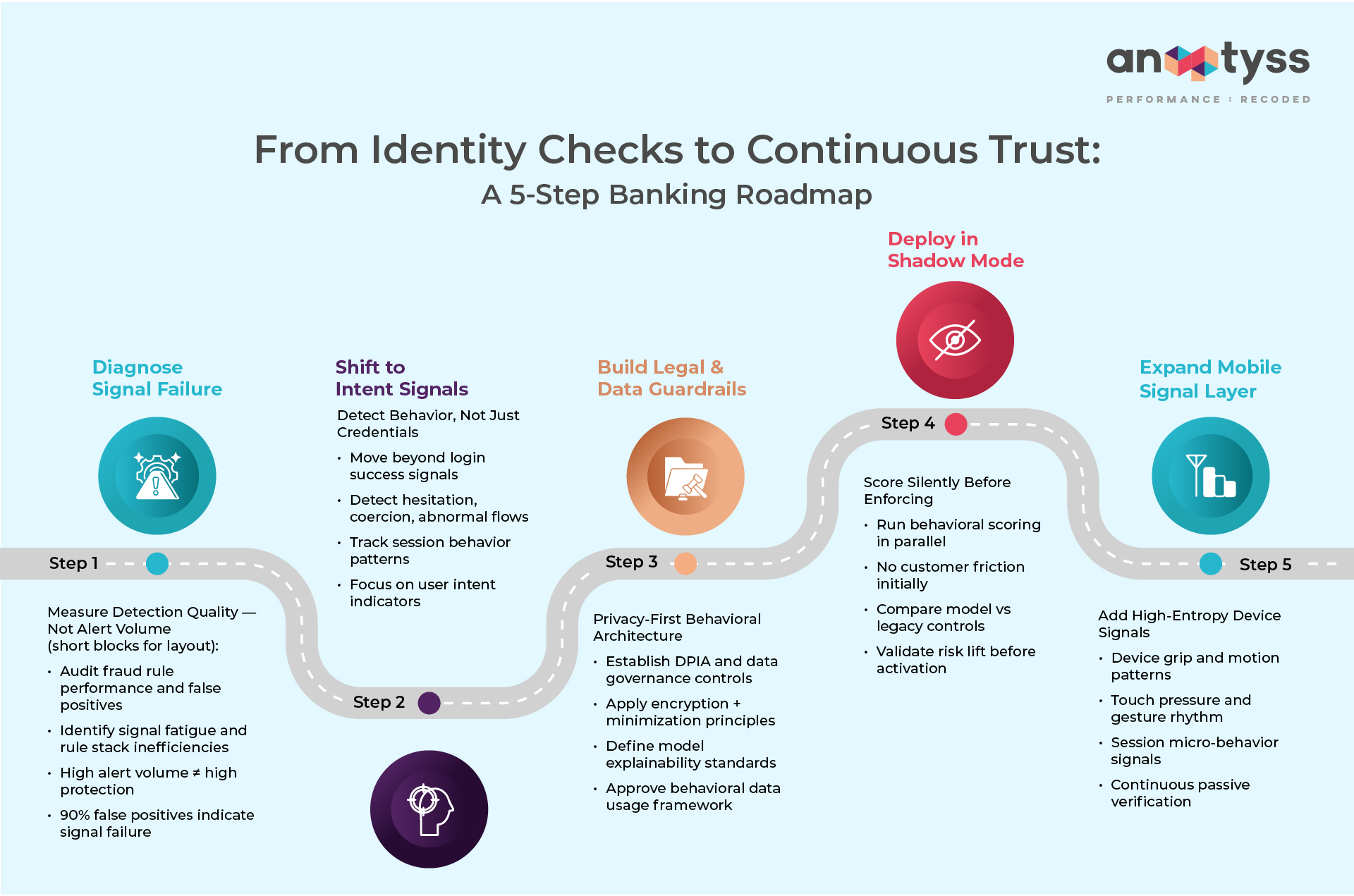
Implementing behavioral biometrics is not just an IT upgrade; it is a strategic move toward a Continuous Trust Architecture. Here is a checklist for the next 6–12 months:

From Identity Checks to Continous Trust

Conclusion

We are entering the post-password era. The assumption that a user is safe simply because they logged in successfully is the most dangerous fallacy in modern banking. Fraud has evolved from hacking systems to hacking humans, and from stealing data to mimicking identities.

To protect your institution’s capital and your customers’ trust, security must move from the perimeter to the person. It must become continuous, invisible, and inherently human. Behavioral biometrics offers the only viable path to securing digital sessions in real-time without sacrificing the seamless experience your customers demand.

From KYC to KYT | How 2026 Is Redefining Financial Crime in the Converged Financial System

By 2026, the narrative that cryptocurrency is the “Wild West” of finance has been largely dismantled. With the full implementation of the European Union’s Markets in Crypto-Assets (MiCA) regulation and the United States’ GENIUS Act setting strict frameworks for stablecoins, we have entered the era of the Converged Financial System,. Traditional banking rails and decentralized protocols are intertwining, with stablecoin transfer volumes surpassing $27 trillion globally.

However, the victory of blockchain transparency has not eradicated financial crime; it has triggered a brutal evolutionary filter. Low-tech criminals have been expelled, leaving behind sophisticated actors who no longer simply evade surveillance—they manipulate the very logic of financial protocols.

For Chief Risk Officers (CROs) and Compliance leaders, the challenge of 2026 is no longer just about “hiding” assets. It is about Protocol Manipulation. We are witnessing a fundamental shift where a user’s identity matters far less than their behavior.

The Rise of the “Clean Skin”

For the last decade, the banking and fintech sectors have obsessed over the “Gate”—the point of entry. Institutions spent billions on biometric scanners and document parsing to ensure they “Know Your Customer” (KYC).

But in the age of AI and industrialized fraud, the Gate has been breached. We are now facing the “Clean Skin” Paradox.

A “Clean Skin” is a money mule or synthetic identity with a valid passport, a clean background check, and a passing sanctions screen. They walk through your digital front door, fully verified. Ten minutes later, they receive $5 million in stablecoins and funnel it through a cross-chain bridge to a wallet linked to a ransomware syndicate.

If your compliance program relies solely on static identity checks, you are defenseless. As noted in recent 2026 compliance analyses, identity is merely a claim; behavior is the proof. The only way to catch a synthetic identity is not by looking at their face, but by watching the velocity and topology of their transactions.

Stablecoins—The New Rails for Sanctions Evasion

The second major shift in the 2026 landscape is the weaponization of stablecoins. While stablecoins are now a pillar of financial innovation, settling trillions in value, they have become the preferred vehicle for state-sponsored sanctions evasion.

Recent intelligence reveals that sanctioned actors, including Russian and North Korean operatives, are utilizing stablecoins like USDT on the TRON network to move billions, bypassing the US dollar clearing system entirely. We are even seeing the rise of “sovereign-backed” evasion tools. For instance, following the disruption of the Garantex exchange, a new ruble-backed stablecoin known as A7A5 has emerged, processing billions in swaps specifically designed to be robust against Western sanctions.

For banks holding reserves for stablecoin issuers, or fintechs facilitating payments, this creates a massive indirect risk. It is no longer enough to screen your immediate client; you must now monitor the ecosystem risk of the assets they hold using Issuer Due Diligence (IDD) tools.

The End of “Decentralized Immunity”

Perhaps the most jarring wake-up call for institutional investors in 2026 is the collapse of the “decentralized defense.”

For years, many operated under the assumption that Decentralized Autonomous Organizations (DAOs) were immune from legal liability because they lacked a central corporate entity. The courts have shattered this illusion. Following the precedent of Sarcuni v. bZx DAO, token holders can be deemed members of a “General Partnership”.

This means that if a DAO votes to approve a risky protocol change that leads to a hack, or fails to implement AML controls, individual governance token holders can be held jointly and severally liable for the damages. For a bank or venture fund holding governance tokens, this represents an unbounded liability that traditional risk models often fail to capture.

The Strategic Pivot: From KYC to KYT

How do institutions survive in this landscape? The answer lies in a strategic pivot from Know Your Customer (KYC) to Know Your Transaction (KYT).

In 2026, compliance must be dynamic, not static.

  1. Behavioral Baselines
    We must move beyond rigid rules (e.g., “flag transactions over $10k”) to behavioral analytics. AI-driven systems can now detect “Fan-In/Fan-Out” topologies—where a user receives 50 small deposits and attempts one large withdrawal—signaling mule activity regardless of the user’s verified status.
  2. Taint Analysis
    Compliance teams must track the “hops” of a coin. If funds arriving at your OTC desk are three hops away from a bridge exploit or a sanctioned mixer like Tornado Cash, they must be flagged immediately.
  3. Smart Contract Audits
    Due diligence now requires “malicious use case” analysis. It is not enough to know if the code is secure from hackers; we must know if the protocol’s logic (e.g., flash loans) can be manipulated to launder money.

Conclusion

The future of financial security depends on the synchronization of legal text and technological reality. The “Wild West” is closing, replaced by a landscape defined jointly by code and law.

For financial institutions, the risks of 2026 are existential—from sophisticated protocol manipulation to state-sponsored evasion. However, these challenges present an opportunity. The same transparency that criminals try to exploit is our greatest asset. By pivoting to dynamic transactional intelligence and embracing the clarity provided by new regulations like the GENIUS Act and MiCA, we can build a resilient infrastructure.

Redefining Business Value in BFSI: How People, Processes, and Digital Excellence Are Shaping the Future

As 2026 begins, the conversation is shifting from debating technology to setting standards for technology-led value delivery. The time of digital transformation as a buzzword is over. Now, the only source of real competitive advantage is digital value delivery—where technology serves not as the end goal but as the means to a higher purpose—resilience, trust, and sustainable growth.

The financial services industry will next see business value being redefined by the intersection of deep domain expertise, operational excellence, and digital intelligence. The mere implementation of the AI cloud or automation is no longer enough. The financial institutions that shall prevail are those who acquire the power to merge these abilities into one regulated, measurable, and scaled system.

People + Process + Digital Excellence = Future-Ready Value is the new equation for business value in BFSI.

People — The Real Differentiator in a Tech-Driven World

Technology alone cannot create value. It is the people who design, manage, and continuously improve the systems that yield results. The most dynamic transformations in banking and insurance are not created by tools, but by teams that bring deep domain knowledge and disciplined execution.

As Alka Jha, Director, Vice President – Head of Service Delivery, emphasizes, efficiency is a byproduct of culture:

“Delivering isn’t just about hitting metrics it’s about people. When delivery is paired with empowered teams and a culture of ownership, operations move beyond tasks and efficiency. Technology supports the journey, but culture drives impact – turning process into purpose and operations into a strategic force that delivers excellence.”

This is the core of modern leadership. It is about designing systems where the learning and reflection are a part of each workflow.

Surat Pyari Satsangi, Vice President – Process Excellence & Training, notes that this adaptability is key to sustainability.

“Transformation isn’t about redesigning processes – it’s about creating systems that grow smarter every day. When learning and reflection are part of every workflow, excellence becomes sustainable. Organizations don’t just adapt to change – they anticipate it, harness it, and turn it into advantage.”

Process — Governance Is the Foundation of Trust

The convergence of financial services and digital assets has accelerated the need for robust governance. Trust is no longer a soft metric; it is the bedrock of market survival.

In 2026, the main risk is not the failure of AI but its implementation without accountability. In an environment of tightening regulation, and where supervisory expectations are increasing, the ability to demonstrate control is becoming as valuable as the capability itself. This is especially true as institutions expand into digital assets.

Tasneem Abdulrahman, Director, Compliance Delivery, highlights this critical link between adherence and trust.

“In a world where financial and digital asset ecosystems intersect, governance and compliance are the anchors of credibility. Consistent adherence builds confidence, and confidence ultimately becomes trust.”

Organizations need to demonstrate that they are indeed addressing the governance issue and doing so responsibly, consistently, and transparently.

Digital Excellence — The ‘How’ Phase of AI

We have moved past the hype cycle. As Rohit Gore, Chief Digital Officer, points out, the focus has shifted entirely to execution.

“We have moved past the ‘wow’ phase of Generative AI; we are now in the ‘how’ phase. In banking, an algorithm is only as good as its understanding of risk and regulation. The true differentiator isn’t the model itself – it’s Contextual Intelligence. When we layer AI with deep domain expertise, we stop building ‘chatbots’ and start building resilient, autonomous operations that actually understand the business.”

The future belongs to the companies that can scale AI while still ensuring responsible and transparent deployment. This needs a new perspective: AI is not a commodity to be bought. It is a capability that can be governed. The most valuable AI deployments will be those that reduce operational friction and ensure regulatory compliance because, in regulated industries, speed without control is not innovation—it is risk.

The New Business Value Equation

The financial ecosystem is evolving into a unified landscape where banking, fintech, and digital asset operations converge. This shift is not gradual—it is happening now.

As digital assets become increasingly integrated into traditional financial systems, institutions are facing new operational realities: 24/7 markets, instant settlements, tokenized assets, and digital custody requirements. In this era, governance is not optional—it is the foundation of trust.

This brings us to the ultimate definition of value for the modern enterprise, as articulated by Anuj Khurana, Co-Founder and CEO

“True client value isn’t delivered through technology alone – it’s forged at the intersection of deep domain mastery, exceptional people, high-performance culture, and digital intellect. That’s how we don’t just solve problems; we redefine what’s possible for BFSI leaders.”

Conclusion

The future of BFSI is not built on tools. It is built on operational excellence, trusted governance, and teams that deliver continuously. This is how business value is redefined in 2026.

At Anaptyss, we believe the next generation of financial services will be shaped by institutions that can operate with speed, intelligence, and trust across banking, fintech, and digital asset ecosystems. As a managed services partner, we help organizations translate innovation into execution—embedding risk, compliance, and AI governance into day-to-day operations.

DKO™
Life@Anaptyss
Careers