(Webinar) A Pragmatic Approach to Digitally Transforming Banking and Financial Services Operations – Key Insights

It explored several in-depth, thought-provoking perspectives on the foundational questions that underpin digital transformation in today’s context, particularly stressing the themes of “pragmatism” and “operations”. This blog shares some of the main takeaways and highlights from the webinar.

The Essence of Digital Transformation – A Pragmatic Outlook

A germinal thought at the onset was about probing the fundamental meaning of digital transformation, which boiled down to a succinct definition –

Digital transformation is essentially about being in a state of perpetual agility than finishing a technology project. It is about constant change and evolution to serve the customers’ needs.

Further, it is not possible to generalize digital transformation for financial services considering that it is a confluence of banking, mortgage, fintech, cards, deposits, commercial loans, and other deeply intertwined areas such as services, products, experience, etc.

And therefore, a pragmatic approach should explore the meaning of transformation in the context of specific application areas and business outcomes. It ought to help business leaders realize the value of digital transformation.

Insights from ERM, Mortgage, Compliance, & More

This section enumerates the insights drawn from prominent BFS verticals and functional areas such as Enterprise Risk Management (ERM), mortgage, and compliance. The webinar, led by a series of specific, thematically related topics, explored the meaning of digital transformation in specific business/functional settings.

Here’s a list of some of the topics with takeaways based on the insights shared by the panelists.

1. The best areas for digital transformation across the ERM landscape Takeaways:

2. Meaning of digital transformation in the mortgage lending space amid the escalating interest rates and slowing demand Takeaways:

3. The perspective of a Chief BSA/AML officer in transforming their group’s ability to deliver world-class compliance Takeaways:

Translating Vision into Execution – Bridging the Gap

A critical point of failure for digital transformation is the translation of the vision and direction into execution. In this regard, the webinar shared insights into the vital factors for the successful execution of transformation projects.

Firstly, banks and financial institutions need to plan realistically in terms of the scope of work and timelines which are achievable and result in the expected outcomes. Generally, organizations tend to be over-ambitious, attempting to do more upfront while unable to execute effectively. They need to consider that the execution capacity and capability for transformation projects are based on the existing staff and resources who also need to operate the routine operations in tandem.

Culture is another critical factor for supporting change management, agility, and technology adoption, which are inseparable parts of digital transformation. An organization looking to change its culture should consider a span of 3-5 years before ultimately changing it. And one of the markers of the right culture besides being supportive of change and agility is that the people do the right things without supervision.

The webinar explored several other crucial aspects of digital transformation in the BFS industry, offering objective and realistic inputs.


Transforming Reconciliations Management with Digital Knowledge Operations™

Reconciliations are critical processes banks need to perform to check and ensure that the financial statement of a company matches with its balance sheet in terms of the opening cash balance, transactions, and closing balance.

This “reconciling of records” aka reconciliations management is crucial to understanding the actual account balance (cash flow) vis-à-vis the data that got recorded/captured in the balance sheet. Reconciliations also help banks detect potentially fraudulent transactions such as money laundering and are therefore mandatory for meeting the audit and compliance requirements.

However, the reconciliations processes — being a manual undertaking that often spreads across multiple locations, teams, and departments — are fundamentally inefficient and error-prone. Also, the financial records and results of the process can be ambiguous due to inadequate visibility of the disparate and fragmented data and data sources.

These reconciliations management issues boil down to two problems, namely high costs of operations and reputational/legal risks that continue to loom due to any potential violations of regulatory standards.

How do banks overcome these issues?


Digital Knowledge Operations (DKO™): A Digital-First Approach for Efficient and Effective Reconciliations

Digital Knowledge Operations or DKO is a proprietary “solutions framework” designed by Anaptyss for driving digital transformation in the banking and financial services industry. However, it is fundamentally different from the cookie-cutter approaches to transformation in several ways, as follows:

1. DKO is a Pragmatic Approach

Unlike theoretical propositions and proof of concepts, DKO-led transformation projects are based on realism and practicality. In other words, it transforms the business operations in an observable and quantifiable way that can be substantiated with data and business outcomes.

2. Customizable by Default

DKO offers out-of-the-box customizability to meet the specific/unique needs of a financial institution based on its segment, offerings, circumstances, budget, scale, etc. It is designed to enable tailored transformation that can include a very specific aspect of a process or processes, a complete process(es), an entire department, a business unit, and multiple-locational service centers.

3. Cost-Effective Transformation

DKO combines the pillars of consulting, digital solution implementation, and operational support (managed services and talent pool) in a “unified package”, offering cost-effectiveness and cost optimization from the get-go.

Let’s understand how the Digital Knowledge Operations framework transforms reconciliations management.

Consulting, Intelligent Automation, and Delivery Capabilities: The DKO-Led Approach to Enabling Failsafe Reconciliations

The approach is based on remodeling the operational aspects, re-engineering the processes, and automating them using digital solutions. Additionally, it deploys a managed services model to support and streamline the delivery especially if the reconciliations processes are executed across multiple locations and departments. Here’s an outline of the approach:

1. Process/Systems/Policy Consulting:

Anaptyss allocates domain specialists to evaluate the existing reconciliations process and capability in the context of the bank’s overall needs. These domain consultants collaborate with the client-side analysts to determine the gaps and recommend remedial measures such as process re-engineering, remodeling, solution mapping, etc.

2. Digital Solution Implementation

This aspect looks into automating the manual processes and digitizing them for more resilient and dependable records reconciliations. For example, the DKO approach might implement robotic process automation and cloud storage to speed up the reconciliations processes and increase data transparency, accessibility, and manageability.

Another real-world example of transforming reconciliations is based on using data analytics and a SMART reporting dashboard that provides real-time insights to support decision-making and compliance needs.

Anaptyss assigns implementation experts who deploy the solutions stack based on the recommendations arrived at from the consulting phase.

3. Managed Services

: Scalable and global service delivery is a unique feature of the DKO approach, which allows banking and financial institutions to get on-demand support for their operations. There are multiple facets to this:

Anaptyss had recently transformed the reconciliation process for a regional community bank through a flexible commercial model, enterprise-grade center of excellence, hybrid operating model, and AI-powered reconciliation suite. The key impact areas were costs, efficiency, and compliance; the DKO-led approach saved approx. 45% of the costs and enabled review of more than 60,000 transactions in 45 days.

How Can Lenders Perform Faster Mortgage Loan Processing?

According to Ellie Mae, the average time for closing a mortgage loan is around 30 to 60 days. The long time involved in mortgage processing is due to several factors such as the massive number of manual tasks involved, the bank’s policies and procedures for underwriting, and the borrower’s financial situation.

Lenders go through several challenges during mortgage loan processing. They have to comply with the evolving rules and regulations, keep the turnaround time (TAT) under check to get the pre-underwriting paperwork done and ready, and at the same time prepare loan papers and NDA documentation. The slow, unorganized, and labor-intensive process leads to inefficiencies in meeting customer expectations.

To stay competitive and offer a delightful customer experience, lenders need to make mortgage loan processing fast, and hassle-free.

For more details on innovative growth strategies, you may want to check out our blog on Unleashing Growth for Mortgage Lenders with Right Shoring.

Ways to Shorten the Loan Closing Time

Here are a few ways to streamline mortgage loan processing, enhance efficiency, and improve customer Net Promoter Score (NPS). These are based on automation solutions, data-driven insights, and managed services, as follows:

1. Automate tasks using Robotic Process Automation (RPA)

Technologies such as RPA can shorten the overall mortgage loan processing duration and increase accuracy. Lenders can adopt RPA tools to automate repetitive tasks such as pre-underwriting, loan documentation, organizing unstructured data, and speed up income verifications thereby reducing the dependency on manual, time-consuming tasks.

2. AI/ML-powered tools for customer insights & engagement

Deploying AI-based tools can increase mortgage processing efficiency. It can help digital lenders perform a variety of tasks such as analyzing the borrower persona to reduce default risks and provide swift responses to customer queries on a 24×7 basis.  Tools with machine learning capabilities can help transform loan operations by increasing origination, minimizing compliance issues, and expediting online lending.

When discussing efficiency, it’s also useful to learn about the emerging trends in Rise of Mortgage Automation.”

3. Extract and digitize documents using OCR

Technologies such as Optical Character Recognition (OCR) allow automated document extraction and digitization. OCR tools extract textual data from physical documents, scanned images, handwritten notes, etc., allowing the creation of a fully digitized and indexed document repository without any manual data entry. The applications of OCR can span the digitization of process documents, customer records, etc.

4. Analyze unstructured information with data analytics

Using data analytics, lenders can predict and prioritize loan accounts at risk of default and foreclosure, examine complex data and observe productivity trends. Portfolio analysis helps in saving costs, reducing loan processing time in mortgages, accommodating market changes and regulations, and enhancing loan processing efficiency.

5. Update borrowers on the timeline

Mortgage processing is time-consuming leading to inevitable delays. Providing borrowers with an upfront loan processing timeline can allay their frustrations or avoid them altogether. Lenders should list down all the tasks to be performed by the borrowers and within what time. As per lending industry think tanks, any technology that gives borrowers more control of the loan process can speed up the processing time significantly.

6. Leverage managed services to augment delivery

Outsourcing mortgage operations to a managed services provider can save time, enable scalability, and offer readymade expertise. Partnering with a reliable service provider can offer benefits of the right-shoring model, including scalable global talent, “follow the sun” delivery, risk mitigation, and business continuity. The managed services model can also ensure diligent delivery in compliance with regulations such as the Home Mortgage Disclosure Act (HMDA).

Streamlining Mortgage Loan Processing with DKO™

The Digital Knowledge Operations (DKO)™ framework offers a comprehensive solution for transforming mortgage operations through a seamless adoption of digital tools, domain-led consulting, and managed services through a scalable delivery model. The approach is highly customizable and data-driven, offering practical outcomes such as reduced loan closing duration and increased customer satisfaction.

Transforming Business Process Documentation in the BFS Industry with Digital Knowledge Operations (DKO)™

Business process documentation is a vast and tedious activity every banking and financial institution needs to perform perpetually in line with their internal policy frameworks and regulatory mandates. Banks often need to maintain a dedicated staff or capacity for documenting the business processes diligently.

At least a few hundred processes and sub-processes constitute front, middle, and back office operations such as customer onboarding, mortgage lending, card processing, core banking (KYC, reconciliations), conflict management, risk mitigation, compliance, etc.

Traditionally, these business processes have been recorded “manually” relying heavily on human diligence and expertise. Aside from consuming sizable efforts and time, this conventional “trust-based” approach has chances of errors or omissions. For example, a subject matter expert or process operator may miss including or updating the steps for a process or record it incorrectly. Further, manual process documentation is cost-intensive for obvious reasons based on human limitations concerning efficiency, productivity, accuracy, integrity, etc.

Another issue is the looming risk of losing vital information due to reasons like loss of physical documents, obsolete steps, and dependencies on people; imagine the only person executing or knowing a business process leaves the organization without documenting the procedure, associated guidelines, and invaluable learnings amassed over time. The situation can result in issues such as capability loss, regulatory risks, and customer dissatisfaction.

Digital Knowledge Operations™ – A Realistic Approach for Transforming BFS Operations

The Digital Knowledge Operations or DKO™ framework can help eradicate the issues related to traditional process documentation practices through digitization and automation. Devised by Anaptyss, DKO adopts a pragmatic solution approach that offers to transform financial services operations by combining the three vital aspects viz.-

1. Careful, domain-centric consulting

: The DKO-based approach hinges on domain-centric advisory to counsel the clients on aspects like policy frameworks, process redesign/reengineering, operating model evaluation, risk management, compliance, etc. The consulting is delivered by a team of industry experts and experienced professionals in a tailored manner based on the scale and specific needs of the financial institution.

2. Digital solution implementation :

DKO is a unique approach as it “unifies” the consulting and implementing pillars to enable more practical, cost-effective, and impactful outcomes. It enables razor-sharp implementation of intelligent digital solutions based on real-world observations and immersive consulting.
The solutions available with DKO are vast, comprising tools for robotic process automation, document extraction, predictive analytics, NLP-enabled bots, AML transaction monitoring, and many more. These solutions help build/augment operational capabilities such as responding to customers in real-time or automating repetitive processes like documentation, customer profiling, etc.

3. Talent services to support operations:

The DKO framework also takes care of the staffing or capability aspect by providing a trained workforce on-demand to provide operational support across the BFS value chain.
The “right-shoring” model is a salient feature of the DKO-based operations model that enables the delivery of services on the client’s preferred shore – onshore, off-shore, hybrid – in a scalable and managed way. In other words, it deploys the workforce and capabilities based on client needs and ensures quality execution with managed operations.

How Does Digital Knowledge Operations™ Enable Fast and Reliable Process Documentation?

Process documentation organizes or collates “instructional” data in the form of process steps, guidelines, best practices, etc. In other words, a business process is standard, repetitive information based on set rules.

The DKO approach can make the documentation activity efficient and sustainable by automating the manual process of observing, recording, and replicating/versioning the procedures. Here’s a general outline of the DKO-based process documentation approach:

  1. Anaptyss assigns domain experts to collaborate with client-side subject matter experts/analysts to understand the operating procedures, program details, regulatory obligations, etc.
  2. It deploys a robotic process automation tool to record step-wise operating procedures by recording real-time screen activities, keystrokes, etc.
  3. Proprietary techniques are used for organizing the recorded process steps into digital “business process blueprints” with annotated text, screenshots, and the latest instructions.

Here’s a case study outlining the implementation of the DKO-based solution approach for end-to-end digital knowledge management for a US-based regional community bank. The business outcomes were astonishing, as the bank could digitize 800+ business process blueprints with 100% accuracy. Also, the digital knowledge Center of Excellence created with the DKO framework allowed the bank to train resources and build execution capability cost-effectively.

Why Do You Need to Consider Digital Knowledge Operations™?

DKO is unlike any other digital transformation approach, and there are several reasons that make it popular in the BFS industry:

  1. DKO is data-driven and realistic, which means it promises practical outcomes that are measurable and observable. It relies on the findings of a diligent consultative approach and data insights derived from the systems and people in the client environment.
  2. It offers hassle-free and fast implementation of digital solutions, process frameworks, re-engineered models, and any other aspects that require hands-on expertise.
  3. The framework offers an extensive solution umbrella comprising tools for automation, data analytics, document extraction, customer interaction, AML compliance, and more.
  4. DKO is designed to deliver “value” through cost optimization, scalability, and customizability, making it equally viable for small-to-mid-sized financial institutions, including regional/community banks, mortgage lenders, commercial lenders, etc. The approach offers unparalleled comfort, assurance, and partnership for financial institutions to get started and done with their digital transformation goals!

The High Costs of AML Transaction Monitoring: Can Machine Learning Help?

The Bank Secrecy Act (BSA) obligates financial institutions to follow a stringent transaction monitoring process to track/monitor, investigate, and report suspicious transactions to U.S. government agencies. According to OCC, these obligations comprise imperatives such as monitoring cash purchases, reporting daily aggregated cash transactions in access of $10000, and reporting activities that might indicate money laundering. As per anti-money laundering (AML) regulations, banking and financial institutions need to screen dubious transactions and notify the authorities through a document called Suspicious Activity Report (SAR).

Filing the SAR places a considerable cost burden on banking and financial institutions, which is incurred in detecting/screening, and investigating suspicious transactions. Additionally, legal penalties and reputational damage are looming threats that may arise due to potential regulatory violations or procedural lapses concerning AML mandates.

This blog outlines some critical challenges financial institutions face with transaction monitoring processes for detecting suspicious transactions. It also sheds light on the emergent machine learning techniques that can help financial institutions track, analyze, and report suspicious transactions effectively, and mitigate the risks of not complying with the regulatory norms.

Detecting and Investigating Suspicious Transactions: The 3 Key Challenges

1. The upfront cost of AML transaction monitoring

Monitoring millions of ongoing transactions is inherently cost-intensive due to the IT infrastructural requirements. It needs to infuse capital into acquiring anti-money laundering systems such as Automated Transaction Monitoring System (TMS) – software to detect and report suspicious activities. According to Reuters, banks have invested billions of dollars in these Anti Money Laundering (AML) systems, which is a sizable capital expense.

2. High cost of false positives

The capital cost spills over to operational expenses incurred in “manual” investigation. Reuter reports that 95% of the software-generated alerts are inaccurate or false alarms, and 98% of these do not result in a SAR. According to SAS Analytics, only about 0.5-7% of the transactions detected by a TMS are genuinely suspicious and warrant SAR submission.

The low efficacy of AML systems such as TMS compels financial institutions to trudge through manually investigating the “false positives” that can run in millions of records. As per SAS Analytics, these false alerts could be anywhere between 8-124 million per firm annually, snowballing the investigation costs.

As per the Reuters report cited earlier, this wasted investigation time and manual resource cost billions of dollars to the banking industry annually.

3. Cost of regulatory violations

Banks and other financial institutions face a potential risk of legal penalties and reputational loss in the event of violating the prevailing SAR filing norms. Failure to identify suspicious transactions or delayed reporting can attract regulatory fines and other legal action such as cease and desist orders, remediation costs, and more. A recent example is Commerzbank AG which was fined £37,805,400 in 2020 for failing to deploy adequate AML systems. According to BCG’s Global Risk Report, financial institutions have incurred more than $394 billion in fines since 2009 due to regulatory violations.

How Can Machine Learning Help Banks Detect Suspicious Transactions Effectively?

Machine learning systems leverage “evolutionary algorithms” that can empower AML transaction monitoring processes and AML systems to learn emergent behavioral patterns dynamically as they evolve within the specific circumstances or bounds of the financial service provider’s network. Here’s an outline of how ML can help:

  1. ML models allow the AML system to mine, ingest, wrangle, and analyze large, unstructured datasets (big data) to draw meaningful and accurate insights. Some of these techniques include semantic analysis and statistical analysis to create a realistic risk profile of customers based on their KYC information and transaction patterns.
  2. Unsupervised machine learning models can detect anomalous transactions using K-means clustering and One-Class Support Vector Machine (SVM) approaches. Combined with conventional rule-based logic, machine learning techniques can equip the TMS with a superior ability to detect suspicious transactions with higher accuracy.
  3. Neural network-based supervised learning models are also being developed to detect suspicious transactions. The Radial Basis Function (RBS) neural network is an example that uses clustering and recursive algorithms to build transaction monitoring capability for anti-money laundering (AML) systems. The method is found to have the lowest false positive rate among other ML techniques based on support vector machines and outlier detection.

The primary benefit of ML in transaction monitoring is the remarkable drop in false-positive alerts. According to industry estimates, machine learning and artificial intelligence can detect more than 95% of false alerts.

Adopting Intelligent Solutions with Digital Knowledge Operations (DKO)™

The time is ripe for banks and financial institutions to leverage machine intelligence and build scalable AML systems to detect suspicious transactions effectively. However, considering the ongoing developments in AI, machine learning, and intelligent digital solutions, institutions need to observe due diligence and care while making the decisions when evaluating a machine learning-based AML system.

Digital Knowledge Operations™ is a solution framework that provides a consultative, data-driven, and tailored approach to implementing intelligent digital solutions across BFS industry verticals and functions. It facilitates seamless adoption of digital tools based on technologies like machine learning, data analytics, robotic process automation, etc.

Anti-Money Laundering Compliance – Checklist and Best Practices

Money Laundering is a persistent problem globally. As per UNODC, 2-5% of global GDP ($800 billion – $2 trillion) is the estimated amount of money laundered in a year.

The vast umbrella of Anti-Money Laundering (AML) Compliance obligates financial institutions to deter any potential money laundering activity, primarily through proactive tracking and reporting of suspicious transactions to authorities. However, this entails extensive transaction monitoring and due diligence, which has challenges such as volume of transactions, sanctioned entities, false positives, domain expertise, etc.

This blog shares a checklist of action items and best practices for financial crime teams that can help them as a ready reckoner to follow through with the key imperatives for complying with AML regulations.

Before the checklist, here’s a list of red flags that typically indicate a money laundering activity.

Potential Red Flags for Money Laundering

  1. Unusually high amount of transactions
  2. Large cash transactions
  3. Immediate withdrawal of funds from the account
  4. Inconsistent transfers without any logical explanation
  5. Discrepancies in the identity verification/KYC process
  6. Small and frequent transfers to different accounts
  7. Conversion to virtual assets or vice versa
  8. Transactions from unregistered geographies
  9. Multiple accounts under the same client

AML Compliance Checklist

We have broadly covered the most relevant anti-money laundering legislation and regulatory checklists as a reminder for you. Here’s what is expected from the financial institutions:

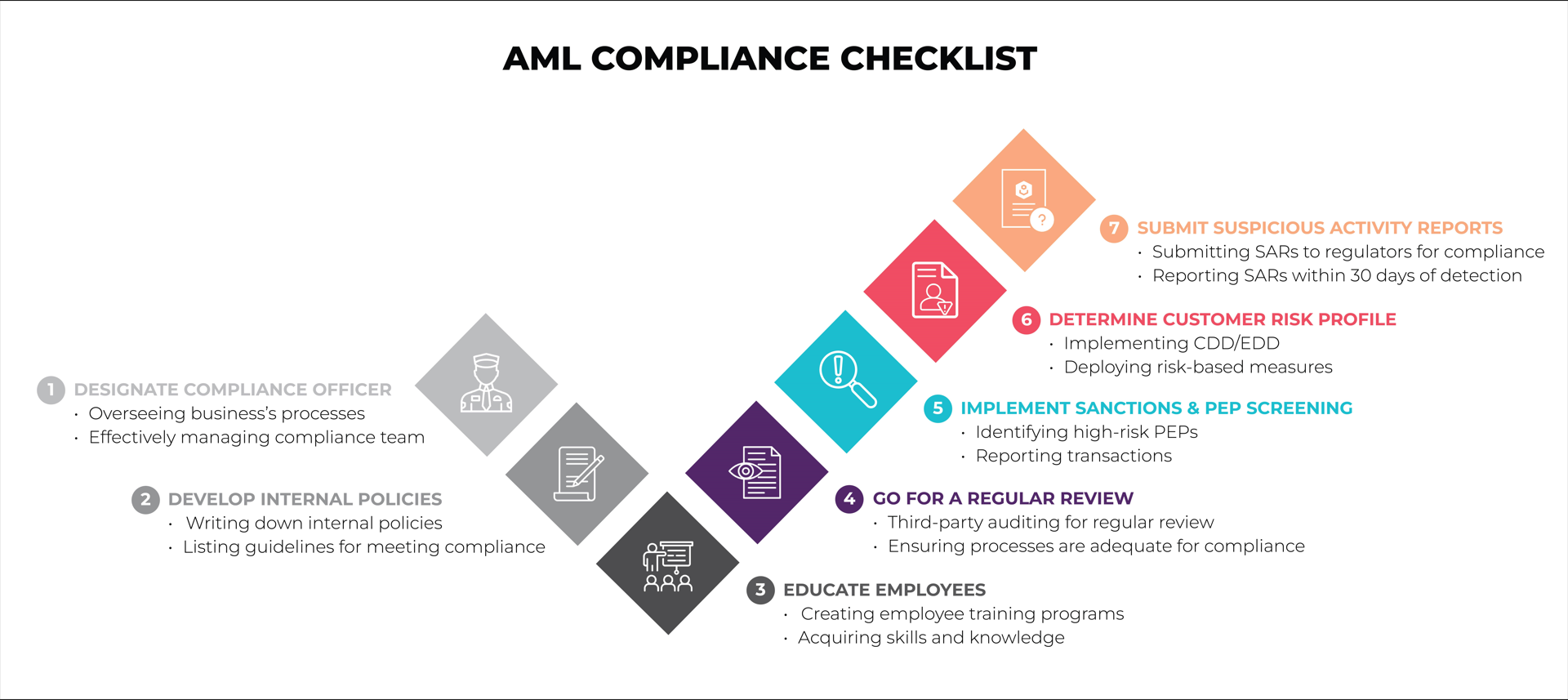
aml compliance checklist

1. Assign a dedicated CCO/MLRO

You’ll need someone at the top of the hierarchy to ensure that the policies are being administered consistently, the processes are aligned with the program, customer files are up to date, and training is efficient and on time.

Designate a Chief Compliance Officer (CCO) or a Money Laundering Reporting Officer (MLRO) to develop, implement and administer all aspects of the applicable program and act as a liaison for the financial authorities.

2. Get the written policies under check

Construct written internal policies to be followed by all the members to limit and control the risks. The policies need to specify the guidelines for meeting AML regulations and compliance imperatives, KYC and identification needs, monitoring and reporting suspicious activities, etc.

3. Provide proper training to members

Provide training to employees, agents, and brokers concerning their responsibilities in maintaining compliance. Anyone who deals with your customers and transactions needs to be trained about your jurisdiction-specific AML legal requirements, common techniques used by money launderers, policies to abide by during onboarding, and how to report suspicious activities.

4. Go for a regular review

Anti-money laundering compliance is an ongoing activity. Your programs need to be updated from time to time with the relevant regulations. Schedule an independent third-party review for all the policies and procedures, officer qualifications, and training materials to ensure that the records, reports, and processes are on point.

5. Implement sanctions & PEP screening

Politically Exposed Persons (PEPs) have more opportunities to earn illegal income, hence they are high-risk customers. It’s important for banks to explicitly identify PEPs and report their transactions according to the BSA regulation. Banks should be careful to not allow any individuals, companies, or countries that are named on international sanctions lists to hold an account with them. A proper sanctions screening process should also be performed to prevent, detect, and report suspicious money laundering transactions.

6. Determine your customer’s risk profile via CDD

Customer Due Diligence (CDD) is an AML component that requires you to identify the nature and purpose of customer relationships and report suspicious transactions while conducting ongoing monitoring of the beneficial owner(s) of legal entity customers. CDD combined with Enhanced Due Diligence (EDD) helps in identifying:

Deploy risk-based measures such as sharing or obtaining customer information across business lines, separate legal entities within an enterprise, and affiliated support units. You can refer to the FFIEC BSA/AML Manual to learn more about assessing Anti-money laundering compliance with BSA/AML requirements.

7. Submit Suspicious Activity Reports (SARS)

As a part of the BSA compliance obligation, financial organizations must submit SARS no later than 30 days after the initial detection of money laundering. If no suspect is identified on the date of detection of the incident requiring the filing, the organization may delay filing the report for an additional 30 calendar days to identify a suspect.

Violating AML Regulations – Key Implications

Not complying with anti-money laundering regulations can lead to vast implications, including monetary loss, legal action, reputational risks, etc., as follows:

Consulting-Led Approach to Meeting AML Compliance

Financial institutions need to explore a multi-pronged approach based on data-driven decision-making, people readiness, and technology for a long-term strategy to meet anti-money laundering compliance. Starting with a carefully drafted and audited internal policy framework, the AML compliance strategy needs to pivot on human expertise and intelligent digital tools to ensure effective tracking and reporting of transactions. 

The Digital Knowledge Operations (DKO)™ framework can offer a viable solution as it combines these critical aspects in a customized manner to help financial institutions fulfill AML obligations.

Anaptyss had implemented the DKO™ framework to offer a consultative BSA/AML-focused risk mitigation program for a US-based community bank.

Transform Mortgage Loan Origination with Intelligent Digital Solutions

Today mortgage lenders face unprecedented challenges in this fast-paced and competitive marketplace. The need to streamline operations, optimize costs, and provide a seamless user experience has become more crucial than ever. As per McKinsey, digital transformation practices and enhanced customer experience result in about 20-30% customer satisfaction and up to 50% profits.

Indeed, digital transformation cannot occur overnight, but lenders can adopt some fundamental solutions to start their journey.

Digital Solutions for Mortgage Lending – Key Benefits

1. Maximize efficiency with automation

Banks and lending institutions see automation as a synonym for savings, i.e., saving time, money, and effort. They’re embracing low-code and no-code solutions, including Robotic Process Automation (RPA) and AI-powered document extraction. With the help of automation tools, mortgage lending businesses can streamline their labour-intensive processes, reduce costs, increase the team’s overall productivity, and quickly scale with demand.

From digital boarding, document management, and underwriting to calculating real-time mortgage pricing options, meeting industry standards, and staying compliant, intelligent automation solutions can improve the overall mortgage loan origination process.

2. Make informed decisions with data analytics

The mortgage lending industry has to deal with large volumes of data daily, which consumes immense time and effort. Advanced analytics solutions based on predictive analysis techniques, machine learning algorithms, and business process automation enable accurate analysis of customer information, anticipate risks, and make informed decisions. Here are some ways in which advanced analytics has revolutionized the traditional mortgage lending process:

    • Analyze data to recruit the best human resources
    • Improve lead generation and management
    • Live monitoring of loans across products and channels
    • Steer large-scale pre-approvals and instant loan decisions

3. Enhance user experience with Conversational AI

Implementing AI, ML, and NLP is the new revolution in the mortgage lending industry. To maximize the user experience, industries are delivering truly ‘phygital’ lending experiences. From chatbots, virtual assistants, and smart dashboards, to responsive UX and contactless payments, lending institutions are aggressively investing in advanced technologies to deliver ultra-personalized customer service from the moment the homebuyer lands on the website. Some advantages of advanced interactive technology are:

      • Round-the-clock services
      • Human-like interaction
      • Accelerated response time
      • Personalized experience
      • Increased lead generation possibilities
      • Cost optimization

4. Accelerate mortgage experience with APIs

Mortgage lenders are implementing mortgage software using application programming interfaces or APIs to increase efficiency and provide comprehensive services across the ecosystem of borrowers, regulators, and partners.

While many mortgage lending companies struggle to maintain margins due to costs, low-interest rates and emerging competition, APIs revolutionize the mortgage process to increase productivity and overall turnover. Here are a few benefits of APIs:

      • Speed up application development
      • Seamless integration with existing and new features and technologies
      • Data consistency and accuracy
      • Better compliance
      • Automated workflows
      • Better monetization via data or service ordering

Adopting Digital Solutions for Mortgage Loan Origination

Mortgage lending is heavily data-driven, from initiating and underwriting to post disbursal and servicing. It is imperative for mortgage lenders to capitalize on digital solutions to streamline their procedures and efficiency.

With intelligent digital solutions, mortgage lenders can optimize the loan processes and meet compliance with the ever-changing regulations, deliver services in a shorter time, and maintain robust systems for consumer data security.

The Digital Knowledge Operations (DKO) ™ framework is a tailored solution approach that helps mortgage lenders and other financial service providers transform their business and technical operations in a customized and cost-effective manner.

For example, the DKO™ approach helped a US-based mortgage lender re-engineer the business processes to enable agile service delivery. It also helped the company adopt optimal digital solutions, including the RPA tool and SMART dashboard, enabling approx. 15% improvement in the closing cycle time and 20% efficiency improvement.  Read this case study for more details.

Why Adopt Robotic Process Automation to Fight Financial Crimes (5 Benefits)

Financial crimes have been a growing problem for banks and other financial institutions. Offenses like money laundering have drawn increased regulatory attention over the years. As a result, due diligence efforts like KYC processes and tracking and reporting suspicious transactions have become critical to combating financial crimes and meeting compliance.

The high costs of meeting compliance with BSA/AML regulations is a critical challenge for banks. A study by the United States Government Accountability Office (GAO) informs that financial institutions spend between 0.4% and 2.4% of their total operating expenses on anti-money laundering efforts.

Digital technologies such as Robotic Process Automation (RPA) can help financial institutions counter financial crimes and meet compliance with cost-effectiveness. Here’s how-

The high costs of AML programs are incurred on manual efforts in cross-verifying automated alerts, including a high percentage of false alerts, processing of suspicious transactions, and filing the Suspicious Activity Report (SAR). Robotic Process Automation can cut short the processing time and offer better accuracy than the traditional AML software using advanced machine learning capabilities.  In fact, RPA has emerged as a powerful technology in BFSI industry’s efforts to counter financial crimes.

How Does Process Automation Help Counter Financial Crimes?

Robotic Process Automation is essentially software embedded with machine learning capabilities such as evolutionary algorithms to learn behavioral patterns. Thus, RPA tools can learn patterns and automate complex and error-prone workflows with high accuracy.

They can help financial institutions reinforce AML programs by automating the tracking and processing of transactions with high accuracy and efficiency. Further, by taking over the monotonous, rule-based tasks, RPA programs free up manual capacity for strategic, high-value tasks.

RPA for Fighting Financial Crimes – Key Benefits

1. Automate with accuracy

RPA programs can automate repetitive tasks such as data retrieval and formatting with high accuracy and efficiency. For example, robotic process automation can check the data authenticity for processes such as KYC screening and transaction tracking.

2. Leverage machine learning and NLP

It can analyze unstructured data such as service logs, and leverage machine learning algorithms to analyze the data and detect suspicious transactions. RPA programs can understand human language using natural language processing techniques, enabling emotive tone analysis to detect fraudulent activities.

3. Create compliance readiness

It can also carry out anti-bribery and anti-corruption tests while analyzing red flags in financial transactions. RPA tools can also generate an audit trail for recordkeeping to support compliance.

4. Save costs with high efficiency

RPA tools can save financial institutions thousands of dollars by reducing the dependency on manual processes that are prone to errors and manipulation.

5. Highly scalable and productive

Enables scalability to manage high data volumes during peak times.  Also, process automation tools can function 24×7, offering higher productivity and throughput.

Adopting Robotic Process Automation

Like other technology-based solutions, RPA requires assessing the processes and environment for effective adoption. Additionally, there are different types such as attended/unattended automation and hybrid RPA.

A consulting-led approach can help in adopting the automation solution based on a financial institution’s specific needs and circumstances.

The Digital Knowledge Operations™ framework enables easy and successful adoption of RPA in several ways:

  1. Domain-led consultative approach to assess the AML obligations and compliance parameters
  2. Data-driven and pragmatic approach to determining the scope and automation solution
  3. Technical expertise for implementing the RPA solution
  4. Customization options to support the business’ specific needs

As Mortgage Rates Increase, Mortgage Fraud Increases

Due to growing inflation and the Federal Reserve’s interest rate hike since 2018 in mid-March, the mortgage market, which had been booming since mid-2020, started to sputter last quarter. The Fed increased its benchmark rate by an additional half of a percentage point last month and stated that it would continue to do so until prices stabilized, which has caused that slump to accelerate this quarter. The average 30-year fixed-rate mortgage then crossed the 5% threshold for the first time in more than ten years.

Researchers caution that the mortgage fraud risks may be heating up as rising interest rates cool in the mortgage market. According to the real estate analytics company CoreLogic, risky loan applications have been on the rise for the past year and are expected to increase by 75% in 2022.

The tepid demand may increase the number of high-risk loans in the coming months, as mortgage transactions decline and the balance of applicants changes away from refinancing loans and more toward purchases.

Mortgage Fraud Risks – Key Trends

The rise in mortgage fraud is frequently observed when markets weaken and financing costs increase. It is fueled partly by desperate purchasers and loan officers who, with fewer viable possibilities, are more likely to ignore fraud or even take part in it to close deals.

Because of their forced reduction in detection due to declining earnings, banks and other lending institutions are often less prepared to detect riskier loans during downturns.

The biggest worry is that mortgage lenders might reduce some of their fraud controls just when they’re most needed. For example, taking shortcuts or outsourcing projects without having the best employees review them, resulting in difficulties in mortgage fraud prevention.

The overall risk level during the first quarter of 2022 received a score of 137 from CoreLogic’s index, a 15% increase from one year earlier. The index compares current loan applications against prior loans that have been shown to be fraudulent. The index dropped below 100 at the beginning of 2020 and has increased quicker since then.

The report’s three highest-risk metro areas—the Hudson Valley in New York, Greater Miami, and Silicon Valley in California—saw a rise in their individual threat risk scores to over 230 over the third quarter.

How Does Mortgage Fraud Happen?

The following are some of the ways in which fraudsters may exploit the controls:

1. Income deception:

In this prevalent form of mortgage fraud, applicants fabricate bogus employers and pay stubs to appear as though they are making enough money to buy expensive residences. Some even go so far as to file false income tax returns with the Internal Revenue Service.

Recent modifications to the underwriting guidelines make it simpler for borrowers to deceive loan officers. For example, the asset-only verification process, which merely examines a bank statement when verifying an applicant presents a loophole vulnerable to exploitation. Institutions that cater to gig workers who do not receive regular salaries have adopted such products. Applicants may also game the system by shifting money between accounts.

2. Occupancy fraud

Borrowers claim they are buying a home for their use when they are buying it only as an investment. Occupancy fraud is more prevalent in locations where there are more likely to be out-of-state buyers. Fraudsters can obtain mortgages with lower down payments and frequently qualify for better interest rates than their credit scores would normally permit.

Countering Mortgage Fraud with Intelligent Automation

With rising mortgage rates, investing in fraud prevention solutions is more critical than ever. Considering the possibilities of collusion across the loan transaction chain and vulnerable fraud controls, mortgage lenders need to consider intelligent automation solutions such as Robotic Process Automation (RPA) and big data analytics. This step can drastically reduce the risks due to human elements and bring in systemic intelligence for mortgage fraud prevention.

Anaptyss’ Digital Knowledge Operations™ framework offers an integrated approach to help lenders counter mortgage fraud with intelligent automation in the following ways:

  1. Thoughtful, domain-led consultative approach to determine mortgage lenders’ specific needs and optimal digital interventions
  2. Tailored implementation of automation solutions to enable robust protection against fraud
  3. “Managed Services” model coupled with an automation-first approach to delivering agile end-to-end digital business processes.

Overcoming the Top Challenges in Mortgage Lending Industry with Digital Solutions

COVID-19 caused considerable shifts in the mortgage lending services industry amid the volatile market landscape defined by increased customer expectations, reduced rates, and sweeping policy measures to contain the pandemic.

While the situation triggered demand, it also heightened the need for operational agility, customer engagement, and compliance. The new “digitized” market landscape put the financial services industry, including lenders through various challenges while opening new opportunities.

For example, the digital lending experience took the front seat, wherein customers expected financial institutions to offer them fast and precise services focused on delightful experiences.

According to Million Insights, the global digital lending platform market is projected to amount to USD 15.3 billion by 2026, which indicates sizeable opportunities for digitized businesses.

In contrast, “customer retention” was a challenge for mortgage lending services companies, as easy refinancing and restructuring options helped borrowers reduce their loan costs, resulting in switchovers.  As the situation tapered, the demand reduced due to the rate hikes, and now, “servicing” and handling delinquent accounts are among the key business challenges for mortgage lenders.

Let us look at some of the critical challenges mortgage lenders face today.

The 3 Key Challenges Faced by Mortgage Lenders

1. Operational Inefficiencies

Mortgage lending is an “operations-heavy” business relying on several complex and manual processes that are repetitive and interlinked. Nonetheless, these processes, spanning the back, middle, and front office business and technical operations, need to follow a rigorous approach to meet regulatory compliance and required outputs.

These processes lead to inefficiencies, productivity issues, and errors, inflating the overall operating costs and turnaround times.

2.Compliance Risks

The paper-based documentation practices followed by conventional mortgage lending businesses can expose them to compliance risks due to obsolete or missing records. Also, physical records are prone to damage, loss, and inaccuracies due to various reasons such as human errors, environmental conditions, etc.

3. High costs

Mortgage origination involves substantial costs due to extensive human capital involvement, complex transactions, and the need for high accuracy and diligence. According to McKinsey, the origination cost per loan in 2021 was $7000–$9000, highlighting the critical need to build a cost-efficient ecosystem.

Overcome These Challenges with Digitization

Digital solutions like Robotic Process Automation (RPA), Data Analytics, and Optical Character Recognition (OCR) can help address the above challenges and transform the mortgage lending industry by automating repetitive processes and eliminating redundant ones.

Accelerate Your Digitization Journey with Anaptyss

The traditional mortgage lending organizations need to speed up the adoption of digital solutions to streamline their operations.

Anaptyss’ Digital Knowledge Operations™ framework provides intelligent digital solutions that leverage AI-powered technologies like document indexing, robotic process automation, text extraction, and more to transform mortgage lending and other BFSI processes.

Further, Anaptyss’ seasoned industry experts offer expert consultation to allow a practical, compliant, and realistic implementation of digital solutions. By bridging the gap between operational capacity and technology, Anaptyss can help transform your business to implement cost-effective solutions and deliver business outcomes.

DKO™
Life@Anaptyss
Careers