An Overview of the OFAC Sanctions and Program Types

Economic and trade sanctions are one of the ways the United States uses to deter and penalize human rights violations, state-sponsored criminal activities, or breaches of international laws.

The Office of Foreign Assets Control (OFAC) U.S. Department of the Treasury imposes these sanctions on countries, entities, or individuals. This blog covers various OFAC sanctions programs the US imposes to accomplish its national security and foreign policy goals.

What is OFAC and What Does it Do?

OFAC of the U.S. Department of the Treasury enforces economic and trade sanctions against foreign countries and regimes, terrorist organizations, international narcotics traffickers, persons or entities engaged in activities related to the proliferation of weapons of mass destruction, human rights violation, and other threats to the US national security, foreign policy, or economy.

Sanction Types and Who Do they Apply?

The sanctions apply to all US citizens, including US permanent residents, who are subject to US jurisdictions, regardless of their location. All US-based entities, including their subsidiaries and foreign branches, are also subject to sanctions.

OFAC administers several different sanctions programs, which can be comprehensive or selective. These sanctions impose mandates for blocking assets and apply trade restrictions to achieve national security and foreign policy goals.

The following is an outline of the types of sanctions:

1. Comprehensive Sanctions (Targeted Against Countries)

Comprehensive sanctions generally prohibit activities, including customer relationships and financial transactions or products, with individuals and entities located in a country or geographic region.

a) These programs include blanket prohibitions on most commercial activity, an activity involving goods or vessels of sanctioned country origin, and activity with government officials and their agents.

b) OFAC’s Specially Designated Nationals and Blocked Persons List (“SDN List”) contains ~6300 names. Besides the SDN list, OFAC also maintains several other sanctions lists.

c) North Korea, Syria, Cuba, Iran, and the Regions of Ukraine: Crimea, Donetsk, and Luhansk are the countries and regions that are currently subject to OFAC sanctions.

d) In addition to the sanctions administered by OFAC, the U.S. government maintains separate export control regulations prohibiting all exports and re-exports of U.S.-origin items, such as goods, software, and technology, to these comprehensively sanctioned countries/regions.

2. Selective Sanctions (Targeted at Specific Entities or Individuals)

Selective sanctions prohibit specific individuals and entities that are named in OFAC’s SDN list. The list is continually updated by the U.S. Department of the Treasury. OFAC prohibits U.S. citizens, businesses, and corporations from transacting with Specially Designated Nationals and Blocked Persons (SDNs). The list also serves as a notice for US citizens to block any property or interest in property that belongs to a person or entity in the SDN list.

SDNs can be situated anywhere in the world. They may include front individuals, parastatal entities, and companies owned or controlled by, or on behalf of, or acting for targeted countries, groups, or specially identified individuals such as narcotics traffickers or terrorists.

A. List-Based Sanctions

a) List-based sanctions prohibit activity involving individuals or entities that OFAC has listed as Specially Designated Nationals (SDNs).

b) Comprehensively sanctioned countries also employ a list-based component; however, not all lists of SDNs are affiliated with a comprehensively sanctioned country. For example, the comprehensive Syria program also has a list of SDNs, but the Counter Narcotics Trafficking Sanctions contain parties located in various countries. Entities owned 50% or more, individually or in aggregate, by SDNs must also be treated as SDNs.

B. Sectoral/Limited Sanctions

a) OFAC maintains more limited sanctions against a few additional countries where sanctions may apply depending on entity/individual/organization/item/industry (i.e., sectoral sanctions).

b) The Sectoral Sanctions Identifications List (SSI List) is administered by the U.S. Department of the Treasury, Office of Foreign Assets Control (OFAC). The SSI list includes persons operating in sectors of the Russian economy, ranging from finance to petrochemicals to aerospace. The SSI List is not included within the SDN List but may overlap.

c) The SSI sanctions prohibit certain types of activity with entities listed by OFAC as SSIs, primarily dealing in new debt or equity of such entities outside certain parameters.

d) Countering America’s Adversaries Through Sanctions Act (CAATSA) – Under this federal law, the American government can impose sanctions on any country that has “significant transactions with Iran, North Korea or Russia”. The law entails economic & financial penalties for any nation that transacts with Russia on arms.

C. Restricted Parties Lists

a) The U.S. government also imposes sanctions and other trade restrictions on individuals, entities, and organizations that have violated U.S. export control laws, participated in proliferation activities, are determined to be terrorists or terrorist organizations affiliated with certain sanctioned governments, etc.

b) These lists are collectively known as “Restricted Parties Lists.” The most significant of these are OFAC’s lists of sanctioned entities and individuals, including the Specially Designated Nationals and Blocked Persons (SDN) List, Foreign Sanctions Evaders (FSE) List, and the Sectoral Sanctions Identification (SSI) List.

D. Targeted Sanctions

a) Targeted sanctions generally prohibit United States persons from transacting with an individual or entity designated by the State or Treasury Departments pursuant to the individual listing criteria under a specific sanction’s regime, such as the Terrorism Sanctions and the Foreign Narcotics Kingpin Sanctions.

b) These sanctions aim at specific, named individuals, such as key leaders in a country or territory, named terrorists, significant narcotics traffickers, and proliferators. These sanctions often include freezing assets and travel bans, when possible.

Domain-Centric Approach to Meeting Compliance with OFAC Sanctions

Considering the vast and evolving sanctions landscape, financial institutions must be aware of the mandates and adopt the necessary measures. A pragmatic, domain-centric approach can help financial institutions build a robust policy framework and response mechanism to mitigate the risks of violating the sanctions.

As a strategic partner, Anaptyss can help financial institutions with tailored guidance and a domain-centric consultative approach to transform their OFAC sanctions compliance capabilities and risk scores.


Image Credit: rawpixel on Freepik

BSA/AML and Sanctions Program Framework: Key Imperatives for Banks

A robust BSA/AML and Sanctions Program framework is crucial for banks to attain compliance with heightened regulatory requirements.

The rapidly evolving landscape poses incredible complexities from the standpoints of capabilities, due diligence, internal controls/policies, etc.

Despite varying obligations in the context of geographies and business circumstances, a few aspects remain fundamental to having an effective governance framework. The following sections outline these.

Framework for BSA/AML Program – Five Pillars of the Bank Secrecy Act (BSA)

1. Responsible Individuals: The designation of a BSA/AML Officer or responsible individual(s) who needs to independently coordinate and monitor the day-to-day compliance and applicable anti-money laundering (AML) laws and/or regulations.

2. Training: Imparting the requisite AML training to all the employees as necessary to meet the standards of due diligence

3. Independent Testing: Requirements for regular independent testing of financial institutions and affiliate vendors concerning their adherence to the BSA/AML program, procedures, and processes

4. System of Internal Controls: Internal control structure, including policies, procedures, and processes designed to limit and control AML risks and to attain compliance with applicable BSA/AML laws and/or regulations

5. Customer Due Diligence (CDD): Requirements to identify and verify the identity of customers, including the beneficial owner(s) of legal entity customers. Further, conduct ongoing due diligence on relationships having higher risks of money laundering or terrorist financing.

Framework for Sanctions Program

The framework for the Financial Institutions Sanctions Program is based on performing the following functions to ensure that the institution complies with applicable sanctions laws and/or regulations.

1. Senior Management Commitment: The BSA/AML Officer has oversight of the Sanctions Program and ensures it receives adequate resources and is fully incorporated into its daily operations. These steps are key to instilling a culture of compliance throughout the organization.

2. Risk Assessments: Annual assessment of customers, products, and services to determine potential risks of Office of Foreign Assets Control (OFAC) sanctions. These risks will inform the policies, procedures, internal controls, and training to allow effective mitigation.

3. Internal Controls: Oversight and maintenance of the financial institutions’ sanctions procedures and processes across all the products and services

4. Testing and Auditing: Requirements for regular independent testing of financial institutions and associated vendors concerning their adherence to the Sanctions Program, procedures, and processes

5. Training: Focused training programs for sanctions-screening personnel as appropriate

To summarize, the key imperatives for an effective compliance program include, designating responsibilities, securing commitment from senior management, employee training, setting up internal controls, independent testing and auditing, and rigorous risk management.

Image Credit: pressfoto on Freepik

What is Financial Crime Risk Management (FCRM)?

Financial crime risk management or FCRM refers to the process of protecting an organization’s finances from criminal or fraudulent activity. Managing financial crime risks involves looking for suspicious activity and evaluating and developing the institution’s processes to minimize the risks of financial malfeasance.

This blog covers the main aspects of the prevalence of financial crimes, regulations, ways to manage the risks, and more.

Financial Crimes: The Ever-Evolving Domain

As criminal activities soar incessantly, here are the prevailing financial crimes institutions need to be aware of:

a) Fraud

An activity to deceive an organization or individuals for financial gain. For instance, a fraudster may send false invoices to a company, which get unduly paid due to a lack of due diligence or deception.

b) Bribery & corruption

An act where members of an organization harm it for personal financial gain. For instance, an account manager may enter into deals with related parties (like friends or family) even if the partnership is unsuitable for the company.

c) Money laundering

Money laundering reportedly accounts for 2-5% of the global GDP. It is an act of obfuscating actual sources of money generated using illegal activities like drug trafficking, arms dealing, etc., and projecting them as legitimate sources. Criminals may launder money through an organization’s legit cash flow transactions using techniques like layering and smurfing.

Further, financial crimes also include cybercrime, terrorist financing, insider trading, tax evasion, identity theft, and more.

Financial Crime Compliance Landscape

The US has enacted several regulations with specific guidelines to bolster financial crime risk management. The Financial Crimes Enforcement Network (FinCEN), the bureau of the US Department of Treasury, is responsible for administering these regulations and imposing the obligations.

Here is an overview of these regulations constituting the financial crime compliance landscape:

a) The Bank Secrecy Act (BSA)

The Bank Secrecy Act is a federal law in the United States that obligates financial institutions to document and report financial transactions of more than $10,000 to the FinCEN.

As per the BSA, financial institutions need to maintain records and report transactions that exceed the threshold value and appear suspicious. Also, they should implement internal policies and procedures to ensure compliance with the law.

b) The Patriot Act

The Patriot Act, aka USA PATRIOT ACT, was enacted in response to the September 11 terrorist attacks. The Act grants more authority to law enforcement agencies for combating terrorism.

It bestows additional powers to authorities to conduct enhanced surveillance, wiretapping, access bank records, and business transactions, share intelligence, and take more actions to curb financial crimes.

c) Know Your Customer (KYC)

Know Your Customer is a standard requirement, which is a part of the US Patriot Act. Its components include Customer Identification Program (CIP), Customer Due Diligence (CDD), and Enhanced Due Diligence (EDD).

KYC norms demand that financial organizations ascertain the identity of customers with their detailed financial information before transacting business with them. Moreover, KYC also obligates banks to determine the nature and purpose of financial activities undertaken by the customer. 

How Does Financial Crime Risk Management Help?

There are several ways FCRM can help institutions take appropriate steps for managing financial crime risks:

a) Meet Compliance

Financial institutions are subject to various laws and regulations that obligate them to implement measures to prevent financial crimes. As enforcement actions are on the rise, FCRM can ensure that an organization complies with these requirements and avoids potential fines and reputational damage.

For example, FCRM tools can help automate repetitive tasks involved in financial reporting. Since financial institutions need to make extensive reports for financial regulators, such tools can help save several working hours.

b) Risk Management

Financial crimes pose significant risks to an organization’s financial health and reputation. By identifying and mitigating these risks, FCRM helps protect the business interests and ward off future crimes.

For example, FCRM tools such as machine-learning-based transaction monitoring programs can help financial institutions detect suspicious transactions with speed and accuracy. Since the detection happens quickly, it can also help preempt a financial crime. Such tools can also detect suspicious transactions more accurately than humans.

c) Foster Trust

FCRM helps build trust with customers, investors, and regulators by demonstrating that an organization is taking appropriate steps to prevent financial crimes. This can improve an organization’s reputation and enhance its ability to attract and retain business.
For example, FCRM tools can help an organization make data-driven decisions and streamline the customer experience.

Best Practices for Financial Crime Risk Management

Here are some of the best practices to strengthen the FCRM program:

a) Implement a risk assessment process

This aspect involves identifying, analyzing, and prioritizing potential financial crime risks faced by the organization.

b) Develop a financial crime risk management policy

This should outline the organization’s approach to managing financial crime risks, including its stance on compliance with laws and regulations.

c) Establish a risk management framework

This should include processes for identifying, analyzing, and responding to financial crime risks and ongoing monitoring and review.

d) Implement controls to mitigate financial crime risks

This may include measures such as customer due diligence, transaction monitoring, and employee screening and training.

How to Conduct a Financial Crime Risk Assessment?

Regular risk assessments are crucial to the well-being of a financial organization. These risk assessments ensure that the systems to prevent financial crimes are working as expected. The three steps involved in financial crime risk assessment include:

a) Identify Risks

Every institution is unique and comes with its unique vulnerabilities. This first step requires them to assess their systems and determine the potential security risks and vulnerabilities. For example, common risks include forgery, embezzlement, and identity theft.

b) Plan to Counter Risks

This step involves creating a plan that can effectively counter all the risk areas. The plan should consider the organization’s unique needs and business context. For example, a financial organization operating multiple branches around the country should consider training customer-facing employees to understand the financial crime symptoms. This step can help reduce the risks.

c) Regularly Test Crime Prevention Systems

Make sure the tools and systems are up-to-date and work according to the design. Technology is constantly evolving, so deploying the best and latest tools is also an essential part of this step.

Orchestrating an Effective FCRM Approach

Financial crime risk management is necessary for any financial institution. Not only because regulations demand it but also because the financial health and reputation of the organization are at stake.

As criminals devise more sophisticated methods and tools, the fight to prevent financial crimes must also utilize the latest tools and approaches to managing financial crime risks.

As a strategic partner, Anaptyss can help financial institutions transform their risk management and compliance capabilities with tailored guidance and domain-centric consulting.  

Image Credit: jcomp on Freepik

Rise of Mortgage Automation – Business Impact and Benefits

Bank and nonbank lenders have been increasing investments in mortgage automation technologies to perform document extraction, verification, process flow management, e-closures, and various other tasks.

Traditional software tools typically assist lending companies in the initial processes. For instance, they allow customers to create loan applications online or request a callback, and seldom more than that. However, lenders need tools that can help mechanize more processes in the origination cycle.

Mortgage loan automation tools address the need by automating nearly all the rule-based tasks in the origination process, reducing manual efforts.

The measurable impact of automation on efficiency, quality, and the cost is driving this adoption, wherein lenders have optimized their repetitive, error-prone tasks and streamlined overall operations.

For instance, Robotic Process Automation (RPA) tools are widely used to automate data entry, validate applications, facilitate customer interactions, and speed up process documentation.

RPA tools can route application forms and data with minimal human intervention and high accuracy, improving the overall service quality and customer experience.

Benefits of Mortgage Process Automation

In today’s competitive markets, mortgage loan automation solutions can help lenders reduce costs, increase quality, and save time. Here are some of the key benefits:

1. Reduces the Origination Cycle Time

The biggest benefit of mortgage process automation is that it reduces the time taken across the entire loan processing journey. From the time taken to onboard a new loan application to disbursement, automation can help lenders reduce the overall cycle time.

Some tasks that can be partially or completely automated include reviewing a loan application, verifying the information, submitting relevant files to underwriters, getting appraisals from other parties, and so on.

2. Optimizes the Processing Costs & ROI

Automation tools can augment, reduce, or replace human efforts in repetitive, rule-based tasks, and thus optimize the overall ROI by freeing up the workforce for more valuable or strategic activities. However, this is not the only way automation benefits a lender’s bottom line.

It allows lenders to deploy their resources cost-effectively based on data-driven insights, reducing costs across functions such as marketing, legal, finance, business strategy, and more.

3. Increases Accuracy and Quality

While automation might not eliminate all the errors, it can reduce human errors in routine tasks dramatically and save human efforts for higher-level tasks. This further diminishes human interventions and delays while improving the response time and service quality.

4. Data-Driven Decision Making

Lending businesses generate immense information (customer and financial data) that poses unique challenges to analysis due to its size and complexity.
Some mortgage automation tools have built-in data extraction and analysis features that can process data and provide actionable insights to support business decision-making.

5. Improves Customer Experience

Mortgage automation tools allow lending institutions to process loan applications faster, resolve queries in near real-time, and offer a personalized service experience to customers.

6. Detects Fraudulent Activities

Mortgage fraud is on a constant rise. As per industry estimates, frauds have consistently increased since 2020, and approximately 0.8% of all mortgage applications are fraudulent. With the help of fraud detection systems and predictive analytics, lenders can access and verify borrower data, employer data, and property data and can identify risky loans promptly.

Domain-Centric Approach is Key

Considering the vast variety and applications of mortgage automation solutions, lending institutions look forward to swift adoption. However, successful outcomes depend on “fitment” with specific needs and necessary proficiencies for using these tools. A realistic and domain-centric consultative approach can help lenders find optimal solutions that meet their needs.

How to Improve Commercial Loan Servicing?

Commercial loan servicing is a crucial aspect of lending services, which can impact the borrower’s experience and business outcomes.

Loan servicing encompasses processes associated with collecting monthly payments, sending out statements, following up on defaults, collecting and paying taxes, handling delinquent accounts, maintaining documentation, etc.

This blog post outlines some of the challenges concerning commercial loan servicing processes along with the strategies to address them.

For a case study on cost reduction and compliance, read – Approx. 45% Reduction in Operating Costs & Regulatory Compliance for a US‑Based Regional Community

Challenges to Servicing Commercial Loans

Process execution gaps, excessive manual involvement, and disconnected systems are some of the primary challenges that result in inefficiencies and higher servicing costs. Additionally, the ongoing efforts necessary for complying with regulations also increase loan servicing costs and risks.

The business risks can be due to inadequate due diligence, execution gaps, and similar reasons; for example, insufficient understanding of the latest or emergent regulations can impede customer experience and regulatory compliance.

The Paycheck Protection Program (PPP) loan introduced in 2021 is a recent example. Introduced to help small businesses, self-employed workers, and other entities, the PPP program introduced specific regulatory requirements, expanding the ambit of required expertise for financial institutions.

A report by American Bankers Association illuminates the impact of loan servicing challenges on customer experience. The report states, “Traditional banks are at risk of losing their competitive advantage if they do not meet customers with the services they expect wherever they are.”

A pragmatic combination of digital technologies such as robotic process automation and data analytics with a consultative approach can help improve the process efficiency and accuracy. In tandem, employee upskilling and gradual cultural shifts can transform commercial lending services.

Strategies to Improve Commercial Loan Servicing

Here are some of the strategies and approaches:

1. Automation-First Mindset

The banking and financial services industry has been on its way forward to optimizing efficiencies and costs. Digital solutions such as Robotic Process Automation (RPA), document extraction and indexing, machine learning, NLP-powered chatbots, etc., can help commercial lenders offer faster and better servicing experiences to customers. Intelligent digital solutions can also free up the skilled workforce for more strategic tasks, increasing the ROI and business impact. McKinsey informs that machines will soon perform an estimated 10-25% of banking functions, allowing employees to do higher-value tasks.

The key lies in maximizing the collective impact of human talent and machine intelligence rather than replacing humans with machines, which is a misconceived notion.

2. Leverage Data for Customer Insights

In the rapidly digitizing financial services landscape, customers expect personalized experiences across the channels they use. Lending institutions need to acquire a deep understanding of their customer’s pain points and preferences, which is possible with the vast availability of customer data in the form of documented records, behavioral/preference data, etc.

Predictive analytics solutions can help financial institutions forecast future events such as retention rate, default rate, etc., based on the historical data for a given customer. Predictive analytics solutions use statistical modeling and data mining to draw customer insights that can help lenders make key decisions to improve servicing quality, determine potential risks, etc.

3. Focus on Employee Skilling

Upskilling and reskilling the workforce to perform tasks with higher accuracy and efficiency can improve business outcomes across the front, middle, and back office. Also, building new capabilities and competencies can help financial institutions, including lenders, attain a competitive advantage because the outcomes depend on both digital adoption and human proficiencies.

From the standpoint of servicing commercial loans, employee upskilling can help improve customer engagement by delivering better service quality, relationship management, and prompt risk management.

A Consultative and Practical Approach

Transforming commercial lending services essentially needs a holistic approach based on data-led insights and practicality. For example, how does an institution redesign or optimize the servicing ecosystem unless it pinpoints the specific areas that need intervention?

A thoughtful consultative approach can uncover the areas to guide the next steps, and data-led insights can validate the findings based on customer behavioral patterns, the performance of servicing team, etc. Additionally, implementing the identified solutions is also critical for driving the outcomes.

The Digital Knowledge Operations™ approach is designed to simplify the process and enable a realistic transformation of financial services. It combines real-world domain expertise with digital intellect and managed operations to offer a holistic solution.

Streamlining the Commercial Loan Origination Process with Automation

Commercial loan origination is becoming increasingly competitive, with new-age players like neo-banks and FinTech companies permeating the market with reimagined borrowing experience that is faster and easier.

To meet customers’ growing expectations and gain an edge over competitors, traditional banks and financial institutions need to automate their processes to improve the efficiency of originating commercial loans.

Managing Commercial Loan Operation – Key Challenges

The commercial lending process involves plenty of manual documentation and review processes during underwriting. Besides tackling issues like evolving customer expectations, burgeoning costs of resources and maintenance, growing competition, and stringent regulations, lenders seek solutions to inefficient documentation, manual data entry, legacy systems, inflexible business models, etc.

Studies show that only one-third of lenders allow prospects to submit their loan application documents digitally. Further, loan processing officials spend about 35% of their time on data entry tasks, which can be automated.

Automating Commercial Loan Origination Processes

Today, customers demand a 32% increase in company responsiveness and empathy toward their needs. As borrowers become more demanding, lenders need to digitally transform and automate commercial lending services to yield optimal results.

While automation is not a complete cure-all, it does create a real impact on commercial loan operations. Automating commercial lending processes can be a boon for banks and financial institutions. It can improve competitiveness across the board and also reduce overall lending costs.

Commercial Lending Origination – Automation Scope

1. Customer Management

56%  of banks state that their biggest problem in loan origination is data collection from the prospective borrower. Currently, most banks and lenders re-enter data into their internal systems after procuring the relevant documents from prospective borrowers. This process is error-prone and complicated.

With the help of APIs, prospective borrowers can directly enter their loan application documents and relevant data points into the loan management system used by the lender. This setup helps avoid repetitive data entry tasks and removes the chance for manual errors.

2. Credit Analysis

Another critical aspect of the lending process is credit analysis, which involves collecting data and documents from prospective borrowers and then spreading the data to assess their financial state. Half of all bankers state that they do not automate this phase of the loan origination process.

With the help of OCR and workflow automation, lenders can take relevant financial data points from documents such as income tax returns, financial statements, and related documents to provide a snapshot view of the borrower’s financial health for credit analysis.

3. Credit Presentation

While making the credit presentation, loan officers need to sift through volumes of data and mine it for relevant data for presentation purposes. This tedious task is prone to errors and mistakes.

Automation can help lenders perform real-time data synthesis with better accuracy and efficiency, reducing the time for making better decisions.

4. Decisions and Approvals

After preparing the credit presentation, loan officers determine whether approving the loan is in the lender’s interest. This phase is largely automated for low-ticket retail lending. However, thanks to technological advancements, it is now possible to automate high-ticket commercial lending.

5. Covenants Monitoring

Covenants determine whether there is an event of default by the borrower or not. Traditionally, these covenants were monitored using spreadsheets, however, this is notoriously error-prone and inefficient.

Automated covenant monitoring software exists, which can monitor all the relevant documentation submitted by the borrower and use this data to provide any red flags in case the borrower fails to meet any of the relevant covenants.

6. Portfolio Risk Management

Lenders use pre-determined risk appetite tolerances to manage risk in their portfolios. However, without a proper portfolio reporting tool, this exercise is usually just theoretical. This is where the latest automation tools can help by providing accurate reports to help determine whether risk parameters are being met or not.

DKO™ – A Pragmatic Approach to Automating Commercial Lending Operations

Process automation is gaining industry momentum due to its several benefits in commercial lending and other verticals. From significant overhead cost reductions, improved closing timeframes, enhanced competitiveness, and market presence to Improved delivery quality and loan data quality, automation can add value for lenders and borrowers.

The Digital Knowledge Operations™ or DKO framework provides a practical, tailored, and cost-effective approach to automating loan origination processes. The framework combines domain-led consulting expertise, intelligent automation, and human talent to help lenders achieve hassle-free and effective outcomes.

FATF Risk-Based Approach to Managing Financial Crime Compliance – Guidance for Banks

Adopting a “risk-based approach” or RBA is crucial for financial institutions to meet compliance with anti-money laundering (AML) regulations. The Financial Action Task Force (FATF) maintains specific guidance for a risk-based approach in the banking sector, which states that “The risk-based approach (RBA) is central to the effective implementation of the revised FATF International Standards on Combating Money Laundering and the Financing of Terrorism and Proliferation.” This latest guidance updates the earlier endorsements for RBA per the latest FATF recommendations amended in Mar 2022.

FATF RBA directs countries, authorities, and financial institutions to identify, evaluate, and understand their money laundering and terrorist financing risks. Subsequently, it guides them to take the necessary measures for mitigating the risks for meeting financial crime compliance. At the onset, finding “how the identified ML/TF risks affect the entities concerned” is key to determining the optimal AML/CFT measures for a “risk-sensitive” application.

This blog outlines the FATF risk-based approach and guidance to help banks manage their financial crime compliance process in line with the latest recommendations.

FATF Risk-Based Approach – Key Guidelines for Banking Institutions

1. Resource Allocation

To begin with, banks need to assign resources and organize their internal controls, policies, procedures, etc., to dissuade and detect money laundering and terrorist financing. Advance allocation is essential to a forward-thinking approach to managing the financial crime compliance process.

2. Risk Assessment

a) Risk assessment should help the bank to assess its vulnerability in terms of the “how” and “scope”, allowing it to determine the resources needed for mitigating the risks. The assessments should be documented and communicated to relevant people in the bank.

b) Banks should consider diverse factors for identifying and assessing the ML/TF risks, including –

c) The bank’s senior management should periodically review and update the risk mitigation policies, procedures, and controls in line with the risk-based approach. Also, the risk evaluation should be approved by the management to support internal measures and policymaking.

3. Risk Mitigation

a) Banks should devise and implement risk mitigation policies based on “individual risk assessment.”

b) They should design Customer Due Diligence (CDD) processes to determine the customer risk profile and the extent of CDD needed for individual cases to deter unwanted business relationships and criminal activities.

c) The scope of CDD should include –

d) Banks should periodically review and update the customer risk profiles to support/guide the necessary CDD requirements. This is crucial to managing financial crime compliance processes.

e) In the absence of the requisite CDD, they should not enter into business relationships or terminate them altogether

f) Banking institutions should conduct CDD and transaction monitoring on an ongoing basis to detect anomalies vis-à-vis the customer’s documented risk profile and peer group. Monitoring should also be triggered for specific transactions. For automated transaction monitoring systems, the banks should understand their functionality and capability for addressing the ML/TF risks.

g) Funds with an allegedly suspected source should be flagged and promptly reported to Financial Intelligence Units (FIUs) for scrutiny.

4. Internal Controls, Governance, and Monitoring

a) Banks should install adequate internal controls to facilitate policy and process implementation. Key internal controls include –

b) Strong senior leadership and oversight are key governance requirements to support the FATF risk-based approach and manage the financial crime compliance process. The critical aspects of governance include:

c) Sufficient measures should be taken by the bank to ensure training and raise awareness of its staff concerning the risk mitigation processes and requirements. As per the FATF risk-based approach, the training should be highly relevant, up-to-date, obligatory, ongoing, and tailored to meet the bank’s ML/TF risks and business activities.

d) “Monitoring of AML/CFT policies and controls” is another critical factor for effective management of financial crime compliance processes. As per FATF RBA guidelines, the bank’s compliance officer should provide measures for ongoing monitoring of the policies and controls, including an independent audit function.

Meeting Financial Crime Compliance with Digital Knowledge Operations™

Adhering to AML/CFT regulations can pose several challenges ranging from complex guidelines and fast-paced developments (such as a rapidly evolving sanction list) to technological roadblocks and human limitations. The FATF risk-based approach provides comprehensive guidance to preempt the ML/FT risks, however, understanding it is crucial to reap the benefits.

Anaptyss can help banks adopt the FATF RBA through a domain-led consultative approach based on the Digital Knowledge Operations (DKO™) framework. Anaptyss had leveraged the DKO framework to devise a consultative BSA/AML-focused risk mitigation program for a US-based community bank. Read this case study more details.

The 5 Benefits of Managed Services for Mortgage Lenders

Mortgage lending institutions face numerous operational challenges due to market volatility and policy changes, which affect demand and customer expectations. Lenders have to constantly strive to reduce their overhead costs, improve operating efficiencies, onboard and optimize the talent pool, meet the changing regulatory norms, and deliver a consistent customer experience.

One of the ways they can tackle these issues is by “re-engineering” their operating models. However, this is easier said than done because the operating model encompasses multiple facets, including the practices and processes, workforce, and tools and technologies. The efficiency and effectiveness of service delivery further depend on factors that span the back, middle, and front-office operations.

“Managed services” is an emergent operations model that can help simplify the re-engineering exercise or even obviate it based on the extent of changes. For example, a mortgage lender that wants to create or increase the capacity for a process such as underwriting or KYC can engage with a service vendor and readily scale. Sometimes, only a process component can be managed by a service vendor due to regulatory constraints or intellectual property.

Nonetheless, these mortgage-managed services can help lenders ramp up their capacity and capability across a spectrum of processes and functions. This blog explores some of the key benefits of the managed services model.

Benefits of Mortgage-Managed Services

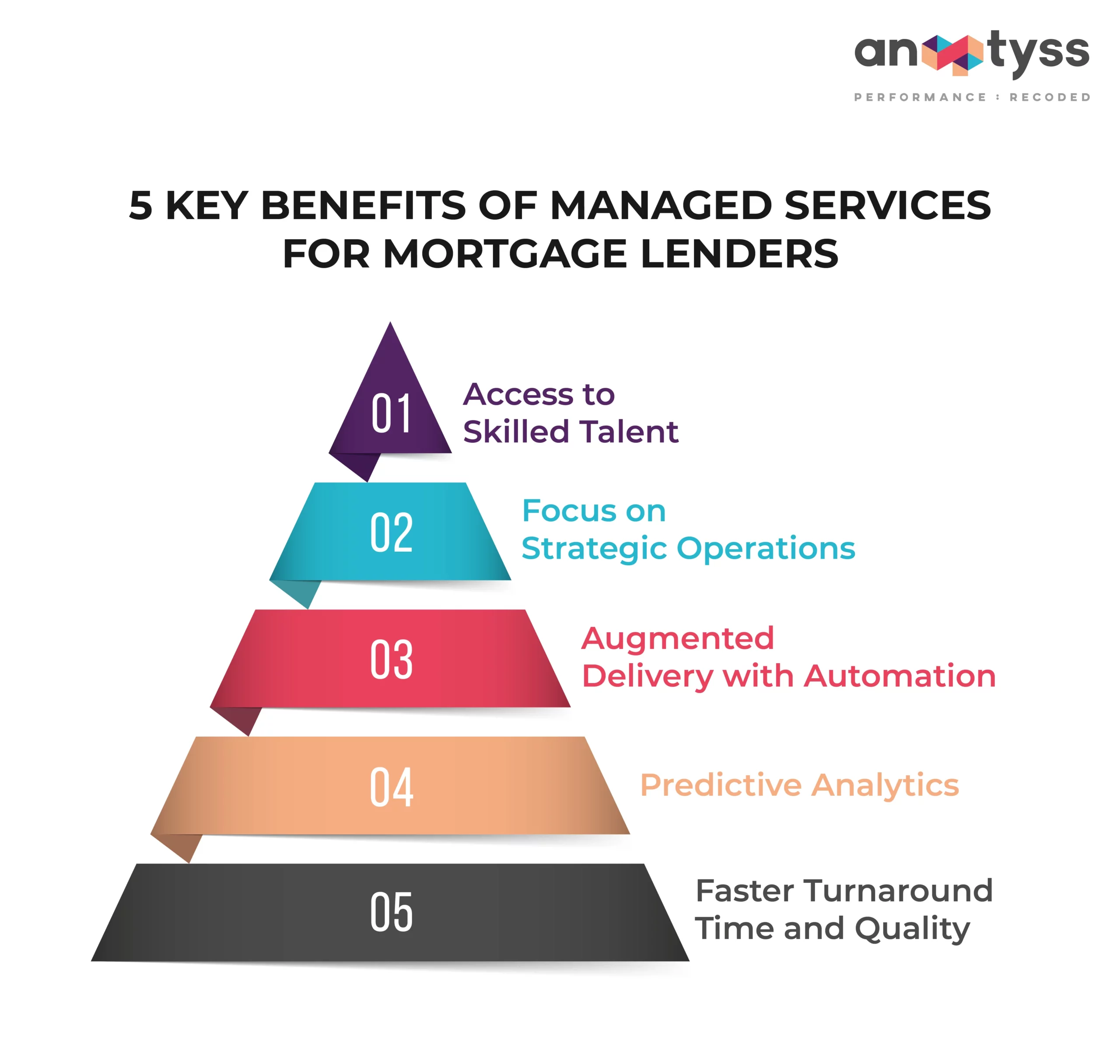
5 Key Benefits of Managed Services

1. Access to skilled talent

Mortgage lending companies face challenges in scaling their talent pool due to fluctuating business requirements based on market demand. With managed services, lenders can access skilled professionals and readily scale up their operations.

2. Focus on strategic operations

Managed services allow mortgage lenders to focus on their core, strategic projects while the tactical/repetitive work is delivered by the service vendor. The model can help lenders increase the value derived from their in-house teams, increasing the talent RoI and profitability.

3. Augmented delivery with automation

A tech-savvy managed services provider can offer mortgage lenders the benefit of process automation by deploying intelligent digital solutions such as Robotic Process Automation (RPA) and intelligent document extraction. Combining human talent with automation can augment overall efficiency and reduce costs due to wasted efforts or slow production.

4. Predictive analytics

Managed service providers with data analytics capability can help mortgage lenders derive insights from the unstructured datasets that hold valuable information about customer preferences, market trends, competition, etc. These insights can allow mortgage companies to arrive at optimal pricing and engage customers by serving personalized experiences.

5. Faster turnaround time and quality

Managed mortgage services can help lenders attain delivery excellence through increased speed-to-market, accuracy, and accountability. Further, they can help lenders improve the overall service quality and customer experience through integrated quality control frameworks.

Managed Services for Mortgage – The Digital Knowledge Operations™ Approach

The Digital Knowledge Operations or DKO™ framework offers managed services and talent solutions to transform the delivery capabilities in the banking and financial services industry. The right-shoring model available with DKO allows mortgage lenders to leverage managed services and deliver services on their preferred shores. Availability of global, scalable talent capital is another major offering with the DKO-based solution approach, which allows lenders to acquire market-ready skills and capacity.

Here’s a case study that outlines the application of the DKO-led managed services model to increase the efficiency and productivity of a US-based mortgage lender. Aside from implementing digital solutions, Anaptyss had implemented a dual-location scalable staffing model to meet the fluctuating demands.

Managing ACH Fraud Monitoring and Investigation Using the Digital Knowledge Operations™ Approach

Automated Clearing House (ACH) frauds are among the most common financial crimes involving the illicit siphoning of money from one account to another. Financial institutions rely on the ACH network for transactions involving direct deposits, checks, cash transfers, and billing, underlining the prevalence of automated clearing. Therefore, the risk occurrences and monetary implications are growing swiftly.

As per the Federal Trade Commission (FTC), customers reported over 2.2 Mn fraud transactions in 2020, with a loss of more than $3.3 Bn. Banks and other financial institutions have to bear a significant cost burden due to ACH fraud if they fail to detect or take timely action on the transactions flagged by consumers and businesses.

Therefore, effective monitoring of accounts is critical to avoid ACH fraud and allow a swift investigation of the reported transactions. Banks also need to gain the agility for faster settlement and recovery.

Digital Knowledge Operations (DKO™): An Overview

Digital Knowledge Operations™ is a proprietary and customizable solutions framework for digitally transforming banking and financial services operations. Its purpose is to enable “realistic” enhancements and improvements in the existing banking operations by combining a thoughtful consultative approach, intelligent digital solutions, and human talent. Here’s an outline of these components:

1. Domain-Centric Consulting

Thoughtful advisory is a key feature of DKO, characterized by a distinct consultative approach to implementing solutions (tools, technology policies, processes, people, etc.). Anaptyss deploys industry experts to audit, liaise, and devise the strategic framework and approach to support the implementation phase for digital transformation.

2. Digital solution implementation

This component focuses on implementing digital solutions across the tools, technology, processes, policies, and other operations aspects. The intelligent digital solutions include Robotic Process Automation (RPA) tools, digital analytics, automated data extraction, indexing, etc. Digitization and Automation are the outcomes of solution implementation.

3. Human talent & business operations

: The DKO™ framework augments the talent capital through staffing, upskilling, and reskilling to support business operations in tandem with process automation. The human capital aspect of DKO translates to distinct solution offerings such as managed services delivery, right-shoring model, and workforce training.

How Does the DKO Approach Help Manage ACH Frauds?

ACH is a complex, process-driven system that needs to rely on human diligence to operate multiple interlinked processes related to aspects like account monitoring, claims investigation, dispute resolution, settlements, etc.

In traditional banking, most of these processes are “manual” and therefore they are bogged down with issues related to efficiency, quality, and accuracy, impacting the cost and compliance metrics.

Another area of concern is inadequate process intelligence to support effective decision-making. For instance, banks may lack a consolidated tracking and reporting system to provide insights into metrics like quality, productivity, accuracy, etc., jeopardizing business goals, including ACH monitoring.

The Digital Knowledge Operations approach focuses on resolving (or alleviating) the issues by targeting the root causes based on processes, practices, tools, technology, and execution capabilities (workforce readiness). The following is an outline of the approach –

1. Process audit and re-engineering

Anaptyss domain consultants facilitate a rigorous assessment of the processes for managing ACH frauds. Further, they re-engineer the processes/process components in collaboration with the client-side subject matter experts.

2. Quality control framework

This aspect focuses on setting up an integrated QC framework to monitor, measure, and calibrate the process execution & quality. Key implementations include audit checklists, root cause analysis, and automated feedback systems.

3. Reporting dashboard

The DKO approach establishes a data-driven and automated reporting dashboard to support the business with real-time insights into performance, deviations, risks, and other critical metrics.

This case study outlines a real-world implementation wherein the Digital Knowledge Operations framework transformed a US-based regional bank’s treasury management operations, including ACH fraud monitoring and investigation. The business impact was significant, including more than a 10% increment in process accuracy and efficiency, a 20% reduction in costs, and real-time business insights.

Deliver Fast and Compliant Mortgage Lending with Digital Knowledge Operations™

The digitized marketplace highlights two striking trends for mortgage lenders viz. the growing customer expectations and the evolving regulatory landscape necessitating more robust measures for meeting compliance.

Digital-savvy borrowers expect faster loan processing, personalized interactions, and hassle-free services. They have multiple options, including traditional banks, specialized lenders, and Fintech offerings, competing on service offerings, experience, and cost. So, mortgage lenders also need to operate cost-effectively to offer competitively priced services to borrowers.

Serving delightful and cost-effective mortgage services boils down to the effective adoption of digital solutions and an agile mindset. Also, while undergoing this systemic change – across tools/infrastructure, processes and policies, and workforce capabilities – lenders need to be mindful of their compliance obligations in the digitized ecosystem.

For example, a lending institution that wants to digitize documents like customers’ financial records and process blueprints must ensure that the records are well-maintained, protected, and updated. Additionally, these digital records should be accurate, accessible, and auditable to meet regulatory guidelines.

Digital Knowledge Operations (DKO™): A Real-World Approach for Transforming Financial Services Operations

Digital Knowledge Operations™ is a customizable solution framework from Anaptyss, which is widely adopted for driving “realistic” digital transformation across the banking and financial services industry. The framework has distinct application areas and use cases in verticals such as mortgage, financial crime, commercial lending, insurance, cards and deposits, wealth and asset management, and others.

It is also known for enabling transformation in critical functional areas such as customer experience, capability development, finance and accounting, and financial technology.

The DKO-based solution approach emphasizes pragmatism and personalized care/attention as standout aspects to enable quantifiable outcomes based on specific business needs. Here are the key components of Digital Knowledge Operations™:

1. Domain-Led Consulting

This element involves a thoughtful and domain-centric consulting approach to identify particular areas such as organizational policy, tools, technology, practices, processes, people, etc., that require digital intervention or operational expertise.

2. Digital solution implementation:

This aspect looks into implementing digital solutions to enhance operational areas like tools, systems, policies, processes, people, etc., to support the transformation goals.

3. Talent capital & managed services:

The DKO framework also provides a scalable talent pool and managed services to support global delivery on the client’s preferred shores through the right-shoring model.

How Does DKO Help Transform Mortgage Operations?

The proprietary framework offers a highly customized and targeted approach for augmenting or transforming specific areas such as manual processes, physical recordkeeping, execution gaps due to lack of capacity or skills, etc. Here’s an outline of some of these specific solutions:

1. Robotic Process Automation (RPA):

DKO facilitates the implementation of intelligent automation tools to streamline the processes for documentation, application evaluation, approval, form fill-ups, etc. RPA tools help reduce manual efforts, costs, and closing time, and can increase the overall efficiency.

2. Document Extraction:

It allows automating processes like document extraction and indexing, KYC, etc., using intelligent document extraction tools that use Optical Character Recognition (OCR) technology.

3. Predictive Analytics

DKO helps lenders reap the benefits of data by enabling the extraction of actionable insights from unstructured data using advanced data analytics tools. Further, mortgage companies can use data-driven insights to predict demand and optimize pricing and promotions to increase origination, retention, revenue, and profits.

4. Digital Learning

With the Digital Knowledge Operations framework, lenders can access fast and industry-recognized digital learning solutions that enable large-scale workforce training and capability development.

5. Quality Control:

The DKO-led digital transformation approach establishes integrated quality control measures to ensure that the services meet customer expectations. End-to-end quality control also mitigates legal risks by helping lenders adhere to the regulatory guidelines.

Read this case study which illustrates the application of DKO to reengineer the business processes of a US-based mortgage lender. The lending institution faced efficiency and productivity issues due to manual processes, paper-based documentation, manual tracking and reporting, and inadequate quality control. Digital Knowledge Operations™ helped transform these areas, resulting in a 15% improvement in the closing cycle, a 20% increment in efficiency, and other business outcomes.

DKO™
Life@Anaptyss
Careers