The financial services landscape is undergoing a profound paradigm shift, fundamentally reshaping how core functions like risk pricing, underwriting, and portfolio management operate. For banking executives, financial analysts, and risk managers, the integration of Artificial Intelligence (AI) is no longer an emerging trend; it is today’s competitive imperative. Financial institutions that successfully integrate AI are moving from reliance on historical metrics to adopting highly granular risk assessment tools to secure a crucial competitive advantage in an increasingly volatile global economy.
This transformation is driven by convergent pressures, such as the need for enhanced operational efficiency, the demand for more personalized risk pricing, and the escalating complexity of systemic risks. While traditional, history-based models have long provided a necessary baseline, their inherent limitations—including slow processing, constrained scalability, and a fundamental blindness to structural market changes—make them inadequate for managing modern risk.
Traditional Risk Models Can’t Keep Up
For decades, risk assessment, particularly in commercial real estate (CRE) lending, has been built on conventional actuarial methodologies or standardized ratios. In lending, processes heavily rely on established financial ratios like the Debt Service Coverage Ratio (DSCR) and Loan-to-Value (LTV) ratios, coupled with manual underwriting based on historical performance.
Traditional methods struggle to incorporate real-time market fluctuations, dynamic transactional behaviors, and complex, non-linear patterns that define true risk today — resulting in:
Slow decision cycles and prolonged underwriting timelines
Limited scalability across high-volume lending portfolios
Weaker predictive power for emerging and systemic risks
Persistent manual workloads that elevate operational costs
Why Banks Are Adopting AI for Risk Management
The adoption of AI and Machine Learning (ML) techniques—including advanced ensemble methods such as Gradient Boosting and Deep Learning—provides banks and financial institutions with dramatically improved accuracy and efficiency.
Faster Decisions & Lower Costs
Operational cost reductions of 20–30% and straight-through processing rates of 80–90% enable loan decisions in minutes instead of days.
Better Use of Data You Already Have
Generative AI and NLP automate the extraction of insight from thousands of pages of documents — like leases and KYC files — with high accuracy.
To maintain reliability and auditability at scale, organizations are adopting robust MLOps governance frameworks.
AI Governance Is Now a Regulatory Priority
Regulators are increasingly scrutinizing automated decision-making in risk and lending. Two areas are top of mind—
Bias & Fair Lending Risk — Algorithms trained on historical patterns can reinforce inequities without strict fairness controls.
Decision Explainability (XAI) — Regulators expect clear explanations for how risk decisions are made, especially those affecting customers.
Financial institutions must embed transparency, human oversight, model validation, and robust control frameworks to align with global compliance expectations. Explore deeper guidance in our white paper on AI/ML model risk management.
The Best Model – AI + Human Expertise
Human judgment remains indispensable. The most effective approach is not replacing people — it’s augmenting them.
AI delivers scale, speed, and complex signal detection. Human underwriters provide contextual understanding, regulatory judgment, and accountability. This balanced model:
Improves confidence in lending decisions
Supports customer experience with faster service
Maintains regulatory and ethical oversight
Conclusion
The deployment of AI-based risk models represents a fundamental and necessary disruption to traditional financial methodologies.
Anaptyss enables banks to adopt explainable, compliant, and scalable AI models.
From underwriting automation to real-time portfolio monitoring and GenAI workflows, we ensure advanced intelligence with human oversight.
The integration of Artificial Intelligence (AI) and Machine Learning (ML) has brought significant changes to credit underwriting. It is enabling financial institutions to shift from fixed, rule-based systems to smarter, predictive models.
This technological shift promises enhanced predictive accuracy, significant operational efficiency gains, and the potential for greater financial inclusion by offering credit to traditionally underserved populations. However, this transition introduces a critical ethical and regulatory challenge known as algorithmic bias.
AI models, when designed without rigorous oversight, risk perpetuating or amplifying historical discrimination, leading to unfair outcomes for applicants based on protected characteristics like race or gender.
For banks and financial institutions operating in the highly regulated US market, complexity and opacity are not a defense against fair lending violations. Federal regulators scrutinize the deployment of AI. Therefore, building ethical AI in lending needs a clear, step-by-step plan that balances high model performance with strong fairness and regulatory compliance.
The Dual Risk of Opaque Models and Inherited Discrimination
To effectively mitigate bias, financial institutions must first understand where it originates and how it manifests within modern credit scoring systems.
1. The Legacy of Historical Bias in Credit Data
The foundational source of bias is the training data itself. AI models learn from historical financial data which reflects decades of economic and social inequities. If the data is biased, the algorithm learns to replicate these discriminatory patterns at scale. For instance,
Training models on historical lending data, which may encode practices like redlining, will cause the AI to associate geography with risk, inadvertently perpetuating discrimination. This is referred to as historical bias.
Similarly, models may show bias if the training data is not representative of the population the model is intended to serve. This is particularly challenging in credit scoring, where millions of borrowers are “credit invisible” or have thin files and are systematically underrepresented in traditional financial records.
2. The Problem of Proxy Variables in AI Credit Scoring
The most insidious form of bias is proxy discrimination. While fair lending laws prohibit the use of protected attributes (like race or gender) directly, AI models are highly adept at identifying seemingly neutral data points that are strongly correlated with those attributes. Simply removing the race or gender column from a dataset is an insufficient action to ensure fairness.
Proxy variables identified in research include factors such as geographic data (e.g., zip codes), behavioral data (e.g., online shopping habits or even text formatting), and Digital footprints (e.g., the type of device used, like iPhone vs. Android).
A key insight from bias auditing is that the model optimizes predictive performance by sometimes exploiting these correlations, indirectly penalizing protected groups.
3. The Black Box Problem
The adoption of sophisticated AI models, such as neural networks or gradient boosting machines (e.g., XGBoost), introduces the “black box” problem. These complex algorithms produce superior accuracy but often lack transparency in explaining how they arrive at a decision. This opacity creates major difficulties for accountability, consumer trust, and—critically—regulatory compliance.
The Three Pillars of Bias Mitigation
Bias mitigation efforts must be integrated across the entire machine learning pipeline, grouped into three strategic categories, pre-processing, in-processing, and post-processing.
1. Pre-Processing to Eliminating Bias at the Data Level
These strategies target bias within the training dataset before the model sees the data.
This technique adjusts the weight assigned to individual samples in the training data to ensure that underrepresented demographic groups are adequately balanced. This aims to align the input data with fairness objectives. This helps improve data quality and representation.
Similarly, leveraging alternative data (such as rental payments, utility bills, or transaction history) provides a more comprehensive view of creditworthiness, especially for those with thin credit files. As a result, it helps promoting inclusion and reducing bias stemming from limited conventional data. However, institutions must use this alternative data with caution and rigorously validate it to ensure new biases are not inadvertently introduced.
2. In-Processing to Build Fairness into Model Training
In-processing methods incorporate fairness metrics directly into the learning objective or algorithm design.
Advanced ML Architecture
To maximize prediction accuracy while maintaining efficiency, advanced algorithms are essential. For example, a US-based commercial lender achieved US$ 400,000 in annualized cost savings after implementing an optimized credit scoring model based on Extreme Gradient Boosting (XGBoost), random forest, and regression analysis. Using such powerful ML techniques requires integrating fairness during model training.
Adversarial Debiasing This advanced technique employs two models training simultaneously, includes a primary predictor and an “adversary” model.
The primary model is penalized if the adversary is able to accurately predict the protected attribute from the primary model’s outputs. This forces the predictor to learn representations that inherently minimize information related to sensitive attributes.
Fairness Constraints and Regularization
This involves modifying the model’s objective function (loss function) to penalize unfair outcomes, thereby inducing an intrinsically fair model.
This often involves applying constraints to maximize accuracy while simultaneously ensuring predetermined fairness metrics (like equal opportunity) are met.
3. Post-Processing to Correct Bias in Model Output
Post-processing involves modifying the model’s final decision outputs to satisfy specific fairness definitions. This method applies different approval or denial thresholds to different demographic groups based on the model’s risk score. This is practical because it is “model-agnostic,” meaning it can be applied to complex black-box models without altering the underlying algorithm, simply by adjusting the final decision cutoffs.
Research shows that such fairness constraints can significantly reduce bias (e.g., DPD reduction from 0.23 to 0.07 in one study) with only minimal performance degradation.
Governance and Compliance: Building Trustworthy AI in the US
Technical mitigation must be paired with robust organizational governance, particularly given the regulatory environment in the US.
1. Explainability (XAI) as a Compliance Pillar
The opacity of AI models poses a direct compliance risk regarding consumer rights. The Equal Credit Opportunity Act (ECOA) and the Fair Credit Reporting Act (FCRA) mandate that creditors must provide clear, specific, and accurate reasons for any adverse credit decision. Complex algorithms or pointing to a “broad bucket” of reasons is not permissible.
Explainable AI (XAI) addresses this by providing transparency into model mechanisms. Additionally, SHAP and LIME values are critical interpretability-enhancing methods that dissect black-box decisions. These tools isolate and rank the most determinative factors contributing to a credit denial, enabling the financial institution to generate the necessary clear rationales required by regulators.
2. Proactive Bias Auditing and Continuous Monitoring
Fairness is not a one-time achievement. It’s a continuous process, which demands continuous diligence. Financial institutions must adopt structured bias auditing protocols covering the entire machine learning lifecycle.
Audits must quantify bias using established metrics such as Demographic Parity Difference (DPD) (which measures equal distribution of outcomes across groups) and Equal Opportunity Difference (EOD) (which compares true positive rates across groups).
US regulators explicitly push creditors to proactively search for and implement Less Discriminatory Alternatives (LDAs) to mitigate disparate impact. Examiners may search for these alternatives if institutions fail to do so.
Effective AI governance also requires interdisciplinary teams composed of data scientists, legal counsel, compliance officers, risk managers, and ethicists to rigorously evaluate models and vet third-party AI systems for compliance risks. Anaptyss successfully completed a project for a US-based commercial lender that required the validation of third-party credit risk scorecards (including FICO, Dun & Bradstreet, Experian, and PayNet) to ensure compliance with prevalent regulatory standards. This validation was achieved 40% faster using machine learning solution, resulting in 100% compliant credit risk models and reduced risk of regulatory penalties.
Conclusion
The wholesale migration to AI-driven credit scoring is inevitable, fueled by the ability of these technologies to analyze vast and diverse datasets, enhance predictive accuracy, and streamline decision-making. However, this future hinges on the financial industry’s commitment to prioritizing fairness and ethical accountability.
Anaptyss delivers managed services that combine regulatory compliance and risk management with advanced AI and machine learning for banks and financial institutions. We help co-create, deploy, and monitor AI credit scoring models that meet strict US Fair Lending standards, ensuring Explainable AI (XAI) readiness and continuous bias auditing.
Our success stories demonstrate our ability to deliver highly accurate predictive models that explicitly include the provision of objective rationale for credit decisions and advocacy of Explainable AI (XAI). Furthermore, we specialize in the independent validation and auditing of complex models for regulatory compliance and demographic bias, helping clients achieve 100% compliant credit risk models.
The current economic climate is putting significant pressure on lenders. Reports from S&P and TransUnion show that auto loan delinquencies have surged to their highest levels since the 2008 recession. While this trend is most evident in the auto lending sector, it signals emerging vulnerabilities across the broader credit market. This also highlights the need to strengthen risk models across all lending portfolios.
In this volatile environment, traditional risk assessment methods, which rely heavily on static factors like credit scores and income history, are proving to be reactive and inadequate. They are good at telling you “where a borrower has been”, but offer little insight into “where they are headed.”
In this blog, we explore five impactful ways predictive analytics and AI are transforming loan portfolio management and how they are helping lenders anticipate risk, enhance decision-making, and build more resilient portfolios.
1. Continuous Loan Monitoring to Close the Risk Visibility Gap
The traditional lending lifecycle places immense focus on risk assessment at the point of origination. But once a loan is disbursed, many lenders shift their attention to servicing and collections, effectively losing visibility into the borrower’s evolving financial health.
This creates a critical blind spot.
Post-funding cash flow analytics closes this gap. By continuously monitoring transactional data, predictive models can detect subtle but significant early warning signs of distress, such as,
Erratic cash flow patterns, which may signal a shift from stable W-2 employment to less predictable gig work.
Income instability or sudden drops in account balances, which could indicate a major, unplanned expense like a medical emergency, putting immediate pressure on repayment capacity.
Irregular payment behaviors on other credit lines.
This shift to continuous monitoring moves you from reacting to defaults to proactively shaping portfolio outcomes. Instead of scrambling after a delinquency occurs, you can identify financial stress as it develops, surface renewal opportunities with healthy borrowers, and mitigate risk long before an account is in jeopardy.
2. Using Behavioral and Alternative Data for Smarter Lending Decisions
While traditional credit scores remain a foundational element of underwriting, they are static, often outdated snapshots of a borrower’s past. Predictive analytics creates a far more dynamic and complete picture by incorporating a vast array of modern, alternative data sources that reflect a borrower’s real-time behavior.
This isn’t just about more data; it’s about smarter data. App usage, for example, can differentiate between a borrower using a budgeting app (a positive signal) and one frequenting online gambling sites (a critical risk indicator). A predictive model can analyze shifts in spending patterns, drops in account balances, or changes in digital engagement to get a current, forward-looking view of creditworthiness.
This approach is powered by more sophisticated machine learning-based credit risk scoring models. Studies have shown that algorithms like Random Forest, XGBoost, and neural networks are significantly better at predicting defaults than traditional logistic regression. In fact, research demonstrates that artificial neural networks can improve default prediction rates by as much as 20% over classical methods.
3. Building Transparency and Compliance into Predictive Risk Models
As predictive models become more complex, they can also become more opaque. Advanced algorithms like deep neural networks can function as a “black box,” making it nearly impossible to understand why a specific decision was made. For a bank or lending institution, this inscrutability is not just a technical issue—it’s a major business and compliance liability. Imagine a regulator asking why a loan application from a protected class was denied. A “black box” model offers no defensible answer, creating significant legal and reputational risk.
Because of this, modern lenders must invest in “explainable AI” (XAI). Tools like SHAP (SHapley Additive exPlanations) and LIME (Local Interpretable Model-agnostic Explanations) are designed to improve model risk management, providing clear insights into which factors influenced a particular outcome.
In a highly regulated industry, a transparent and explainable model is often far more valuable than a slightly more accurate but completely opaque one.
4. Predictive Analytics for Loan Default Prevention
The primary goal of predicting delinquency is not to flag an account for aggressive collections. The more effective modern strategy is to use early warning signals to engage with at-risk borrowers preemptively and constructively.
Instead of waiting for a borrower to default, predictive insights enable lenders to offer timely support and solutions. These proactive interventions can include:
Offering flexible repayment plans or loan modifications.
Providing financial education resources or information on credit counseling services.
Initiating personalized, supportive communication to understand the borrower’s situation and help.
This preventative approach is not merely theoretical. Consider a practical application, such as one regional bank used a data analytics solution to achieve 93% accurate prediction of vulnerable small business borrowers. By preemptively restructuring these loans, the bank avoided defaults and achieved a notable reduction in critical loans within six months. This approach reduces defaults, strengthens portfolio performance, and fosters more resilient, trust-based relationships with borrowers.
5. The ROI of AI in Loan Risk Management from Real-World
While “AI” can sometimes sound like a speculative buzzword, its application in credit risk management delivers measurable, bottom-line returns. Leading financial institutions are already achieving significant gains in both efficiency and accuracy by deploying predictive analytics.
Here are a few data-backed examples:
These efficiency gains are a recurring theme. As one report highlights, the operational benefits are substantial:
Bank / Institution
AI Application Area
Key Outcomes / Metrics
ROI or Business Impact
HSBC
Anti-Money Laundering (AML)
• 2–4× more true positives
• ~60% reduction in alert volumes
Improved detection accuracy and reduced compliance workload
Danske Bank
Fraud Detection
• ~60% fewer false positives
• +50% increase in true-fraud detection
Stronger fraud defense and more efficient investigations
J.P. Morgan
Cash-Flow Forecasting
• ~50% reduction in manual work
• ~$100K annual savings in treasury operations
Increased automation efficiency and cost savings
BBVA
Loan Delinquency Prediction & Remediation
• Predicts delinquency risk
• Tailors recovery strategies using machine learning
Optimized risk management and improved recovery outcomes
These cases prove that investing in predictive analytics is a proven strategy for reducing operational costs, improving the precision of risk management, and driving tangible financial results.
Conclusion
Risk management is no longer a static, front-end decision but a continuous, dynamic process that relies on both historical scores and real-time behavioral data. As predictive analytics becomes the new industry standard, the question for lenders is shifting from if they will adopt these tools to how they will implement them to stay competitive.
Anaptyss empowers financial institutions to embrace this transformation through data-driven, AI-powered risk management solutions that enhance accuracy, agility, and compliance.
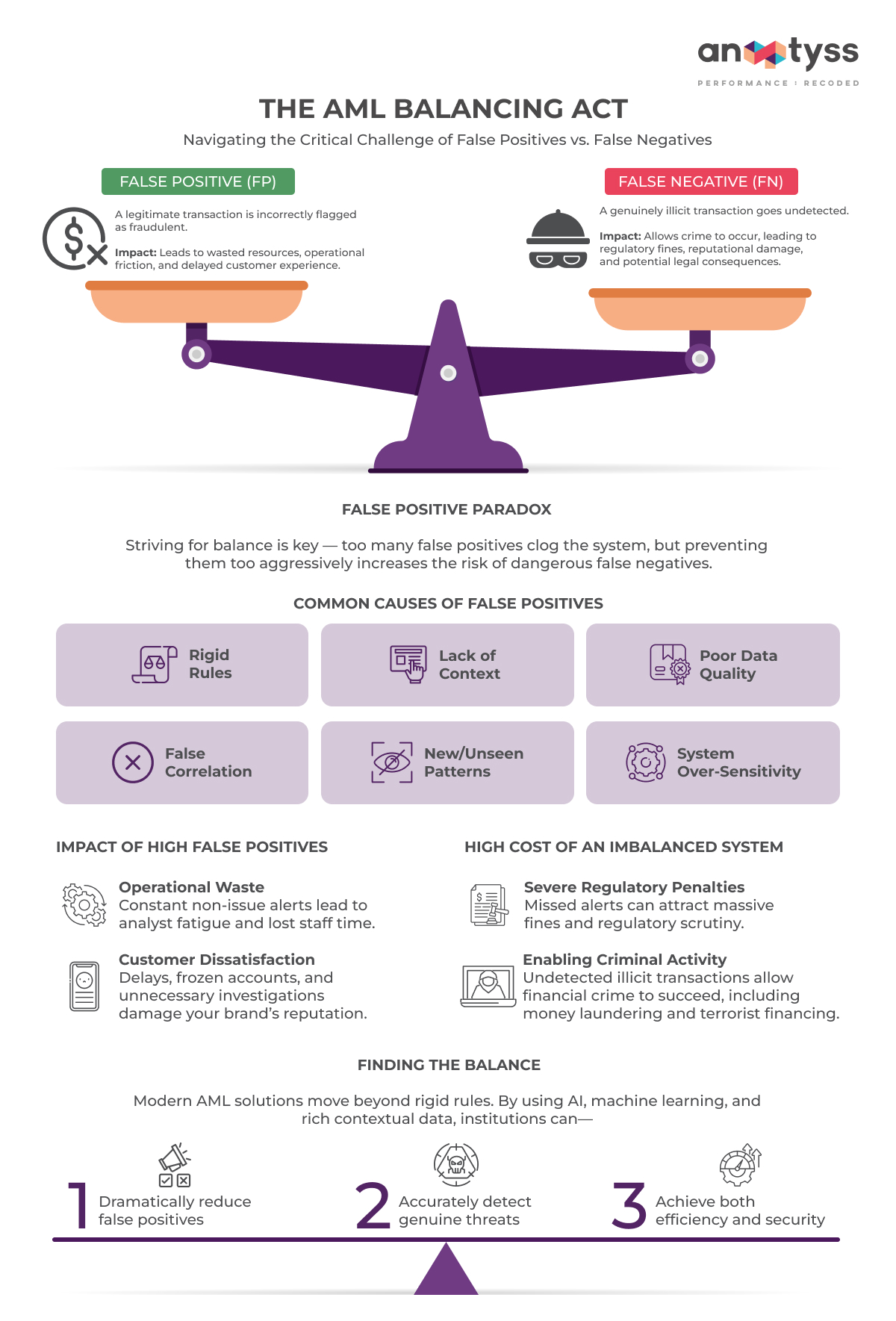
Transaction Monitoring (TM) is critical element of Anti-Money Laundering (AML) compliance and fraud prevention for banks and financial institutions. As the volume and complexity of financial transactions continue to grow, monitoring and identifying suspicious activity becomes increasingly challenging. While automation is essential for maintaining the integrity of transaction systems, it often comes at the cost of generating numerous false positives (FPs).
A false positive occurs when a legitimate financial transaction is mistakenly flagged as suspicious or fraudulent by the AML system. Industry estimates suggest that false positives can account for over 95% of AML alerts. This overwhelming volume of noise obscures truly suspicious activity, creating significant operational and regulatory burdens for compliance teams.
For financial institutions, reducing false positives is not merely a technical adjustment but a strategic imperative that reshapes monitoring standards, enhances customer experience, and ensures alignment with evolving regulatory expectations. High false-positive rates lead to immense costs due to manual reviews, damage customer relationships, and divert essential resources away from genuine threats.
In this blog, we have shared the three proven strategies that banks and financial institutions can implement to significantly reduce false positives and improve both operational efficiency and the effectiveness when it comes to their compliance programs.
The False Positive Crisis — Causes, Consequences, and Strategies
In the context of AML, it is essential to distinguish between the two types of monitoring errors.
1. Deploying Advanced AI and Machine Learning Models
The most effective way to modernize transaction monitoring and drastically reduce false positives is by leveraging advanced analytics tools such as machine learning (ML) and artificial intelligence (AI). This shifts monitoring from a priori rules to proactive and predictive methods.
a. Enhanced Detection Accuracy
AI and ML algorithms can identify and flag suspicious transactions more accurately and efficiently than traditional rules-based systems. AI learns from past transaction data to distinguish effectively between legitimate and suspicious activities.
Instead of just flagging a transaction for reaching a preset threshold, AI solutions can correctly detect complicated patterns and behaviors that signal abnormal activity.
Also, unlike static rule-based systems that require periodic manual updates, AI updates data in real-time, making constant adjustments based on changing behavioral patterns and new risks. This continuous learning process helps reduce redundant alerts and improves decision accuracy over time.
b. Predictive Analytics and Alert Prioritization
AI significantly enhances alert management by moving the demand for incident response to machine learning systems rather than human teams.
Predictive scoring prioritizes high-risk alerts for immediate investigation while lower-risk alerts (those likely to be false positives) can be monitored more passively or “hibernated”. This allows compliance teams to focus their resources on genuine threats.
By analyzing transaction patterns more accurately, AI-driven solutions significantly reduce the volume of false alerts, allowing compliance teams to spend their time, energy, and resources managing the difficult work of investigating and mitigating actual financial crime.
c. Workflow Optimization and Automation
AI systems streamline compliance processes by automating routine tasks, such as generating Suspicious Activity Reports (SARs). Specialized Generative AI tools can even draft concise, accurate, and compliant SAR narratives, significantly reducing SAR completion time and minimizing human error.
AI tools also assist investigators by providing clear alert summaries and suggesting key evidential findings, guiding the investigator on next steps. Centralized operations command systems enable high-quality investigations and maximum efficiency.
2. Adopting Risk-Based Monitoring and Granular Segmentation
Moving away from the “one-size-fits-all” approach of rigid rules to a sophisticated risk-based approach is essential for reducing false positives and achieving healthier alert rates. This strategy focuses resources on high-risk customers and transactions.
Customer Risk Assessment
By assessing the risk profile of each customer (considering factors like business nature, location, and transaction history), financial institutions can determine the appropriate level of monitoring required for their transactions. This ensures that transaction monitoring efforts are targeted and effective, reducing false positives.
Refining Rules and Thresholds
RBA allows institutions to tailor monitoring scenarios to their specific risk profiles, rather than relying on generic, inflexible rules. Institutions must regularly review and adjust alert thresholds based on performance data to maintain a balance between specificity and sensitivity. Testing new rules in a sandbox environment helps evaluate their impact on false positive rates before deployment.
b. Dynamic Risk Scoring and Segmentation
Effective RBA relies on dynamically assessing risk, ensuring that monitoring rules reflect the customer’s actual behavior.
A dynamic risk scoring engine assesses risk based on both onboarding and behavioral risk factors. This score should be continuously updated with new data to maintain accuracy and reduce misidentifications.
Similarly, poor segmentation, which reduces granularity in defining parties and their associated risks, is a cause of increased false positives. Implementing segmentation allows institutions to group customers based on specific traits and behaviors, refining monitoring systems to better understand customer context.
3. Ensuring Data Quality and Contextual Intelligence
Transaction monitoring is effective only when based on accurate and comprehensive data. Addressing data quality issues and enhancing the system’s ability to understand the context of transactions are foundational steps in FP reduction.
a. Improving Data Quality
Poor data quality is recognized as one of the leading causes of false positives.
1. Data Validation and Cleansing Financial institutions should implement data quality controls, such as data validation and cleansing processes.
Data governance frameworks are necessary to ensure that data is collected, stored, and processed consistently across the organization.
2. Data Structuring
Proper organization of collated data is critical. For example, structuring customer names as first, middle, last names, and titles provides more definition to individual identities, reducing false matches with individuals on sanctions lists due to false correlation.
b. Leveraging Contextual Intelligence
Modern monitoring must go beyond simple transactional data and incorporate richer contextual signals.
For instance, behavioral analytics examines patterns in user interactions, such as login times, navigation paths, and transaction habits. This helps distinguish between normal and suspicious activities. This approach identifies a legitimate user based on their typical behavior, reducing the likelihood of false alarms when transactions deviate slightly from the norm.
Comprehensive solutions integrate data from multiple systems to create a complete view of a customer’s behavior. This includes—
Know Your Customer (KYC) data
Transactional records
External data sources
This approach provides an accurate risk assessment, preventing routine transactions from being incorrectly flagged by keeping the risk profiles continuously updated.
Additionally, layering in signals like email age, IP risk, device setup, and social presence helps institutions better contextualize transactions.
This digital footprint analysis screens out benign anomalies before they trigger alerts, providing a broader view for more accurate risk assessments and fewer false flags.
Conclusion
Addressing false positives is a critical component for banks and financial institutions to ensure compliance, mitigate financial crime, and protect customer relationships. By modernizing AML compliance around false positive reduction, financial institutions can move from resource-intensive manual processes to highly efficient, data-driven systems.
A technology modernization strategy is necessary to tackle high volumes of false positive alerts. However, successfully deploying and fine-tuning these advanced systems requires deep domain expertise in financial crime, risk management, and regulatory compliance. Anaptyss understands that AML processes must be subject to continuous monitoring and improvement. By providing expert advice and ensuring detection logic is regularly audited and recalibrated, Anaptyss helps institutions keep pace with changing customer behavior and evolving money laundering tactics.
Traditional Model Risk Management (MRM) frameworks, while essential, possess a critical vulnerability. They operate on the visible 10-20% of structured data and therefore, cannot detect systemic, cross-portfolio risks concealed within the overwhelming volume of unstructured data and documentation. It is estimated that 80% all enterprise data in the financial industry is unstructured in the form of emails, reports, documents, etc.
No matter how diligent a team is, they can only process a fraction of this information. More importantly, it’s challenging for them to connect disparate pieces of information spread across different business lines and geographies, which can lead to blind spots.
For instance, a data vendor weakness, a recurring assumption flaw—are often treated in isolation. While they may seem like minor issues, these deeply embedded, systemic flaws can silently grow into significant enterprise-level threats. Global financial institutions faced $6.6 billion in fines in 2023 for non-compliance with AML, KYC, and sanctions regulations. This underscores the high stakes of missing systemic flaws.
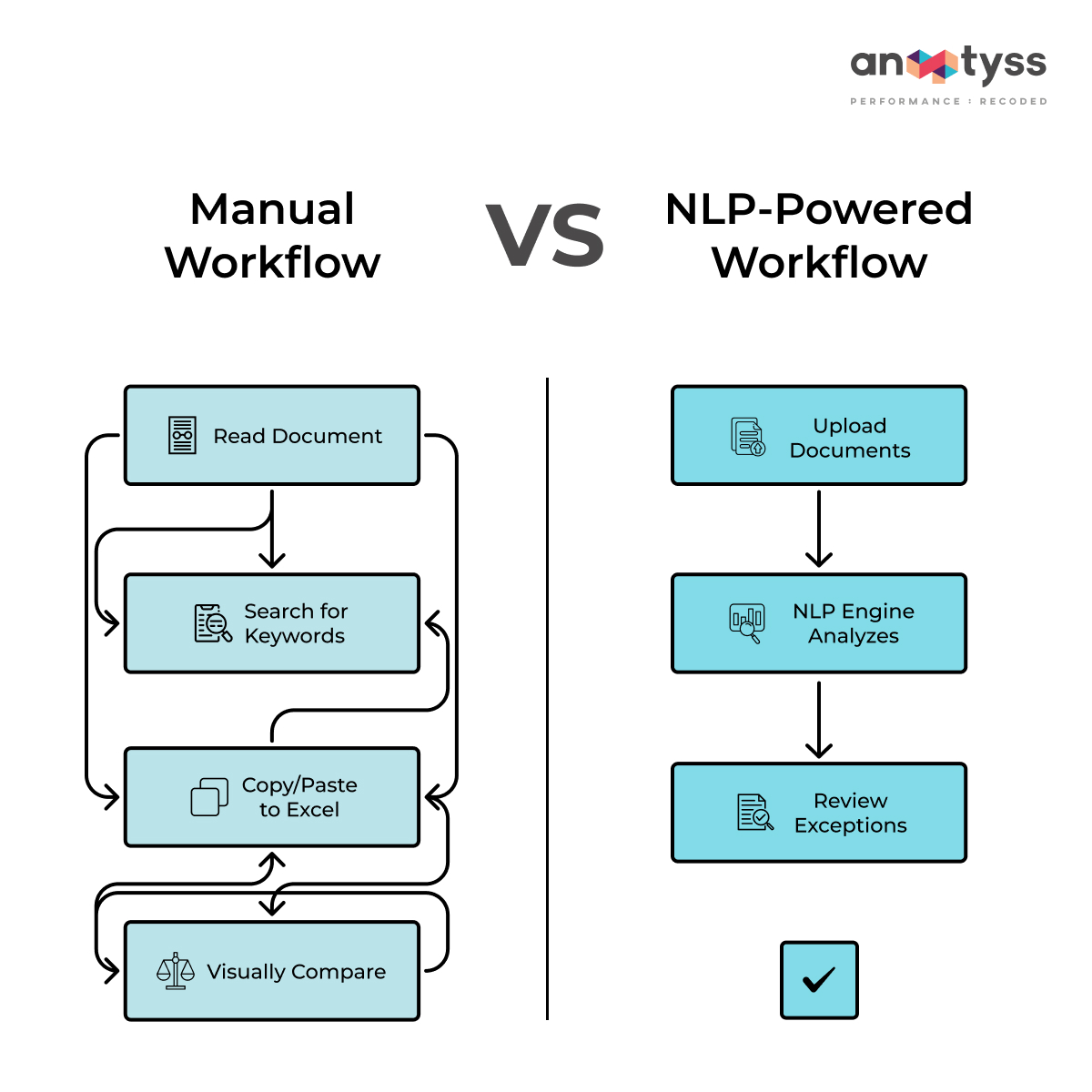
This is where role of Natural Language Processing (NLP) emerges. In this blog, we discussed how Natural Language Processing (NLP) provides a necessary layer of intelligence, enabling a shift from reactive, siloed oversight to proactive, strategic governance.
From Isolated Findings to Enterprise-Wide Threats
Consider a common governance blind spot.
A validation report for a credit card model notes a minor data quality issue from a specific third-party vendor.
Separately, an auto loan model validation flags a data gap from the same vendor.
In a third business line, a small business lending model’s documentation mentions a weakness in an assumption based on this vendor’s data.
Individually, each finding is a low-priority footnote. For a human analyst focused on a single model, it is easily dismissed.
However, when aggregated by an NLP engine, these insignificant notes reveal an alarming pattern—a systemic, enterprise-wide dependency on an underperforming vendor. This is not a failure of individual diligence, but a systemic limitation of manual review. For senior leadership, it represents an unacceptable and previously invisible risk.
NLP-powered thematic analysis is designed to unearth precisely these hidden risks. By structuring the unstructured text from thousands of reports, it enables a holistic, enterprise-level view. It identifies recurring themes and connections that are invisible at the individual document level and helps transform the function from task automation to strategic risk detection.
A New Paradigm for Enterprise Risk Management
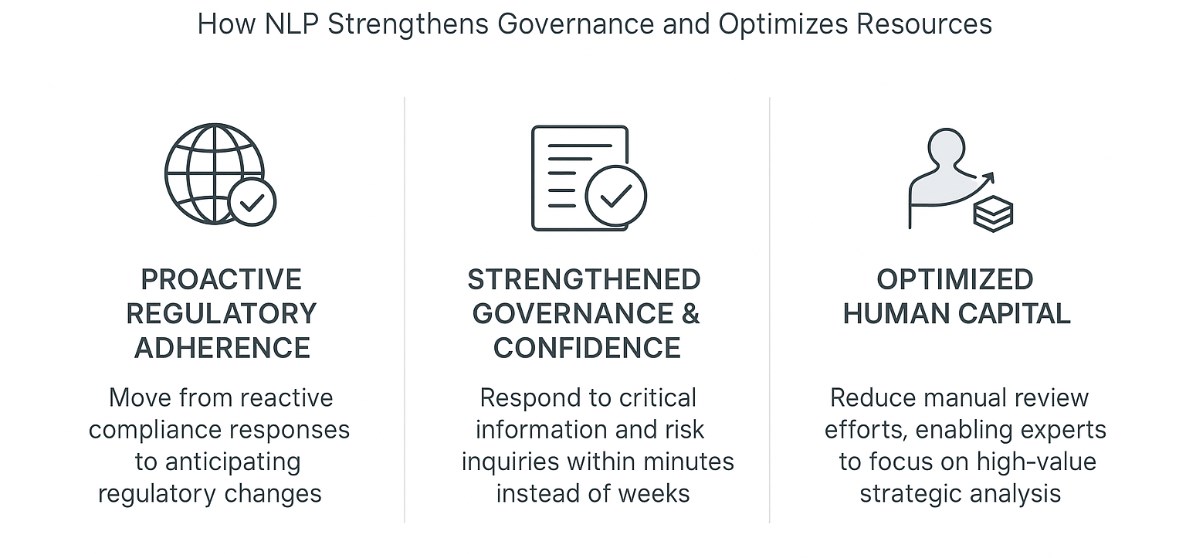
The application of NLP provides a new level of portfolio-wide intelligence that strengthens governance and optimizes resources.
Proactive Regulatory Adherence An NLP-powered intelligence system provides early warnings by continuously monitoring global regulatory updates and enforcement actions. This allows the institution to anticipate and strategically prepare for shifts in compliance obligations, rather than reacting to them.
Strengthening Board and Regulatory Confidence Automated, data-driven governance provides objective evidence of robust oversight. It equips leadership to answer inquiries from the board or regulators with verifiable data instantly. Questions regarding cross-portfolio bias testing in high-risk AI models, for example, can be addressed in minutes, demonstrating a superior level of control.
Optimizing High-Value Human Capital By automating the rote aspects of documentation review, NLP liberates expert resources—quantitative analysts and senior risk managers—from low-value tasks. This reallocation of capital allows them to focus on strategic priorities, such as exercising “effective challenge” on critical models and advising the business on risk-adjusted growth.
From Reactive Controls to Predictive Governance
The ultimate goal of leveraging NLP is to evolve beyond reactive compliance and build a predictive, strategic governance framework. This means moving from a defensive posture to one of foresight and proactive risk management. The structured intelligence extracted by NLP can be seamlessly integrated into existing Governance, Risk, and Compliance (GRC) platforms and executive dashboards. This provides senior leaders with a dynamic, real-time, and aggregated view of the enterprise model risk landscape, complete with trend analysis and automated alerts.
These principles are not merely theoretical. In practice, leveraging AI and NLP for risk oversight yields significant, quantifiable results. For instance, by applying machine learning to the validation of third-party credit risk models, Anaptyss empowered a regional bank to achieve a 40% faster validation lifecycle, while another client realized over $400,000 in annual savings by deploying an ML-based credit risk model. These outcomes demonstrate the tangible value of moving beyond manual, document-centric reviews to an intelligent, data-driven approach.
At Anaptyss, we understand that mastering your data is the key to mastering risk. Our solutions, powered by our proprietary DKO™ (Digital Knowledge Operations) framework, integrate AI-powered technologies like NLP with deep-domain consulting. We empower financial institutions to move beyond the limitations of traditional MRM and unlock a new level of portfolio-wide risk intelligence. To explore this subject in greater detail and learn how to apply these principles in your own institution, download our exclusive white paper.
Commercial lending is inherently complex— involving multiple stakeholders, complex documentation, risk evaluations, regulatory oversight, and ongoing portfolio monitoring. Many regional and community banks still rely on high manual workloads, paper‑based steps, fragmented/siloed systems, and repetitive checks, which slow decision cycles, increase costs, and frustrate borrowers.
According to a recent BCG report, standardizing and simplifying processes can unlock up to 30% gains in efficiency in corporate lending operations. A joint Nasdaq-BCG study estimates that banks could free up USD $25–$50 billion annually by reducing complexity in compliance and operations.
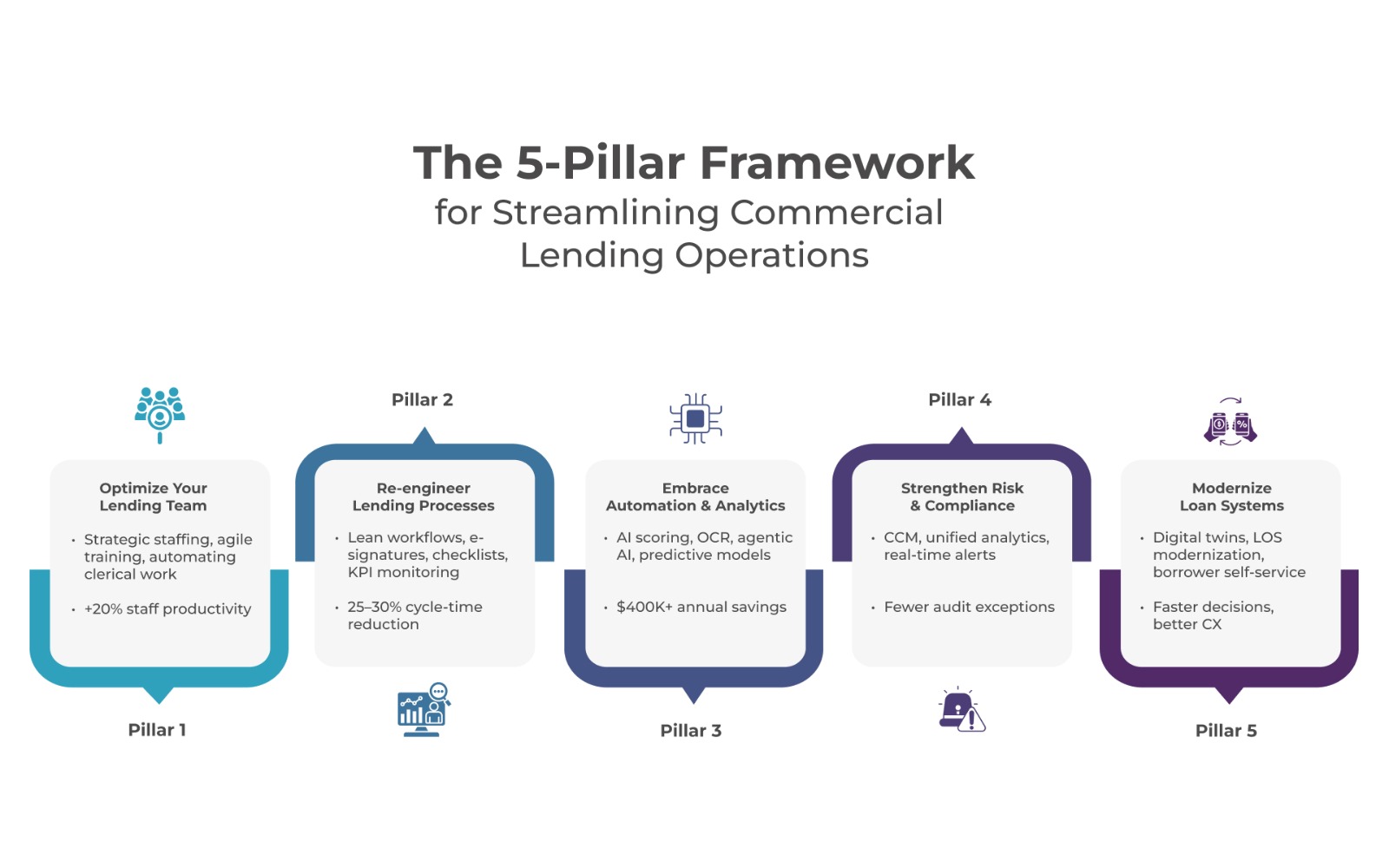
In this blog, we outline five strategies that banks and lending institutions can adopt to streamline their lending operations and meet borrower expectations for speed and transparency.
1. Optimize Your Lending Team (Staffing & Training)
Misaligned staffing models—from duplicated roles to fragmented handoffs—are a major drag on throughput.
Start by evaluating your current workforce against future needs. Conduct a skills inventory and identify critical positions, e.g. relationship managers, commercial lenders, credit analysts, underwriters, compliance officers and operations staff. A well-designed staffing plan anticipates loan volume trends and regulatory demands, ensuring the right mix of expertise is in place.
It’s also crucial to build agile training programs to close skill gaps. For example, use digital learning platforms to provide workforce training where it’s needed most. Online modules, mentoring and cross‑training can make staff more productive (and satisfied) in new roles.
In today’s market, many banks hire candidates with a “growth mindset” – people eager to learn – and train them internally, rather than insisting on years of experience. Robust in‑house development helps retain talent and creates a culture of continuous improvement.
Further, it’s equally critical to free the team to focus on value‑add and strategic tasks by automating or outsourcing mundane or routine work. For instance, banks report that loan officers often spend ~30% of their time on clerical tasks like gathering financial statements and data entry. Mapping out and eliminating these “paper jams” allows officers to spend more time on client relationships and credit analysis. This not only speeds origination but also helps recruit and retain bankers – employees are likelier to stay when they feel their work is meaningful and productive.
2. Re-engineer Lending Processes with Lean Design
Complex, nonstandard paths and many decision touchpoints cause bottlenecks. BCG highlights that applying standardization and “fast lanes” (by risk or size) can deliver up to 20%-30% process gains.
Document every step of the lending process (from application intake through underwriting, approval and funding) to spot bottlenecks. Whiteboarding or flowcharting reveals where paper, hand‑offs or delays occur. Once mapped, set firm standards.
For example, use checklists for required documents and define clear hand-off points between teams.
Also, adopt continuous improvement methods to remove waste. Focus on activities that add value (such as thorough borrower analysis) and eliminate unnecessary steps. Use simple metrics (cycle times, approval rates, error rates) to measure each stage. By regularly reviewing these metrics, managers can pinpoint delays (e.g. slow credit committee decisions) and take corrective action.
Similarly, it’s also important to replace manual processes with digital ones – whenever possible. For example,
Shift from paper applications and physical file rooms to a centralized loan‑origination system that routes tasks automatically.
Electronic checklists and auto‑generated documents ensure consistency.
Embedding e‑signature for agreements and automated funding disbursements can cut days from the closing process.
3. Adopt and Leverage Automation and Advanced Analytics
Data-driven lending is no longer optional. Banks that leverage predictive analytics, sentiment modeling, and behavioral scoring can better evaluate borrower risk, anticipate defaults, and tailor credit structures.
According to AI adoption studies, banks implementing AI in commercial lending may realize productivity gains of 20–60%.
In our success story on ML-based credit risk scoring, a regional bank achieved over $400K annual savings by adopting machine learning models that improved credit accuracy and reduced manual rework. Use data to tailor lending solutions and communication. Advanced analytics can suggest optimal loan structures or cross-sale opportunities based on customer profiles. By making data backed recommendations, bankers can enhance client relationships and close deals more efficiently.
Other use cases includes –
Intelligent document capture / OCR to Auto-extract financials and reports from scanned documents, cross-check consistency, reduce data entry.
Decision support + scoring engines by using predictive models to flag credit risk anomalies, generate summary insights, or estimate pricing.
Agentic AI & workflow agents that act autonomously within guardrails for routine credit tasks (e.g., reviewing covenants). Insights from Reimagining Banking Functions with Generative and Agentic AI demonstrate how emerging technologies can elevate credit operations and customer experience.
4. Strengthen Compliance and Operational Risk Controls
In the current regulatory climate, effective lending operations require robust control frameworks, continuous monitoring, and risk-based oversight. Banks can adopt continuous controls monitoring (CCM) frameworks to detect anomalies in real-time and ensure consistent compliance. Our white paper on Continuous Controls Monitoring in Banking explains how automation-driven monitoring helps institutions mitigate cybersecurity, compliance, and operational risks while maintaining transparency.
Break down silos so that all loan data (applicant info, collateral values, credit decisions, repayments) flows into one analytics platform. With integrated data, it becomes easier for the banks to track key metrics, such as turnaround times, pipeline volume, loss rates and spot trends early — for example, a rise in loan defaults in a particular industry.
5. Modernize Loan Systems with Emerging Technologies
The future of commercial lending lies in integrating AI, digital twins, and intelligent process automation to create adaptive, insight-driven ecosystems. From document intelligence that auto-classifies borrower data to agentic AI that simulates credit risk outcomes, these technologies are transforming how loans are processed and monitored.
Empower customers with online capabilities. Let them upload financial statements via secure portals, sign documents electronically, and even initiate collateral checks or appraisal orders digitally. Digital platforms can automatically notify clients when documents are received or a deal advances to credit review.
But remember the most important element – human touchpoints. Identify critical moments for human contact. For example, automate routine renewals but schedule a check‑in call for larger loans. Personalizing critical interactions (credit pulls, committee briefings, loan closings) can build trust. In practice, some lenders are training loan officers to act more like financial advisors – using the time saved by automation to offer deeper strategic advice on borrowers’ needs.
Conclusion
By combining these strategies – a well‑trained team, lean processes, smart tech and rich data – banks can dramatically speed up commercial lending while controlling risk.
At Anaptyss, we partner with financial institutions to architect end-to-end, domain-led transformations in credit, lending, risk, and operations. Our frameworks and accelerators deliver measurable impact across efficiency, cost, and control.
Lending is the principal business activity for most banks. Their loan portfolio is the largest asset and predominant source of revenue. At the same time, it is also the single greatest source of risk to a bank or lending institutions’ safety and soundness.
Historically, weak credit standards, poor monitoring, and inadequate portfolio management have been the central drivers of bank losses and failures.
Nowadays, this challenge has become even more acute. For instance, Banks and lending institutions are experiencing a convergence of economic volatility, fluctuating interest rates, competitive pressures, and intensifying regulatory expectations. As a result, traditional portfolio monitoring methods—such as delinquency rates and non-accrual trends—are proving to be insufficient and lagging. By the time they flag distress, the window for effective corrective action is often gone.
At the same time, the risk landscape has expanded. Beyond pure credit risk, institutions must contend with operational risk, compliance challenges, legal exposure, reputational pressures, and emerging enterprise risks that directly shape portfolio outcomes. Climate risk, for example, is increasingly factored into expected credit losses as extreme weather events and transitional policies reshape borrower performance. As discussed in one of our previous blogs on ERM benefits for banks, this shift demands governance that is not reactive but proactive and strategic.
In this blog, we discuss how Risk & Control Self-Assessment (RCSA) can help banks and lending institutions move beyond compliance and build proactive, strategic loan portfolio governance frameworks.
The Role of RCSA in Strengthening Loan Portfolio Governance
Risk & Control Self-Assessment is a structured, organization-wide process for identifying, assessing, and mitigating risks and controls. It’s the “Self-Assessment” element that makes it transformative as it empowers the first line of defense (the core business teams) to own the evaluation of their risks and controls.
Thus, RCSA helps create both a cultural and strategic pivot:
Business units move beyond compliance to proactively safeguard performance and resilience.
Risk management shifts from audit-driven snapshots to continuous discipline embedded in daily operations.
Findings highlight the most material risks affecting strategic objectives and external business conditions.
Over time, RCSA embeds risk awareness across the enterprise, strengthening governance, risk culture, and board-level oversight.
An effective RCSA program fosters accountability and transparency. It builds a two-way feedback loop where the institution’s strategy and risk appetite shape the scope of assessments, and the assessments themselves inform future strategy.
Applying RCSA Across the Loan Lifecycle
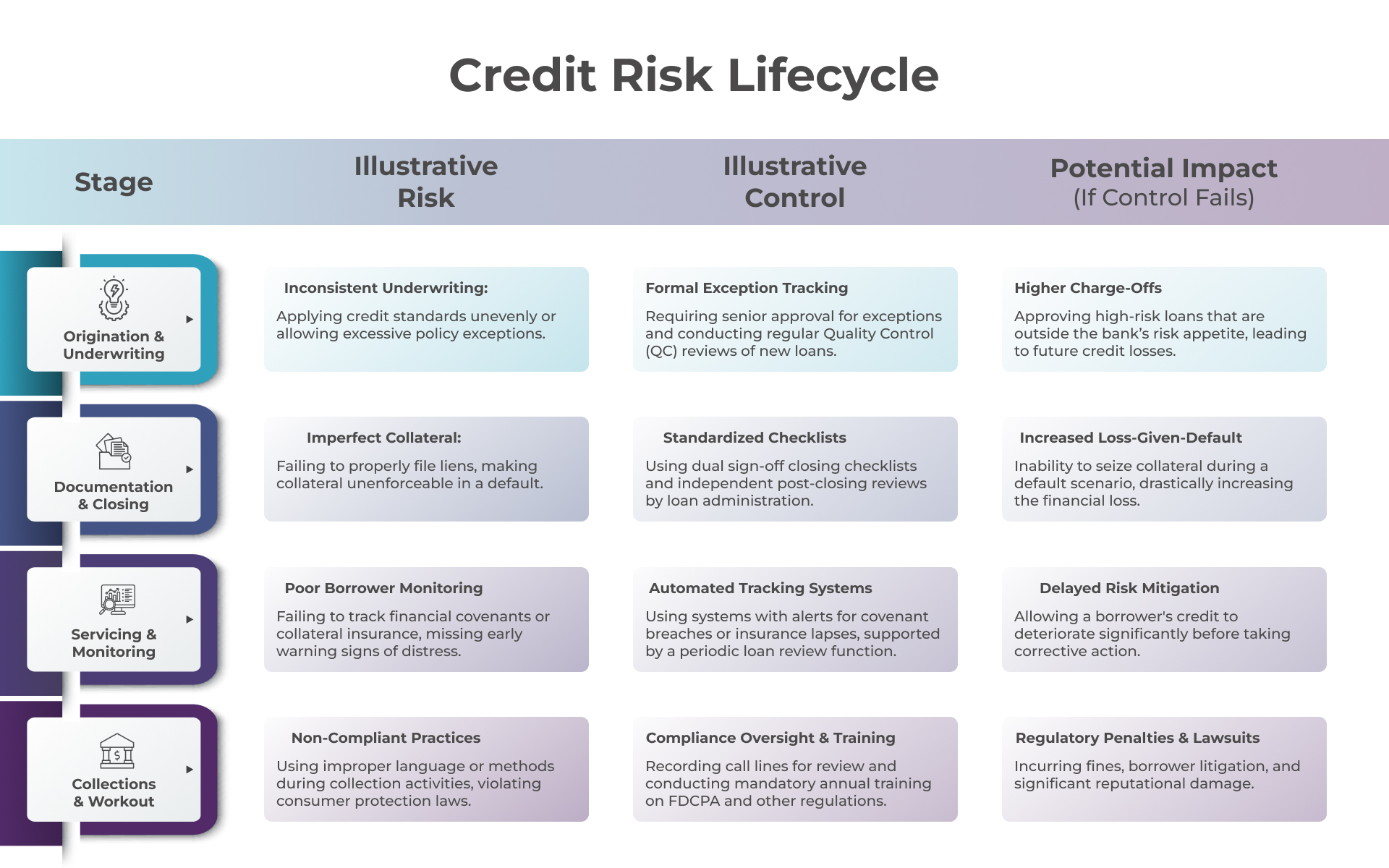
The power of RCSA lies in its application to specific processes within the loan lifecycle. By systematically mapping risks and controls across origination, documentation, servicing, and collections, institutions can expose operational blind spots that often manifest as credit losses.By embedding RCSA into these processes, institutions can shift from treating operational failures as isolated breakdowns to recognizing them as direct contributors to portfolio losses.
Operationalizing RCSA for Effective Governance
For RCSA to deliver real impact, it must move beyond a checklist exercise. An effective program is anchored in the three lines of defense model—a framework we explored in detail in our blog on the Three Lines of Defense in Risk Management.
First Line (Lending, Servicing, Collections)
These are the owners of risks and controls. They perform self-assessments, identify control gaps, and implement action plans to remediate weaknesses. Their role ensures that risk accountability begins at the source of activity.
Second Line (Risk Management, Compliance) This layer designs and maintains the RCSA framework, develops tools and training, provides oversight, and independently challenges the first line’s assessments.
Third Line (Internal Audit) Provides independent assurance to the board that the RCSA framework itself is well-designed, consistently applied, and effective.
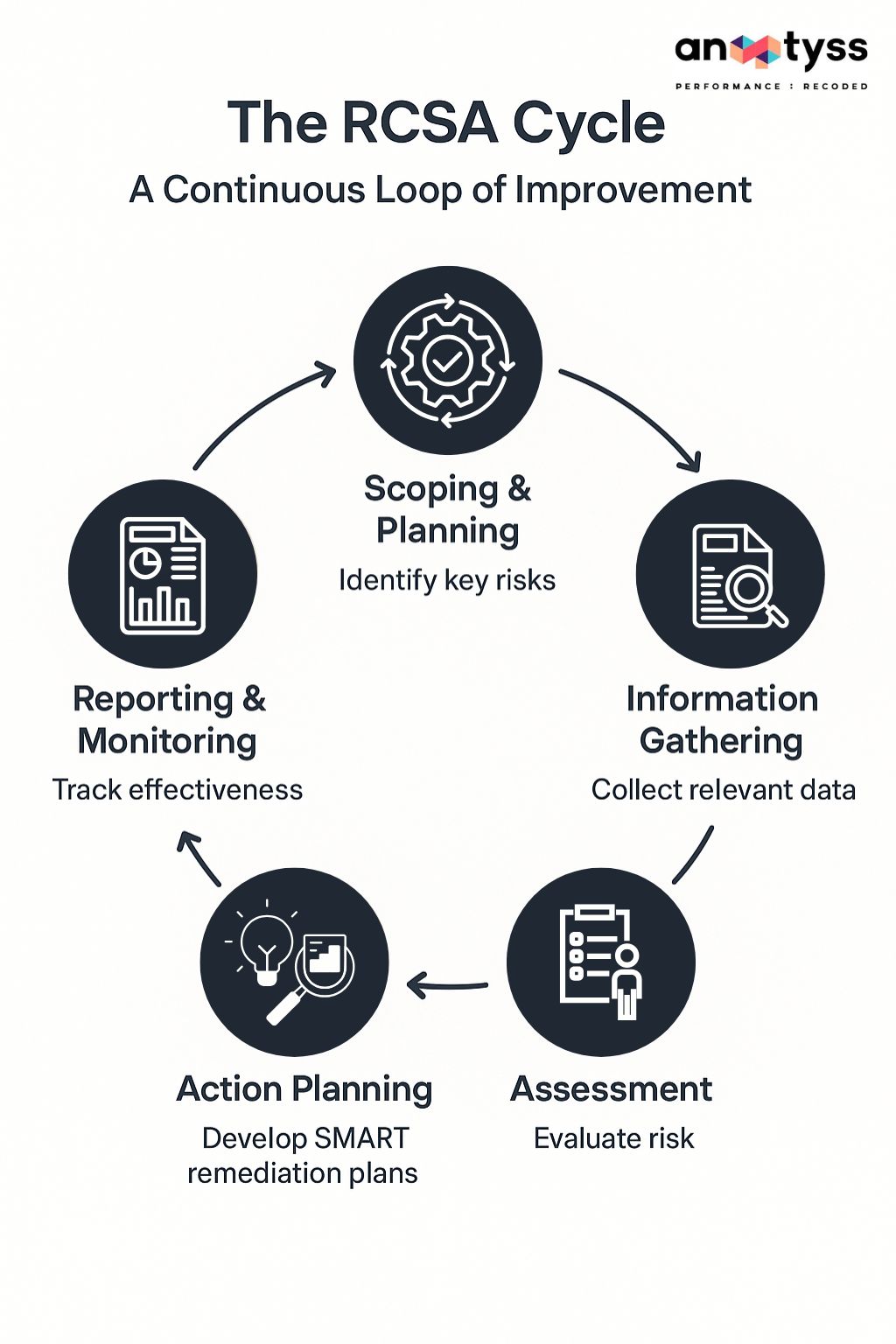
The RCSA process follows a disciplined cycle, which involves –
Scoping & Planning – Define priorities based on business strategy, regulatory requirements, and risk appetite.
Information Gathering – Conduct workshops, distribute structured questionnaires, and gather data across business lines.
Assessment – Use standardized scoring methods to evaluate inherent risk, control effectiveness, and resulting residual risk.
Action Planning – Develop SMART remediation plans with clear accountability and deadlines.
Reporting & Monitoring – Provide visibility through dashboards, heat maps, and trend analysis to inform decision-making at the executive and board level.
What distinguishes a successful RCSA program is not just the identification of risks, but the closing of the loop through actionable, measurable outcomes that improve governance and portfolio resilience.
Integrating RCSA into Enterprise Risk and Capital Planning
When matured, RCSA evolves into more than an operational safeguard; it becomes a strategic enabler for the institution. Its insights directly strengthen enterprise risk management and capital planning:
Strengthening Stress Testing
RCSA findings bring qualitative depth to quantitative stress test scenarios.
For instance, if assessments reveal systemic weaknesses in collateral management, stress tests can adjust LGD assumptions accordingly—making models more realistic and institution-specific.
Supporting ICAAP and Basel III Compliance
Regulators are pressing forward with the implementation of Basel III and the forthcoming Basel Endgame standards. These frameworks require banks to present a comprehensive, forward-looking view of all material risks—including operational risks—within the Internal Capital Adequacy Assessment Process (ICAAP).
RCSA provides the structured, bottom-up evidence needed to meet these expectations. For instance, control effectiveness ratings, emerging risk trends, and scenario analysis inputs that can be directly integrated into ICAAP and broader capital planning. For a deeper perspective on Basel III, see our white paper on Operational Risk Modelling in Banking: Basel III Frameworks.
Refining Risk Appetite Aggregated RCSA outputs—such as heat maps—give boards a clear view of actual versus desired risk posture. This enables executives to adjust appetite statements based on evidence rather than assumptions, ensuring alignment between strategy and operational reality.
By linking RCSA to these enterprise-level processes, institutions can transform it from a compliance activity into a strategic tool that strengthens resilience, improves capital allocation, and enhances regulatory confidence.
Conclusion
By embedding RCSA into the heart of loan portfolio governance, banks can move from reactive defense to proactive foresight. It connects front-line processes to enterprise strategy, ensuring risks are owned, assessed, and acted upon before they erode portfolio health.
Done right, RCSA transforms loan portfolio governance into a strategic discipline that strengthens resilience, enhances decision-making, and ensures regulatory confidence.
At Anaptyss, we help banks and financial institutions strengthen risk management and governance frameworks through digital, data-driven solutions. Our expertise in operational risk, Basel III/Endgame compliance, and portfolio governance equips financial institutions to embed RCSA effectively and align with regulatory expectations.
Escalating regulatory pressures, advanced AI-driven financial crime, and increasing operational burden has rendered the periodic, batch-based monitoring obsolete. Banks and Lending institutions must adopt a continuous, real-time monitoring framework to enhance resilience and reduce compliance costs.
Similarly, in the European Union, the AML Package has progressed significantly. The Anti-Money Laundering Authority (AMLA) commenced operations on July 1, 2025, and a new Delegated Regulation was adopted in June 2025 to address deficiencies in third-country AML frameworks. These measures extend scrutiny to mortgage lenders and consumer credit providers. It also mandates transparency in beneficial ownership and closing gaps in high-risk sectors.
Technological advancements further underscore this shift. Real-time data processing and hybrid AI/ML models enable faster transaction analysis. It can quickly detect subtle patterns that static rules may overlook or fail to detect. However, regulators now require explainable AI (XAI) for transparent workflows and fairness testing. This is crucial to ensure audit readiness and robust model risk management, as highlighted in recent OCC guidance.
Operational risks have also expanded through embedded finance and Banking-as-a-Service models. In this model, lenders bear full liability for third-party controls. Industry reports on digital transformation note that the surge in digital transactions is fueled by demands for instant credit. This amplifies vulnerabilities and make delays in detection potentially catastrophic.
Critical Pain Points in Legacy Monitoring Systems
The persistence of batch-based systems exacerbates a cycle of inefficiencies and risks for lending institutions. Consider these top challenges, informed by industry data and recent analyses.
According to Flagright’s research, legacy rules generate alerts with over 95% false positives. This contributes to a 77% reported shortage of AML analysts and high attrition rates as highlighted by Hawk AI. This is a challenge that can be solved with solutions proven to achieve a 75% reduction in false alerts.
Approximately 30% of banks rely on monolithic systems that hinder data integration, preventing a unified customer risk view and prolonging resolutions—such as fraud disputes taking up to 90 days, according to reports.
Systems designed for simple breaches miss evolving typologies like synthetic identity fraud, where perpetrators build credit histories before executing “bust-out” schemes. This can result in significant losses.
Inconsistent formats and volatile sanctions list lead to manual interventions. As a result, delay in legitimate transactions and frustrated clients.
With average Suspicious Activity Report (SAR) filing times exceeding 160 days against a 30-day mandate, institutions face consent orders and remediation costs, as seen in cases involving unaddressed crypto risks.
Analysts often lack expertise in data science and AI interpretation, undermining investments in advanced tools. The rise of new technologies like Agentic AI that autonomously handles monitoring and investigations requires skilled oversight.
Building a Resilient Continuous Monitoring Framework
To address these challenges, lending institutions must adopt an integrated, multilayered strategic framework that combines technology, process, and human expertise.
This is not about replacing one system but about building an ecosystem. A modern framework rests on five essential pillars designed to create a continuous, self-improving cycle of detection and prevention.
Unified Data Ingestion and Integration
Effective monitoring begins with a holistic risk profile, which is impossible when data is siloed. A modern framework ingests and normalizes data from all disparate sources—including core banking platforms, loan origination systems, CRMs, and third-party data providers—in real time. This unified view of customer activity enables the system to connect seemingly unrelated events into a coherent risk narrative.
A Hybrid AI + Rules Analytics Engine
Static, rule-based systems are necessary for known typologies but are blind to new threats. A resilient framework combines these rules with an adaptive AI/ML engine. Unsupervised learning models can identify anomalies and subtle deviations from established “normal” behavior without prior labels. It can also flag novel fraud schemes that static rules otherwise would miss. Now this hybrid approach provides the dual benefit of reducing false positives and increasing the detection rate of sophisticated, unknown threats, forming the core of a modern transaction monitoring system.
Intelligent Triage and Case Management
The goal is not just to generate alerts, but to generate actionable alerts. The framework must automatically prioritize high-risk cases, enriching them with contextual data to give analysts a head start. A streamlined workflow, such as the one provided by ALFA, should present investigators with all relevant information in a single interface, eliminating the need to toggle between multiple systems and accelerating the time to resolution.
Robust Model Governance and Audit Trails
To satisfy regulators, every step must be transparent and defensible. The framework must include robust model governance to continuously monitor AI for performance drift and bias, ensuring its outputs are explainable. It must also generate immutable, tamper-proof audit logs for every action taken—from the moment an alert is generated to the final case disposition—providing a clear, auditable trail for examinations.
Continuous Learning and Upskilling
Technology alone is insufficient; it must be paired with human expertise. A resilient framework includes a commitment to continuous learning. This involves using investigation outcomes to retrain and refine AI models, creating a feedback loop that makes the system smarter over time. It also requires investing in digital training programs to upskill teams on emerging threats, new technologies, and complex investigative techniques, ensuring the human element of the defense remains as sharp as technology.
Conclusion
For banks and financial institutions, continuous monitoring helps in compliance and drives operational efficiency. As fraud schemes grow more sophisticated and regulators demand real-time proof, institutions that lag risk substantial penalties and reputational harm.
By investing in modern frameworks now, you can transform your organization into a resilient leader in financial integrity. Consider evaluating your current systems against these benchmarks and exploring tailored solutions to stay ahead today and beyond.
Artificial intelligence and automation are fundamentally reshaping credit risk analytics and compliance operations in the banking and financial services industry. As per reports, it is estimated over 90% of U.S. banks are actively investing in AI. Simultaneously, the regulatory requirements are also continuing to shift and evolve. As a result, financial institutions face both opportunities and challenges in implementing AI-powered intelligent risk management and compliance processes and models.
Post digitization of the banking system, the current AI transformation represents the most significant paradigm shift in the core banking systems. Therefore, the question is more about how banks and financial institutions are going to implement AI for credit risk management and compliance effectively while maintaining regulatory compliance and competitive advantage.
AI in Credit Risk Analytics
The numbers speak volumes about AI’s transformative potential. According to the McKinsey research, 78% of organizations now use AI in at least one business function, which is a significant increase from 55% in 2022.
More importantly, for credit risk applications, 20% of credit risk executives have already implemented generative AI use cases. And it is estimated that an additional 60% expecting deployment within 12 months.
We have discussed and mentioned these example a few times when we talk about the AI in risk management. AI platforms like JPMorgan Chase’s COiN and Anaptyss’ CovenAce™ showcase the transformative potential of automation in credit risk management. COiN processes 12,000 commercial credit agreements in seconds—work that once required ~360,000 manual hours annually—now completed instantly with near-perfect accuracy. Similarly, CovenAce™ enables banks to analyze, extract, and organize financial covenants with 80–85% faster processing, up to 70% cost reduction, and improved accuracy. Together, these innovations free legal, compliance, and portfolio teams to focus on higher-value strategic work, governance, and revenue generation.
As per federal regulators, existing laws apply fully to AI systems, with no exemption for compliance requirements. Similarly, the position of Consumer Financial Protection Bureau (CFPB) is unambiguous. The banks cannot use algorithmic complexity as a defense against providing specific adverse action reasons under the Equal Credit Opportunity Act.
Some banks are leveraging compliance requirements as competitive differentiators. Institutions that excel at explainable AI or XAI, robust model governance, and comprehensive documentation find themselves better positioned to scale AI initiatives across their organizations.
The regulatory technology (RegTech) market, projected to reach $35.41 billion by 2029. This reflects banks’ recognition that compliance automation is more than risk mitigation. It’s also about operational excellence and competitive positioning.
The Role of Strategic Partnerships in Accelerating AI Adoption
The implementation divide between large national banks and smaller regional institutions is stark and widening. JPMorgan Chase operates with a $17 billion technology budget and 450+ AI use cases in development, while only 13% of community banks have deployed AI in credit and lending activities.
This disparity creates both challenges and opportunities. Large banks achieve substantial returns—JPMorgan reports $1.5 billion in annual savings from AI initiatives across fraud prevention, trading, and operations. Meanwhile, community bankers consistently report feeling “way behind the curve” with limited resources for emerging technologies.
However, successful implementations by smaller institutions demonstrate that size isn’t destiny. Arizona Credit Union’s 70-80% loan application automation shows that focused AI implementations can deliver significant benefits with appropriate expertise and support.
The key differentiator isn’t budget size—it’s strategic approach. Real-world case studies prove that focused AI implementations can deliver transformative results with the right strategic partnerships.
There are certain AI applications in the banking and financial services that offer the highest probability of success for initial implementations. These includes-
a. Fraud Detection and Prevention
Modern fraud schemes exploit the speed and complexity of digital transactions. AI-powered behavioral analytics can analyze transaction patterns in real-time, detecting anomalies that traditional rule-based systems miss. Banks typically achieve 0.9-1.2 year payback periods on fraud detection investments, making this an ideal starting point for AI adoption.
b. Enhanced Credit Scoring
Traditional credit scoring models rely heavily on historical credit bureau data, potentially excluding creditworthy borrowers with limited credit history. AI models can incorporate alternative data sources—including transaction history, utility payments, and cash flow patterns—to expand credit access while maintaining risk discipline.
c. Automated Underwriting
Mortgage underwriting automation can reduce processing times from weeks to hours while improving decision consistency. AI systems can analyze extensive documentation, verify income and assets, and apply complex underwriting criteria with greater accuracy than manual processes.
d. Compliance Monitoring
Anti-money laundering (AML) and compliance monitoring represent significant operational costs, with U.S. banks spending approximately $25 billion annually on AML processes. AI can reduce false positives by 80-90% while improving detection of sophisticated money laundering schemes.
The complexity of AI implementation often exceeds internal capabilities, particularly for regional and community banks. Strategic partnerships with specialized providers can accelerate implementation while managing risks. Managed services approache offers several advantages vs traditional outsourcing.
Conclusion
The question facing banking executives isn’t whether to adopt AI for credit risk analytics and compliance—it’s how to implement these technologies effectively while maintaining regulatory compliance and competitive positioning.
While major banks like JPMorgan Chase leverage massive technology budgets for in-house AI development, regional and community banks can achieve comparable results through strategic partnerships with managed services providers. Institutions partnering with specialized providers like Anaptyss can get immediate access to domain expertise, enterprise-grade infrastructure, proven compliance frameworks, and outcome-based delivery models that consistently deliver transformational results. This helps improve risk management and enhance regulatory compliance—without massive capital investments.
The landscape of Anti-Money Laundering (AML) and financial crime compliance is changing rapidly. As per UN Office, it is estimated that Financial crime costs global economy $2 trillion annually.
For compliance and risk professionals in banks and financial institutions, artificial intelligence and data-driven methods are no longer “nice to have”—they are the minimum expected. However, compliance leaders know the real challenge is not just keeping up with regulations, but keeping pace with adversaries who are moving faster and exploiting new digital frontiers.
This blog explores the AML trends that will shape 2025, from predictive intelligence and perpetual KYC to decentralized finance risks and the rise of cognitive automation. More importantly, it looks at what these changes mean for compliance professionals who must balance innovation, regulatory expectations, and the need for resilient frameworks in an increasingly complex environment.
Predictive Intelligence and the Evolution of Perpetual KYC
The concept of “Know Your Customer” (KYC) is undergoing its changing significantly. The existing static, point-in-time snapshot is being replaced by a dynamic, always-updated view. This is the era of Perpetual KYC (pKYC), which uses automation to continuously monitor customer risk profiles and triggers alerts when a deviation is detected, such as significant changes in transactions, spike in cross-border payments, or any updates/changes in the beneficial of ownership — in near real-time.
Beyond Behavioral Analytics to Predictive Modeling While current systems are adept at spotting deviations from a customer’s past behavior, the next frontier is predictive modeling. These systems won’t just flag a strange transaction; they will predict the likelihood of a customer engaging in high-risk activities in the future based on a confluence of factors. This includes analyzing not just their financial activity, but also their digital footprint, network connections, and even exposure to emerging geopolitical risks.
The Rise of Synthetic Data in Model Training A major hurdle in training sophisticated AI models has been data privacy. The breakthrough solution gaining traction is the use of synthetic data. This AI-generated data mimics the statistical properties of real customer data without containing any personally identifiable information. Financial institutions can now train more robust and accurate models on vast datasets, stress-testing them against novel money laundering typologies without ever exposing sensitive customer information.
“Glass Box” AI and Explainability Regulators are increasingly demanding that institutions not only have effective AI but can also explain its decisions. The push for “glass box” AI, or eXplainable AI (XAI), is a direct response. This means that when an AI flags a customer or transaction, it can provide a clear, auditable trail of the factors that led to that decision, satisfying regulatory scrutiny and empowering analysts with actionable intelligence.
AML Risks in Decentralized Finance, Virtual Economies, and Synthetic Identities
Financial crime is rapidly migrating to new, decentralized, and virtual frontiers. A robust AML strategy must extend beyond traditional banking rails.
DeFi Exploitation and Sanctions Evasion
Decentralized Finance (DeFi) platforms, with their pseudonymous nature, are becoming a hotbed for money laundering. The challenge for compliance teams is to gain visibility into these ecosystems. Advanced solutions are now emerging that can trace the flow of funds across different blockchains and identify links to sanctioned entities or illicit activities.
The Metaverse and In-Game Economies The burgeoning economies within virtual worlds and gaming platforms present a new and often unregulated frontier for financial crime. The conversion of fiat currency to in-game assets and back again can be a complex layering technique. Forward-thinking institutions are beginning to develop frameworks for assessing the AML risks associated with these emerging digital economies.
Combating Deepfake and Synthetic Identity Fraud Generative AI is not just a tool for the good guys. The rise of deepfakes and synthetic identities represents a profound threat to customer onboarding and authentication. AML frameworks must now incorporate advanced biometric and liveness detection technologies that can distinguish between a real person and a sophisticated digital forgery.
Cognitive Automation and the Future of Compliance Operations
The final pillar is the move from simple automation to cognitive automation, where systems can not only perform tasks but also learn, reason, and make nuanced decisions.
Generative AI as the Analyst’s “Co-Pilot” Generative AI is set to revolutionize the role of the compliance analyst. Instead of just flagging alerts, these AI “co-pilots” will be able to:
Summarize complex case histories in seconds.
Draft initial Suspicious Activity Reports (SARs) with a high degree of accuracy.
Query vast unstructured datasets (like news articles, social media, and internal communications) to provide analysts with a holistic view of a case. This dramatically reduces investigation times and allows human expertise to be focused on the most critical and complex threats.
Federated Learning for Collaborative Intelligence
One of the biggest challenges in fighting financial crime is the siloed nature of data within individual institutions. Federated learning offers a groundbreaking solution. This technology allows multiple institutions to collaboratively train a shared AI model without ever sharing their underlying sensitive data. The model learns from the data of all participating institutions, resulting in a much more powerful and accurate system for detecting widespread money laundering networks.
Agentic AI for Fraud Detection and Risk Mitigation
In 2023, the Federal Trade Commission (FTC) reported that the United States lost $10 billion to fraud, a 14% increase from 2022. Agentic AI provides banks and financial institutions with a new layer of defense. By analyzing transaction patterns within milliseconds, it can flag anomalies in real time, while simultaneously learning from historical fraud cases to anticipate emerging attack vectors. This combination of speed and adaptive intelligence makes it a critical tool for strengthening fraud prevention and overall risk mitigation.
Quantum Computing on the Horizon While still in its early stages, the potential impact of quantum computing on financial crime cannot be ignored. Quantum computers will have the ability to break many of the encryption standards that currently protect financial data. Proactive institutions are already beginning to explore quantum-resistant cryptography to future-proof their systems against this emerging threat.
Conclusion
The AML and financial crime compliance landscape of 2025 is entering a decisive phase. Institutions can no longer rely on static frameworks or reactive responses. The imperative is clear. Compliance must evolve into a resilient, adaptive, and anticipatory architecture—capable not just of responding to threats, but of staying several steps ahead of them.