CBDCs in Banking: Opportunities and Adoption Approaches [Guide]

Central bank digital currencies (CBDCs) are digital versions of a country’s fiat currency issued and regulated by its central bank. It is estimated that 90% of the world’s central banks are engaged in some form of CBDC projects.

Unlike cryptocurrencies like Bitcoin, which are decentralized, CBDCs are centralized and backed by the full faith and credit of the issuing government.

CBDCs are poised to revolutionize the financial landscape, and banks must prepare for the changes.

Why are CBDCs Gaining Traction: 7 Key benefits

The rise of digital payments, accelerated growth of cryptocurrencies, and the decline of cash usage are driving central banks worldwide to explore CBDCs.

A significant factor contributing to this trend is the increasing need for more efficient domestic and cross-border monetary interactions.
Why Are CBDCs Gaining Traction

Additionally, a 2023 BIS survey found that a staggering 94% of central banks are actively researching CBDCs, with 134 countries representing 98% of the global GDP, exploring this new form of currency.  To learn more about global trends shaping banking and financial services, refer to our blog on top trends in global banking and financial services industry.

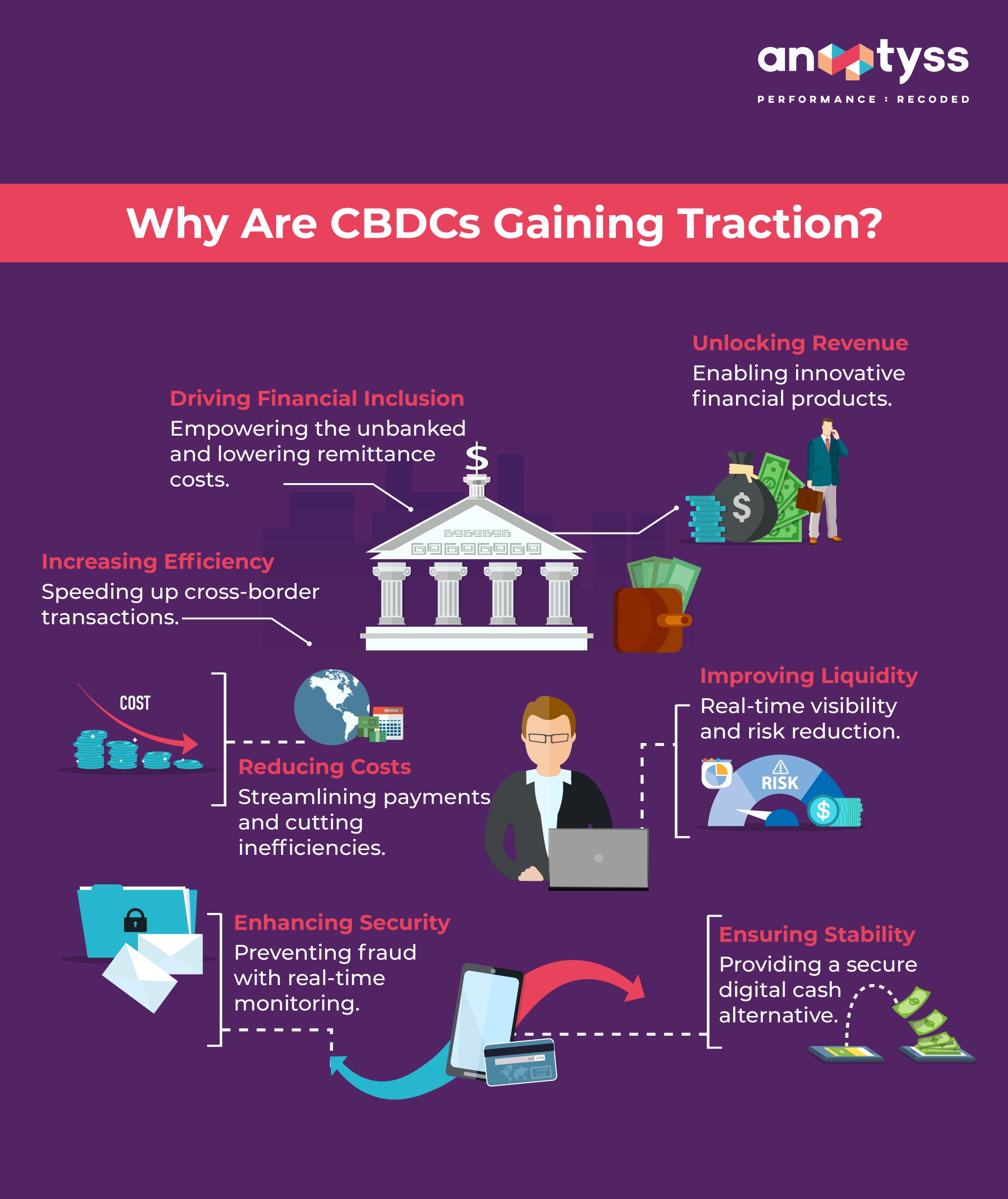
This surge in interest is fueled by the seven key potential benefits of CBDCs, such as –

1. Enhanced Financial Inclusion

CBDCs can provide the underserved population with access to financial services, enabling financial inclusion and economic growth.

For example, migrants often face high transaction fees when sending money back home, averaging 6.25%, according to the World Bank. CBDCs could significantly reduce these costs by removing intermediaries and making remittances more affordable and efficient.

2. Reduced Transaction Costs

CBDCs have the potential to streamline payment systems, cutting down the transaction costs associated with cash handling, manual reconciliation, and regulatory compliance.

By digitizing currency, central banks can eliminate inefficiencies in existing systems and human errors, which could further lower operational costs and ensure more cost-effective transactions.

3. Improved Payment Security

CBDCs can enhance payment security by incorporating advanced digital identity verification and real-time transaction monitoring. These measures can further help in:

4. Increased Efficiency

CBDCs can speed up transaction processing times, especially when it comes to navigating cross-border payments and AML regulatory challenges.

The Bank for International Settlements (BIS) suggests that CBDCs can expedite cross-border transactions by simplifying the settlement process and reducing reliance on correspondent banking networks.

5. New Revenue Streams

CBDCs provide banks with opportunities to develop and offer innovative financial products and services, creating new revenue channels.

For example, banks could leverage programmable money enabled by CBDCs to offer features like automated payments, escrow services, or conditional transactions tailored to customer needs. These new capabilities position banks as leaders in digital financial innovation.

6. Enhanced Liquidity Management

CBDCs can provide banks with real-time visibility into their liquidity positions, improving liquidity management and reducing risk. The continuous monitoring capabilities of CBDC infrastructure enable banks to identify and address potential liquidity issues proactively.

7. Increased Financial Stability

CBDCs provide a secure and stable digital alternative to cash, helping to maintain financial stability. By integrating CBDCs into the monetary system, banks can support a seamless transition to digital currency while ensuring the security and trust to maintain economic stability.

5 Key Challenges Traditional Banks Face in Adopting CBDCs

While CBDCs offer significant potential, banks also face several challenges:

1. Impact on Bank Profitability and Liquidity

CBDCs could potentially reduce the role of traditional banks as intermediaries. By allowing people to hold money directly with central banks, CBDCs may reduce the reliance on traditional or commercial banks for deposits, affecting their profitability.

This shift could reduce demand for traditional banking products like loans and savings accounts, which could further raise liquidity risks for traditional banks. And with fewer deposits, traditional banks may face challenges in maintaining their lending capacity and operational efficiency.

2. Cybersecurity Risks

Despite improved payment security, CBDCs remain vulnerable to  cybersecurity risks at a systemic level. Their digital nature makes them potential targets for sophisticated cyberattacks, unauthorized access to CBDC systems, and risks, such as counterfeiting and double-spending.

Additionally, threats such as malware, ransomware, and large-scale Distributed Denial of Service (DDoS) attacks could disrupt CBDC transactions and impact financial stability.

However, implementing robust security measures and maintaining the necessary infrastructure can be particularly challenging for banks. Smaller and mid-sized banks may struggle with the high costs, technical complexity, and need for specialized expertise required to safeguard CBDC systems against evolving cyber threats.

To understand how cybersecurity regulations and standards can safeguard financial services, refer to our blog on cybersecurity laws, regulations, and standards for the financial services industry.

3. Balancing Privacy and Compliance

CBDC requires a careful balance between protecting user privacy and adhering to strict regulatory requirements for anti-money laundering (AML) and know-your-customer (KYC) compliance. For instance, customers may hesitate to adopt CBDCs if they perceive a lack of privacy or government surveillance.

Protection and sanitization of highly confidential financial data with transparency is another crucial aspect.

4. Technological InfrastructureRequirements

Banks will need to upgrade their technological infrastructure to support CBDC integration and interoperability with existing systems like cross-border and real-time digital payment systems. This includes:

However, handling large transaction volumes without compromising efficiency or reliability is a significant challenge for banks when it comes to CBDC adoption.

To explore how microservices address technological challenges, refer to our blog implementing microservices in financial systems: challenges and their solutions.

5. Regulatory Uncertainty

The regulatory landscape for CBDCs is still evolving. Thus, there’s uncertainty for banks in terms of compliance, reporting, and operational requirements. Additionally, different jurisdictions may have or adopt different rules for CBDCs that could complicate cross-border transactions and international banking operations. Some of the key regulatory concerns include:

Therefore, banks will need to be agile about adapting to new regulatory changes and compliance standards that could emerge as CBDC evolves.

For insights into building efficient compliance systems, read our blog on build a robust transaction monitoring system for AML compliance. You can also read how to navigate cross-border compliance challenges to navigate compliance complexities.

Global Central Bank Digital Currencies (CBDCs) Overview

Country CBDC Name Status Key Features
The Bahamas Sand Dollar Launched (2020) Financial inclusion, retail payments
Nigeria eNaira Launched (2022) Financial inclusion, cross-border payments
China e-CNY Pilot program Retail payments, cross-border applications
Sweden e-krona Pilot program Offline functionality, integration with systems
India Digital Rupee Pilot program (2022) Wholesale and retail transactions
Eurozone (ECB) Digital Euro Development phase Financial stability, cross-border payments
Jamaica JAM-DEX Launched (2022) Financial inclusion, digital payments
Russia Digital Ruble Pilot program Cross-border payments, domestic transaction efficiency
Brazil Drex Pilot program Financial inclusion, retail and wholesale payments
Singapore Project Orchid Research phase Programmable money, smart contracts
South Korea Digital Won Pilot program Offline functionality, digital wallets integration
Canada Digital Canadian Dollar Research phase Cross-border interoperability, financial inclusion
Japan Digital Yen Pilot program Retail payments, security, and privacy compliance
Australia eAUD (pilot name) Research phase Programmable payments, blockchain integration
United States FedNow (Not CBDC)** Active (2023) Real-time payments, CBDC research ongoing


Approaches for Banks to Prepare for the CBDC Future

Banks can take proactive steps to prepare for the CBDC future.
Approaches for Banks to Prepare for the CBDC Future

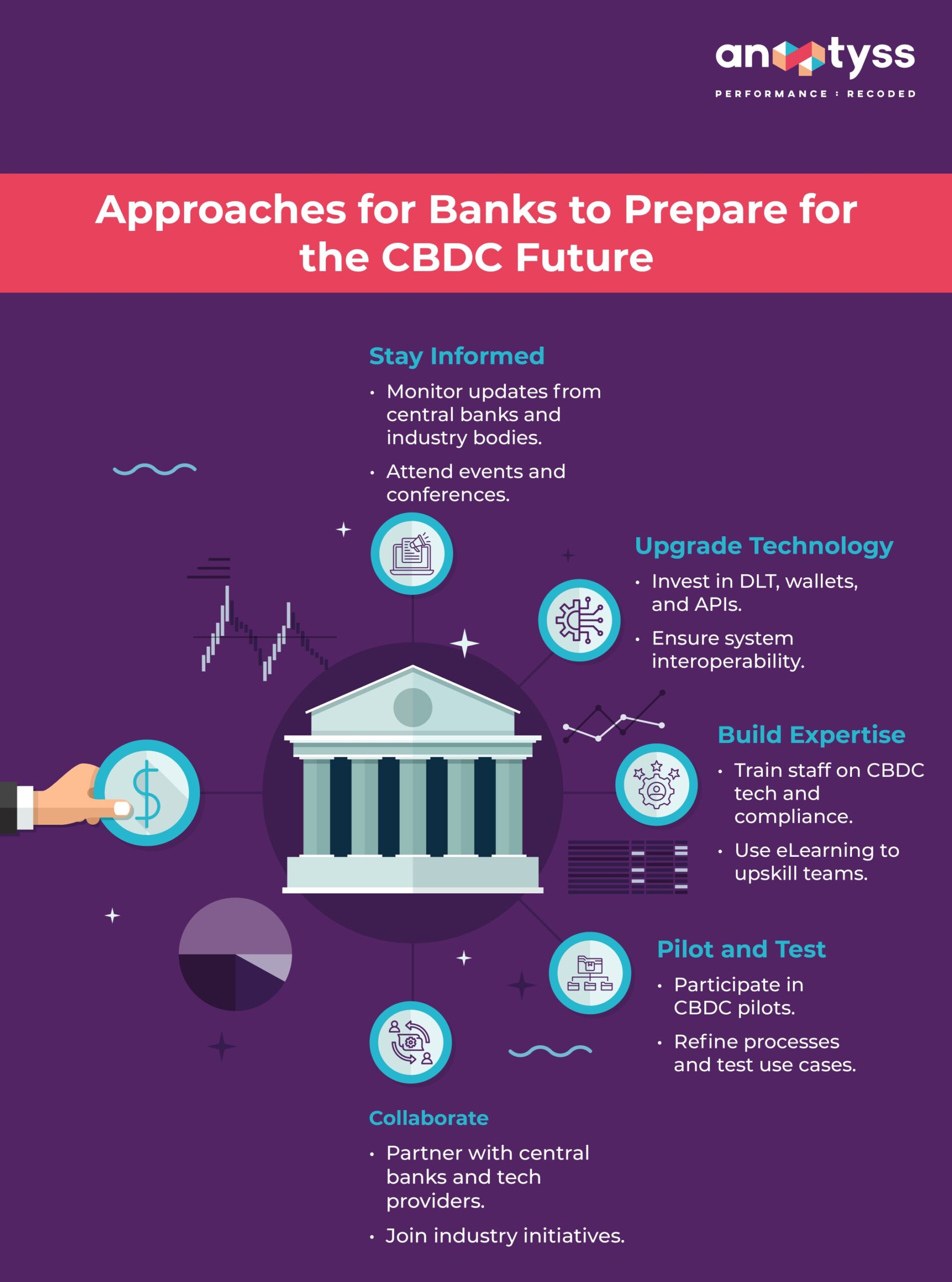
1. Stay Informed

Keep abreast of the latest CBDC developments, research, and regulatory guidance. Actively monitor publications and announcements from:

2. Invest in Technology

Upgrade technological infrastructure to support CBDC integration and interoperability. This includes investing in robust and scalable DLT platforms, secure digital wallets, and APIs for seamless integration with existing banking systems.

3. Develop Expertise

Build internal expertise on CBDC technology, regulation, and operational considerations. Train staff on CBDC functionalities, security protocols, and compliance requirements. Foster a culture of continuous learning and knowledge sharing to stay ahead of the curve.

Leverage digital learning or eLearning platforms to rapidly skill and upskill workforce.

4. Collaborate

Engage with central banks, technology providers, and other stakeholders to shape the CBDC ecosystem. Participate in pilot programs and contribute to the development of industry standards and best practices.

5. Pilot Programs

Participate in CBDC pilot programs to gain practical experience and refine operational processes. Actively test and evaluate different CBDC use cases and technologies to identify optimal solutions for your bank and customers.

Conclusion

CBDCs are ready to reshape the financial landscape, presenting opportunities and posing challenges to traditional banks. It is upon the banks to understand the potential benefits, challenges, and key considerations to proactively prepare for the CBDC future.

This guide has provided an overview of CBDCs, their implications for banks, and the steps banks can take to navigate this new era briefly.

At Anaptyss, we specialize in helping financial institutions stay ahead in the ever-evolving digital landscape. With our 8+ decades of combined expertise in compliance, risk management, and digital transformation, we empower banks to embrace innovations like CBDCs seamlessly.


 

Emerging Technologies and Strategies to Overcome Transaction Monitoring Challenges

Transaction monitoring is a critical function for financial institutions to combat financial crimes, such as fraud, money laundering, terrorist financing, and more.

Traditional transaction monitoring systems often struggle to keep pace with the evolving landscape of financial crime, leading to inefficiencies and vulnerabilities.

However, with emerging technologies and innovative strategies in transaction monitoring, banks and financial institutions can overcome these challenges and enhance their compliance efforts.

In this blog, we have discussed some recent advancements and emerging technologies that can help overcome the challenges inherent in transaction monitoring.

1. Artificial Intelligence (AI) and Machine Learning (ML)

AI and ML algorithms are transforming transaction monitoring with their capability of analyzing vast amounts of data, identifying complex patterns, detecting anomalies, and adapting to new threats in real time.

These technologies can significantly improve the accuracy and efficiency of transaction monitoring. They can also help:

One compelling example of this is a Machine Learning-Based Fraud Detection System implemented by a US-based commercial lender. This system enabled the institution to flag up to 100% of fraudulent transactions, showcasing the power of AI and ML in preventing financial crime.

2. Big Data and Advanced Analytics

The ability to analyze massive datasets is crucial for effective transaction monitoring. With big data and advanced analytics, banks and financial institutions can:

Further, it can also help in:

For example, an AI/ML-Based Data Analytics Solution enabled a US-based commercial lender to achieve 93% accuracy in predicting delinquent and written-off customers, improving their risk management capabilities significantly.

3. Embracing RegTech Solutions

Regulatory technology (RegTech) solutions are automating and streamlining compliance processes. It makes transaction monitoring more efficient and cost-effective by:

For a deeper dive into how RegTech is reshaping compliance in the financial services industry, check out our blog: Regulatory Technology (RegTech) for Compliance in the Financial Services Industry.

4. Blockchain Technology

Blockchain technology is emerging as a powerful tool for monitoring and tracking cryptocurrency transactions and detecting illicit activities. With this, banks and financial institutions can analyze blockchain data to trace the flow of funds, identify suspicious patterns, and assess the risk associated with cryptocurrency transactions.

For example, Ripple, a provider of enterprise blockchain solutions for cross-border payments, uses blockchain technology to enhance its AML capabilities by providing a secure and immutable ledger of all transactions.

Below are some additional advantages of blockchain analytics when it comes to virtual currencies.

Strategies to Overcome the Transaction Monitoring Challenges

In addition to adopting emerging technologies and advancements, financial institutions can also implement the following strategies to improve their transaction monitoring efforts.

1. Adopt a Risk-Based Approach

A risk-based approach (RBA) as outlined by FATF is essential for effective transaction monitoring. By focusing on high-risk customers and transactions, organizations can allocate resources more efficiently and reduce false positives.

This involves the following key steps:

2. Enhanced Due Diligence

Enhanced Due Diligence (EDD) is a comprehensive set of KYC/AML procedures that financial institutions follow to assess and manage risks associated with high-risk customers. EDD goes beyond standard due diligence, providing a deeper understanding of a customer’s background, financial activities, and potential risks. It is crucial for compliance, preventing financial crime, and safeguarding reputations.

Key components of Enhanced Due Diligence include:

It includes four stages, including Customer Identification Program (CIP), followed by Customer Due Diligence and EDD triggers, collection and analyses of extensive information, and risk assessment.

To learn more about Enhanced Due Diligence processes and their importance, check out our previous blog on Enhanced Due Diligence (EDD) in banking and financial services.

3. Collaboration and Information Sharing

The growing collaboration between bad actors is leading to sophisticated fraud and increased attacks.

Banks and financial institutions must also establish a secure platform to share information and collaborate for identifying and reporting suspicious activities to local law enforcement and regulatory authorities. This collaborative approach can help them exchange information and safeguard against evolving fraud techniques.

For example,

Further, banks can use the information sharing platform and publicly available reports by various regulatory bodies, stock exchanges, international organizations, and independent entities to effectively combat money laundering. These include:

4. Continuous Training and Upskilling

A skilled, well-trained, and knowledgeable team is the backbone of transaction monitoring and compliance. Therefore, investing in continuous employee training and upskilling is crucial for engaging talent and building operational expertise.

For instance, a Custom-Built Digital Learning Platform enabled a US-based mortgage lender to scale employee training with 75% less effort, demonstrating how innovative learning solutions can drive efficiency.

However, banks often encounter resource constraints in terms of logistics, time, and costs as continuous training and upskilling the workforce requires substantial time, resources, commitment, and patience.

But with digital learning or e-learning solutions, financial institutions can transform their talent and knowledge base effectively. To learn more, check out our previous blog on boosting workforce training in the banking and financial service industry.

Conclusion

Transaction monitoring is becoming increasingly complex in today’s rapidly evolving financial landscape. However, by embracing emerging technologies and adopting shared strategies, financial institutions can overcome these challenges and enhance their compliance efforts.

Banks and financial institutions can consider deploying an enterpriser-grade AI/ML-powered solution, such as ALFA, to reduce false positives and the costs involved with manual human intervention.

Evolving Model Risks: Challenges and Strategies for Banks

Model risks are an emerging concern for financial institutions, as misused or flawed financial models can have serious adverse consequences.

The scope of model risk management is evolving rapidly due to technological advancements led by artificial intelligence and emerging challenges due to credit risks, climate risks, and fintech partnerships.

The Growing Importance of Model Risk Management

Models are fundamental to modern finance. They enable banks and financial institutions to make informed decisions across various domains, including credit scoring, market risk assessment, capital allocation, and regulatory compliance.

However, as models become more sophisticated and intertwined with emerging technologies, such as artificial intelligence (AI) and machine learning (ML), the potential for model risk amplifies. This necessitates a robust model risk management (MRM) framework to identify, assess, and mitigate potential risks.

Besides, the consequences of negligence or inadequate MRM can be severe, ranging from financial losses and inaccurate financial statements to regulatory sanctions and reputational damage.

For instance, a flawed credit risk model could lead to excessive loan defaults, jeopardizing an institution’s financial health. Additionally, due to poor model performance, institutions may fail to gain regulatory approval for capital plans or damage their reputation.

One of the real-world examples is Zillow. In 2020, Zillow experienced significant losses exceeding $420 million due to its automated valuation model’s inability to accurately predict home prices in a volatile market.

Therefore, it is important to understand why models can be wrong or experience performance degradation. For a deep dive into emerging trends and priorities, refer to our blog, Top 5 MRM Priorities for Banks in 2025.

Highlighted below are the key model risk challenges and strategic priorities that bank executives must address to navigate the evolving financial landscape effectively.

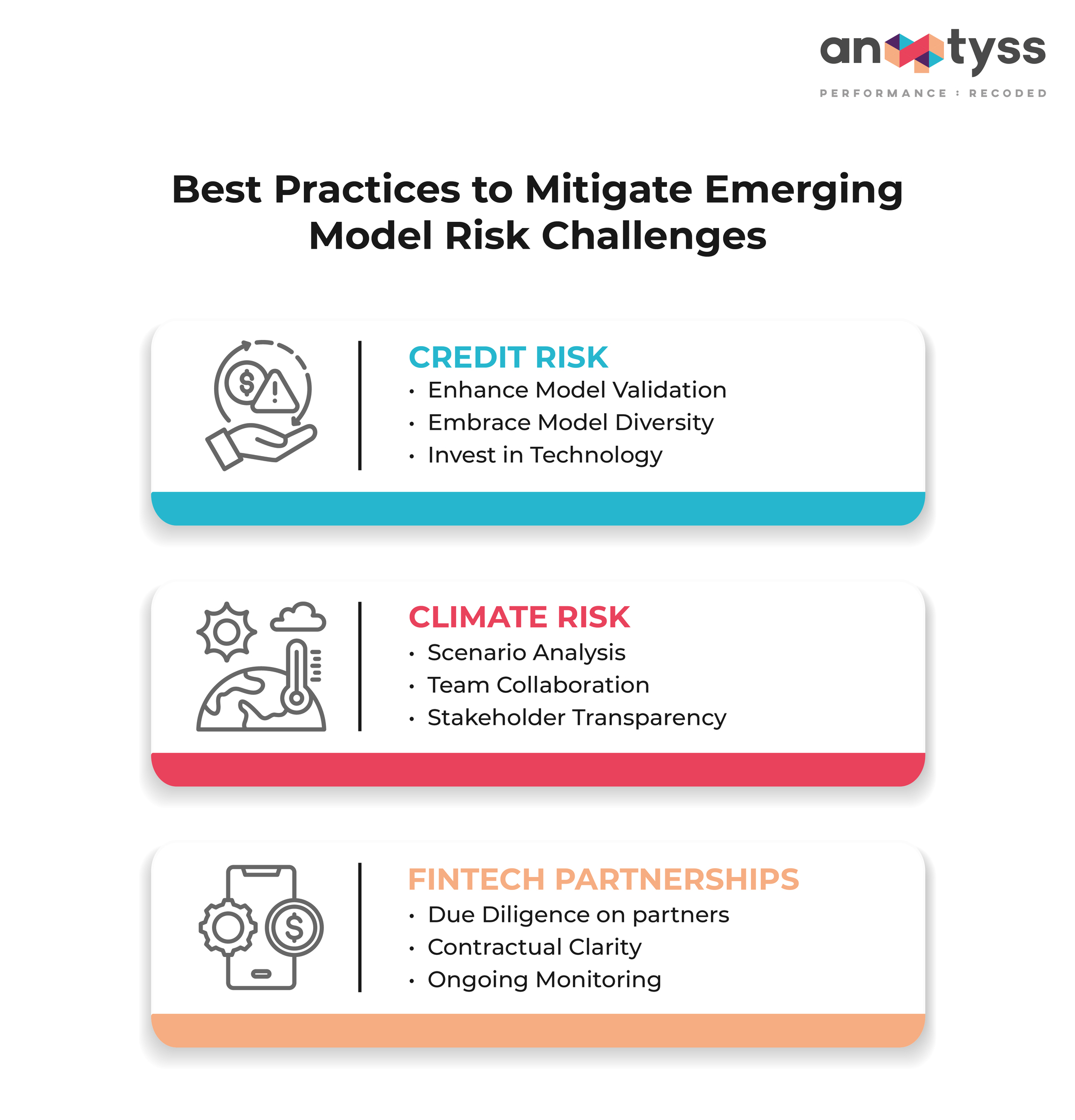
1. Credit Risk – Traditional and Emerging Challenges

Credit risk models are used to evaluate borrowers’ creditworthiness and have always been central to banking. However, traditional models are facing new challenges:

It is crucial to recognize that credit risk models should not only focus on the probability of default but also consider the broader economic conditions and firm-specific factors to generate a credit spread, enabling a more holistic approach to credit risk assessment.

To address these challenges, banks should–

To explore more about managing credit risk effectively, check out our blog on Top Trends in Credit Risk Management

2. Climate Risk – A New Horizon in Model Risk

Climate change poses significant financial risks to banks, including physical risks from extreme weather events and transition risks associated with the shift to a low-carbon economy. Assessing and managing these risks require specialized climate risk models.

Key challenges in climate risk modeling include–

It is important to understand that climate risk models blend Global Climate Model output and Catastrophe (CAT) models, which include a financial engine. These models can be used to understand potential losses for assets in various peril scenarios, providing a highly detailed, asset-level view of damages and business interruption implications.

Best practices for addressing climate model risk include–

3. Fintech Partnerships – Navigating Third-Party Model Risks

Fintech partnerships offer banks opportunities to innovate, enhance customer experiences, and improve efficiency. However, relying on third-party models and technologies introduces new dimensions of model risk.

A structured approach to fintech risk assessment involves three key processes:

Banks also face specific risks related to access to records and reliance on fintechs for regulatory compliance, especially in AML, which need careful consideration in these partnerships.

Best Practice for Model Risk Management

Best Practices to Mitigate Emerging Model Risk Challenges

Key considerations for managing model risk in fintech partnerships include–

You may also Check out our blog on Three Lines of Defense in Model Risk Management to learn about structured approaches for addressing these challenges.

Conclusion

The evolving landscape of model risk requires a proactive, holistic approach to Model Risk Management (MRM). As AI, ML, and regulations rapidly evolve, banks must not only meet compliance standards but also anticipate and manage emerging risks to ensure models remain reliable and aligned with business goals.

Top 5 Model Risk Management Priorities for the Banking Industry in 2025

Banks and other financial institutions use models for credit scoring, fraud detection, pricing financial instruments, and managing risk. As models become more complex and integral to banking operations, the potential for errors and losses also increases. This gives rise to different types of model risks due to inaccurate or poorly devised models to make decisions.

Model Risk Management (MRM) is therefore crucial for banks to address regulatory demands and operational challenges while improving decision-making. Banks are also shifting towards a more efficient and value-focused model risk management approach due to the growing reliance on models, regulatory pressures, and shortage of skilled talent.

As we approach 2025, this blog post outlines the top five MRM priorities that should be on the radar of every bank executive in the coming year.

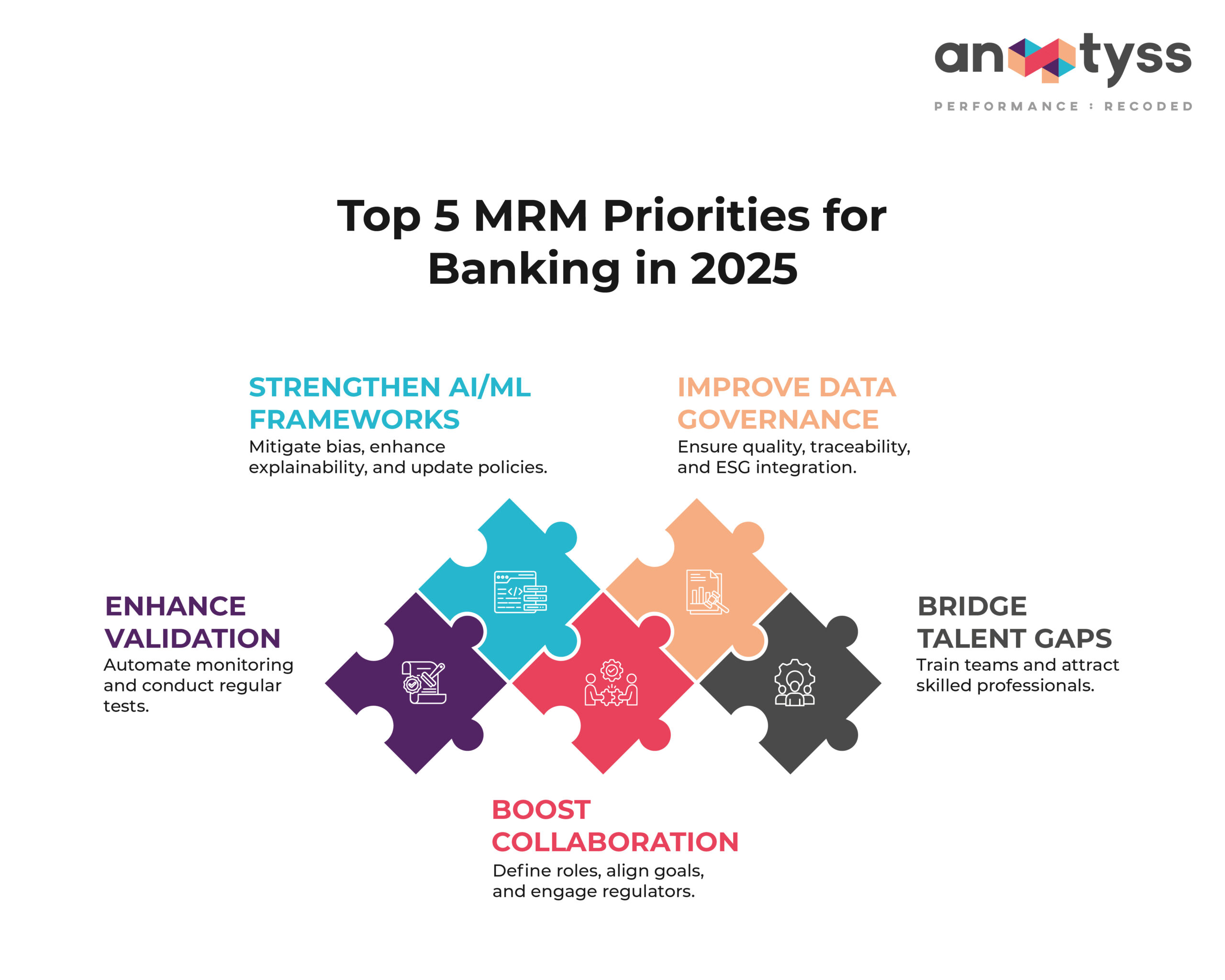
Top 5 MRM Priorities for Banking in 2025

1. Enhance MRM Frameworks Using AI and Machine Learning

Artificial intelligence (AI) and machine learning (ML) are transforming the banking industry by enabling them to intelligently automate processes, personalize customer experiences, and gain deeper insights from data. However, these technologies also introduce new challenges for MRM. Traditional Model Risk Management frameworks may not be sufficient to address the unique risks associated with AI and ML models, such as:

In addition, the regulatory landscape for MRM is constantly evolving, with guidelines like SR 11-7 providing a comprehensive framework for model risk management in the US. Furthermore, international standards like Basel III emphasize the importance of robust MRM practices for maintaining financial stability. These regulations require banks to establish comprehensive MRM frameworks, conduct rigorous model validation, and ensure ongoing monitoring of model performance.

Key Steps for Bank Executives:

Revise existing MRM frameworks to specifically address the challenges of AI and ML models, incorporating guidelines for model development, validation, and monitoring.

Develop in-house expertise or partner with external vendors or managed service providers to gain the necessary skills and knowledge to effectively manage AI/ML model risk.

Develop guidelines and controls to mitigate potential biases in AI/ML models and ensure fair and transparent decision-making. Failing to manage AI and ML model risk effectively can damage a bank’s reputation and erode customer trust.

2. Strengthen Data Quality and Governance

Data is the foundation of effective MRM. High-quality data is essential for developing accurate and reliable models, while robust data governance ensures data integrity, security, and compliance with privacy regulations.

Key Steps for Bank Executives:

Implement a comprehensive data governance framework that covers data quality, lineage, security, and access control.

Utilize data quality tools and technologies to cleanse, standardize, and validate data used in models.

Maintain clear documentation of data sources, transformations, and usage to ensure data traceability and accountability.

Implement measures to protect customer data and comply with relevant privacy regulations, such as GDPR and CCPA.

The increasing adoption of Environmental, Social, and Governance (ESG) models in banks requires careful consideration of ESG data quality and relevance. Banks need to ensure that ESG data is accurate, reliable, and aligned with the bank’s sustainability goals. Poor data quality can lead to inaccurate model predictions and flawed business decisions, highlighting the crucial link between data quality and model accuracy.

3. Improve Model Validation and Monitoring Processes

Model validation and monitoring are crucial for identifying and mitigating model risk throughout the model lifecycle. Effective validation ensures that models are fit for purpose and perform as expected, while ongoing monitoring detects performance deterioration and emerging risks.

Key Steps for Bank Executives:

Establish an independent validation function to provide objective assessments of model accuracy, reliability, and limitations.

Implement a schedule for regular model reviews, including backtesting, sensitivity analysis, and stress testing, to assess model performance and identify potential weaknesses.

Leverage technology solutions to automate model monitoring and alert management, enabling timely detection of performance issues and risk mitigation.

Maintain comprehensive model documentation and reporting to ensure transparency and facilitate effective communication with stakeholders.

Consider the potential benefits and challenges of implementing Robotic Process Automation (RPA) in MRM. RPA can automate repetitive tasks, improve efficiency, and reduce errors in model validation and monitoring processes. However, careful planning and implementation are crucial to ensure successful RPA adoption.

4. Address Talent and Skill Gaps

The increasing complexity of models and the growing adoption of AI and ML require specialized skills and expertise in MRM. Banks need to address talent gaps and invest in training and development to ensure they have the necessary capabilities to manage model risk effectively.

Key Steps for Bank Executives:

Conduct a comprehensive assessment of existing MRM skills and identify areas where training and development are needed.

Develop and implement training programs to enhance MRM knowledge and skills, including areas such as model validation, AI/ML risk management, and data governance.

Implement strategies to attract and retain skilled MRM professionals, including competitive compensation and benefits packages and opportunities for career development.

Encourage continuous learning and knowledge sharing within the MRM team to promote innovation and best practices. Banks with strong MRM talent can gain a competitive advantage by making better decisions related to capital allocation and improving their overall operational efficiency.

5. Enhance Communication and Collaboration

Effective communication and collaboration are essential for successful MRM. This includes clear communication of model risk appetite, roles and responsibilities, and model performance to both internal and external stakeholders.

Key Steps for Bank Executives:

Establish clear roles and responsibilities for model development, validation, monitoring, and reporting.

Clearly articulate the bank’s risk appetite for model risk to ensure alignment between business objectives and risk management practices.

Implement regular reporting mechanisms to communicate model performance, risk exposures, and mitigation strategies to senior management and the board of directors.

Maintain open communication with regulators and proactively address any concerns or questions regarding MRM practices. Discover More – A Comprehensive Guide to Model Risk Management For deeper insights into the challenges, solutions, and emerging trends in Model Risk Management, download our white paper Model Risk Management in Financial Services: Challenges, Solutions, and Trends. This white paper delves into governance, AI integration, transparency, and more—critical for staying ahead in today’s regulatory and technological landscape.

Conclusion

As the banking industry continues to evolve, MRM will play an increasingly critical role in ensuring the safety and soundness of financial institutions. By prioritizing these top five MRM priorities, bank executives can effectively manage model risk, enhance decision-making, and maintain a competitive edge in the dynamic banking landscape of 2025 and beyond.

Challenges in Transaction Monitoring: Navigating Complexities in the Financial World

Recent high-profile cases, like large-scale cryptocurrency laundering operations and cross-border money-laundering scandals, have highlighted vulnerabilities in traditional transaction monitoring systems. As financial crimes grow in sophistication, institutions are facing mounting pressure to adapt their monitoring strategies.

This blog explores the critical challenges faced in transaction monitoring today.

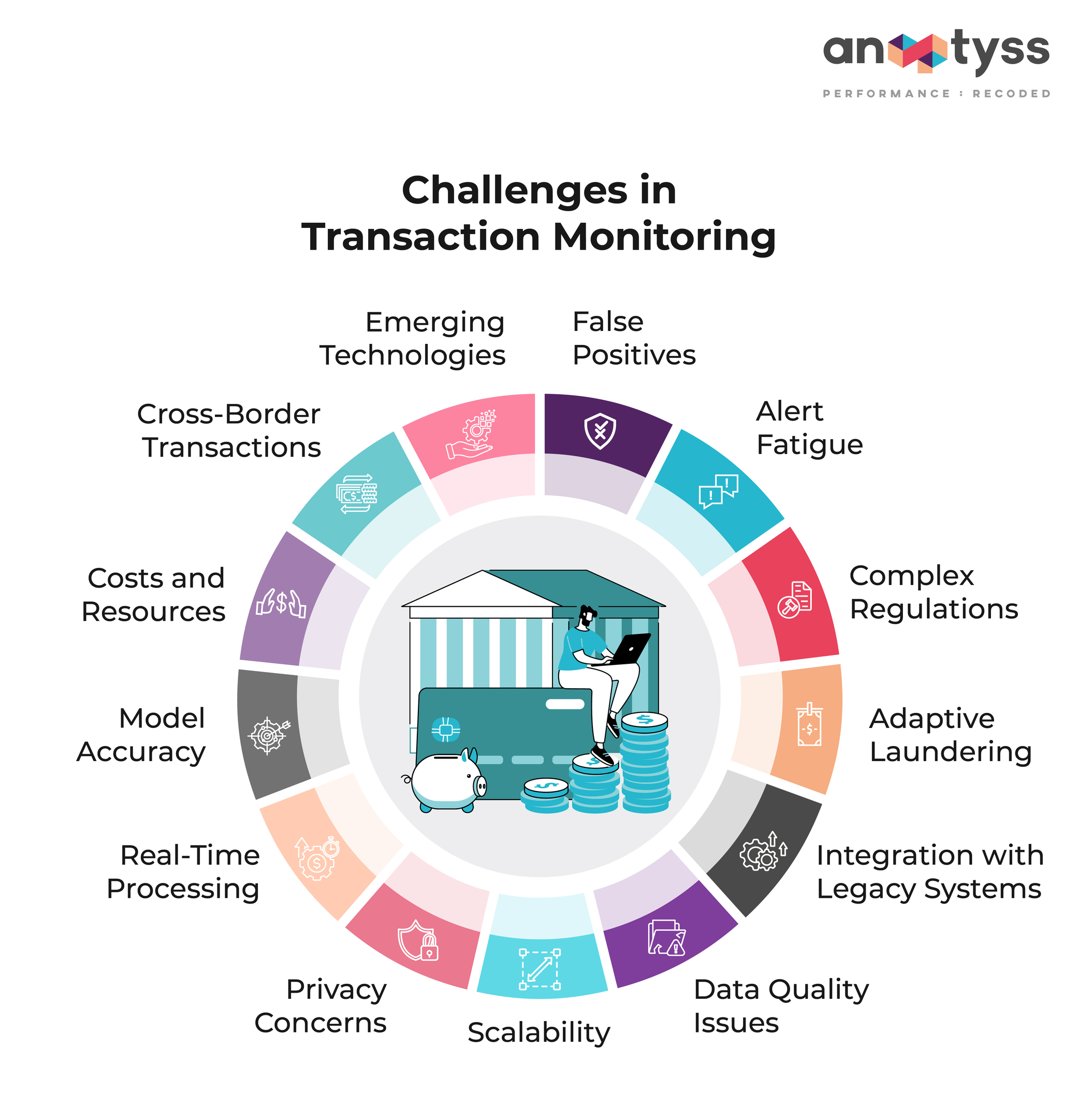
Challenges in Transaction Monitoring

  1. False Positives

One of the most significant challenges is the high number of false positives. Many alerts generated by transaction monitoring systems turn out to be benign, leading to unnecessary investigations and increased operational costs.

Excessive false positives can lead to

However, implementing machine learning-based systems can help, as discussed in High Costs of AML Transaction Monitoring: Can Machine Learning Help

  1. Alert Fatigue

The sheer volume of alerts can overwhelm investigators, leading to alert fatigue. This may result in important alerts being overlooked or not given the necessary attention.

Alert fatigue can result in:

  1. Complexity of Regulations

Financial institutions operate in a highly regulated environment. Adapting transaction monitoring systems to comply with evolving regulations can be challenging and may require continuous updates to rules and models.

Complex regulatory environments can cause:

  1. Adaptive Money Laundering Techniques

Criminals constantly evolve their techniques to bypass transaction monitoring systems. They may employ sophisticated methods to disguise illicit transactions, making it challenging for systems to keep up.

Adaptive laundering techniques can lead to:

Evolving threats like transaction laundering require sophisticated approaches. Insights into these risks are covered in Transaction Laundering: A Growing Threat to AML Compliance.

  1. Integration with Legacy Systems

Integrating modern transaction monitoring systems with existing legacy systems can be complex and time-consuming. Legacy systems may lack the flexibility and features needed for effective transaction monitoring.

Integration challenges can result in:

  1. Data Quality and Consistency

Poor data quality and inconsistency in data sources can hinder the accuracy of transaction monitoring. Incomplete or inaccurate information may lead to incorrect risk assessments.

Data quality issues can result in:

  1. Scalability

As financial institutions grow, the volume of transactions increases. Ensuring that transaction monitoring systems can scale to handle large datasets and growing transaction volumes is a constant challenge.

Scalability challenges can lead to:

  1. Privacy Concerns

Balancing the need for effective transaction monitoring with customer privacy concerns is challenging. Institutions must navigate regulatory requirements and customer expectations to strike the right balance.

Privacy concerns can lead to:

  1. Real-Time Processing Requirements

Achieving real-time processing capabilities for transaction monitoring can be technically challenging. It requires robust infrastructure and may face latency issues, especially in legacy systems.

Real-time processing requirements can cause:

  1. Model Accuracy and Tuning

Machine learning models used in transaction monitoring require continuous tuning to adapt to changing patterns. Ensuring the accuracy and reliability of these models can be demanding.

Model accuracy issues can lead to:

  1. Costs and Resource Allocation

Implementing and maintaining an effective transaction monitoring system involves significant costs, including technology, human resources, and ongoing training. Financial institutions must allocate resources wisely to address these challenges.

Cost and resource allocation issues can lead to:

  1. Cross-Border Transactions

Monitoring transactions that involve multiple jurisdictions can be complex due to differing regulatory requirements and challenges in coordinating efforts across borders.

Cross-border transaction challenges can result in:

Learn more about navigating these complexities in Correspondent Banking and AML Risks.

  1. Emerging Technologies

Keeping up with emerging technologies and incorporating them into transaction monitoring systems is a perpetual challenge. This includes leveraging advancements in artificial intelligence, machine learning, and data analytics.

Emerging technology challenges can lead to:

Additionally, evolving threats such as transaction laundering demand more sophisticated approaches. Insights into these risks are covered in Transaction Laundering: A Growing Threat to AML Compliance.

Conclusion

Tackling the challenges of transaction monitoring in today’s rapidly evolving financial landscape demands a comprehensive, proactive approach. Financial institutions must leverage advanced technologies, embrace regulatory expertise, and implement continuous monitoring to stay ahead of emerging threats.

For deeper insights into how the financial industry can navigate the complexities of cryptocurrency and strengthen defenses against financial crimes, download our whitepaper: Mitigating Financial Crime Risks in the Age of Cryptocurrency.

Key Trends in Digital Transformation for Financial Services in 2025

Looking ahead to 2025, we can expect digital transformation to keep disrupting the financial world with new, game-changing trends emerging and reshaping the industry in ways we can’t fully imagine yet.

In this article, we’ll dive into the big trends driving digital transformation in 2025.

Plus, we’ll break down how these innovations could change financial strategies, streamline operations, and improve customer experiences across the board.

Explore our white paper Digital‑Led Transformation – Financial Services for deeper insights.

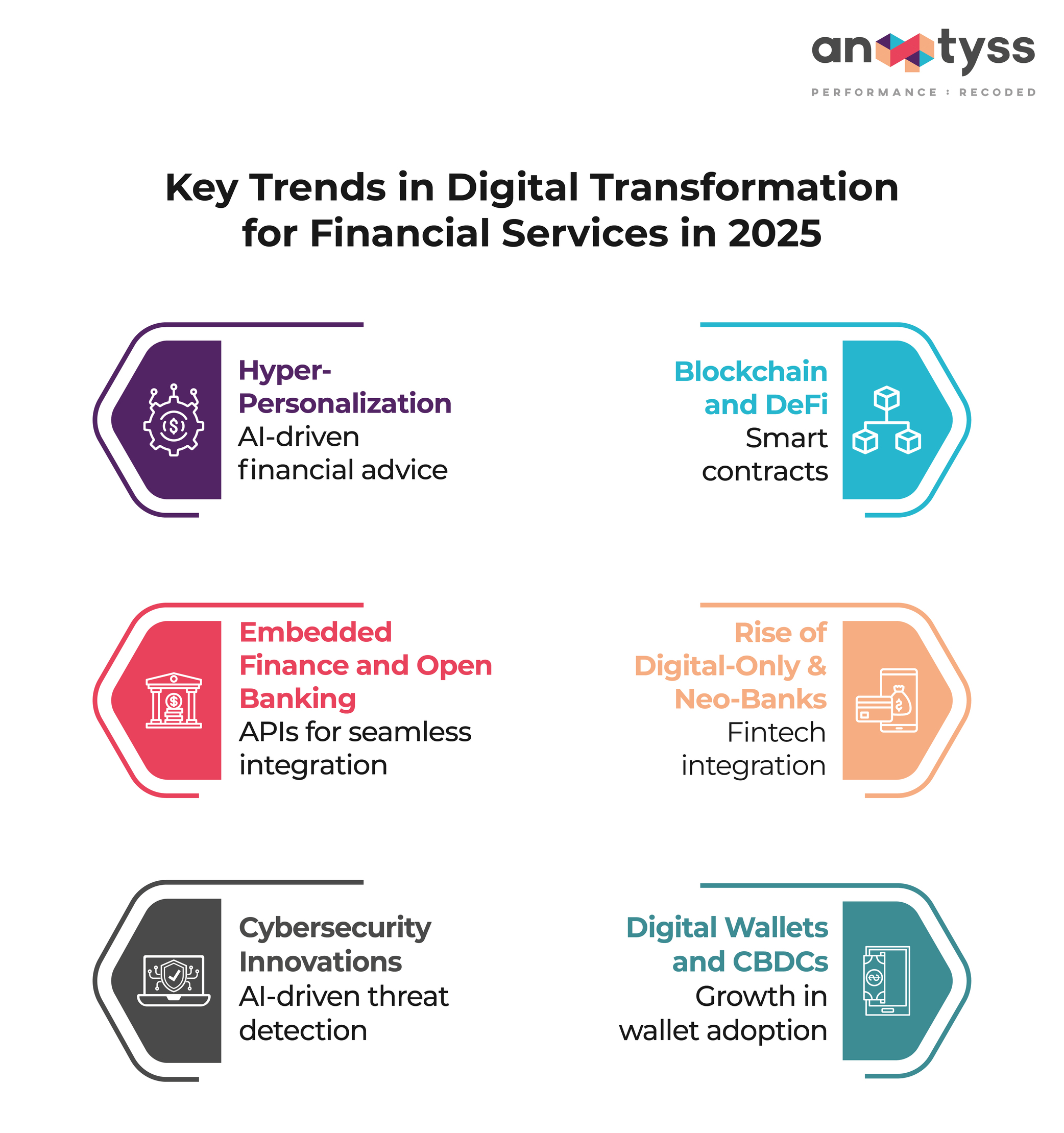
Key Trends in Digital Transformation for Financial Services in 2025

1. Hyper-Personalization through AI and Machine Learning

Hyper-personalization is about to get a major upgrade thanks to advancements in AI and machine learning. These technologies will let financial institutions dive deep into data—everything from transaction histories to real-time online behavior. The result? Tailor-made products, services, and interactions for every single customer. As per reports, effective hyper-personalization can result in an 8x return on marketing investment and boost sales by 10% or higher.

Tailor-made experiences aren’t limited to banking. In insurance too, personalization has become key to customer satisfaction. Learn how hyper-personalization is reshaping insurance through customer-centric innovation.

By 2025, financial institutions will likely use real-time data streams to get insights into customer behavior, refine customer profiles, and deliver the right products at the right time from the right channel – the 3 R’s of hyper-personalization.

AI could also create models to offer personalized tips for saving, spending, and investing, giving customers tools for better financial wellness.

Financial institutions will segment customers into micro-categories using machine learning algorithms and offer precise and relevant products or services. Impact on Financial Services Hyper-personalization will drive customer satisfaction and loyalty. 84% of people say that being treated as a unique person is critical to winning their loyalty. By offering more tailored products and services, financial institutions will be able to increase customer engagement, enhance brand loyalty, and optimize customer lifetime value. For example, insurers might use this technology to identify low-risk customers for cheaper premiums. But beyond that, hyper-personalization could help them manage risks dynamically, making their processes even more efficient.

2. Rise of Digital-Only and Neo-Banks

The global neo-bank market is expected to accelerate at a compounded annual growth rate (CAGR) of around 46.5% between 2019 and 2026. It will generate around USD 394.6 billion by 2026 from USD 18.6 billion in 2018 – PwC. In 2025, these digital-only banks (aka neo-banks) will become even more popular. Neo-banks are online-only financial institutions with zero physical branches.

They appeal to people who prefer a fully digital banking experience. But don’t confuse them with digital banks, which are often offshoots of traditional banks operating entirely online.

These banks can offer cost-effective products and services at a faster pace and greater flexibility with near real-time accounting and reconciliation services. These banks are going to be more popular among the Gen-Z and younger, tech-savvy demographics. Some Neo Banks are becoming more sophisticated offering specialized services like cryptocurrency support.

To stay relevant, traditional banks are increasingly adopting digital-first delivery models and outsourcing models that align with agility and speed. See how managed services differ from traditional outsourcing in banking and why this matters more than ever.

Neo-banks will start offering more complex services like investment management and lending to compete directly with traditional banks.

By 2025, digital-only banks will partner with fintech companies to provide a comprehensive range of financial products in one digital ecosystem. Impact on Financial Services The rise of digital-only banks will challenge traditional banks to rethink their digital strategies. To compete, traditional institutions can adopt a hybrid model where they can work on enhancing their digital services while still offering the option of physical locations. Additionally, these conventional banks and financial services providers can create their digital-only brands to attract younger audiences.

3. Embedded Finance and Open Banking

Imagine paying for something on a shopping app or social media platform without switching to a banking app. That’s embedded finance in action. By 2025, this trend will be everywhere, integrating financial services into non-financial platforms like e-commerce or ride-hailing apps.

Open banking, on the other hand, is a market-driven and regulated framework that enables consumers to share their financial data securely with third parties through APIs, making embedded finance possible.

This makes it easier for the customers to move between providers and enjoy seamless financial experiences. Underpinning these innovations are modern architectures. Implementing microservices in financial systems is a strategic move enabling the agility required for seamless integration via APIs.

In 2025, more non-financial platforms, like e-commerce sites or social media, will offer financial services, including payments, lending, and insurance.

Traditional banks will partner with various industries to integrate their services seamlessly into other digital experiences, offering consumers more ways to access financial products.

In addition to consumer applications, businesses will leverage embedded finance for services like automated invoicing, payroll, and lending directly within business management platforms. Impact on Financial Services Embedded finance and open banking are going to democratize access to financial services and provide a more seamless experience that will drive customer loyalty and engagement. It will also promote innovation and competition in the industry and strengthen customer data portability. Therefore, banks and financial institutions must adapt by:

4. Blockchain and Decentralized Finance (DeFi)

Blockchain technology and DeFi platforms are set to revolutionize the financial services industry in 2025 by offering more secure, transparent, and decentralized alternatives to traditional financial systems.

DeFi runs on blockchain technology to manage financial transactions and blockchain ensures transparency and efficiency. This makes it particularly appealing for financial transactions, enabling faster settlements, reduced fraud, and enhanced security.

It also aims to democratize finance by replacing legacy, centralized institutions with peer-to-peer relationships that can provide a full spectrum of financial services, from everyday banking, loans, and mortgages, to complicated contractual relationships and asset trading.

However, with the rise of DeFi, regulatory compliance is becoming more complex. Explore the challenges of cryptocurrency and money laundering and how banks can prepare for them.

DeFi platforms use smart contracts to automate transactions, eliminating intermediaries and reducing costs. In 2025, smart contracts will find applications in everything from lending to insurance.

The tokenization of assets, including real estate, art, and commodities, will gain traction, providing new investment opportunities.

Blockchain-powered payment networks will streamline cross-border transactions, making them faster and more affordable for consumers and businesses alike. Impact on Financial Services Blockchain and DeFi pose a challenge to traditional financial institutions, potentially disrupting their role as intermediaries. To adapt, banks may explore partnerships with blockchain-based platforms or integrate DeFi solutions into their services to remain competitive.

5. Digital Wallets and Central Bank Digital Currencies (CBDCs)

In 2025, digital wallets and Central Bank Digital Currencies (CBDCs) are expected to play a larger role in the financial ecosystem with potential wide use by households and businesses to store value and make payments. Similar to physical currency in circulation, digital currency is traditional money but in digital form issued by the central bank in the country (such as the US dollar). It’s a legal tender with the central bank’s accountability. Rapid economic digitization, the demand for real-time payments and settlement, and the need for more effective domestic and international financial transactions are the main factors driving the need for CBDCs. Digital wallets have already become popular for their convenience in making contactless payments, and CBDCs offer a new digital form of government-backed currency. Australia’s trailblazing national green bank, the Clean Energy Finance Corporation, has already facilitated more than $37 billion in investments over 10 years.

Digital wallets will become a mainstream payment method, with more financial institutions developing proprietary digital wallets to compete with tech giants.

Many countries will launch CBDCs to provide their citizens with secure, government-backed digital currency alternatives.

As digital wallets become ubiquitous, they will integrate seamlessly with e-commerce platforms, simplifying checkout processes and reducing transaction times. Impact on Financial Services Digital wallets and CBDCs will require financial institutions to reimagine how they handle currency, payments, and customer interactions. Banks and payment providers may need to upgrade their infrastructure to support digital wallets and CBDC transactions, ensuring that they can compete in this evolving landscape.

Conclusion

Digital transformation in financial services is going to disrupt the banking and financial industry dramatically in 2025. It’s going to reshape customer experiences, business models, and operational efficiencies.

Some of the trends outlined above—including hyper-personalization, digital-only banking, embedded finance, blockchain, cybersecurity advancements, and digital wallets—will redefine how financial institutions engage with their customers and deliver value.

And as GenAI becomes more integral to strategic execution, institutions must be ready. Check out our white paper on Generative & Agentic AI in banking to see what’s next in AI-led transformation.

How Generative AI is Transforming Financial Crime Compliance

Our previous blog discussed how access to Generative AI (GenAI) capabilities has enabled new-age threat actors and criminals to carry out various highly sophisticated fraud and financial crime schemes – and how financial institutions can detect and combat GenAI-enabled frauds.

In this blog, you will learn how financial institutions can also use the GenAI capabilities to transform their traditional rule-based systems and static models with models powered by artificial intelligence (AI) and machine learning (ML) to combat financial crime, such as money laundering, terrorist financing, and fraud.

You can also explore strategies to enhance efficiency in financial crime compliance programs with advanced analytics, skill development, and risk-based approaches.

Limitations of Traditional Financial Crime Compliance Processes

While technology is evolving, many banks and financial institutions still rely on their traditional systems for compliance with financial crime. However, these systems have many limitations, such as:

  1. Static, Rule-based System

Traditional systems and processes are often based on predefined rules and procedures to detect fraud and financial crime. However, these quickly become outdated and inefficient in the era of emerging threats.

  1. False Positives

Rule-based systems are known to trigger high rates of false positives. As a result, it leads to inefficiencies and makes the team manually investigate each non-issue (false positives), often redirecting or diverting the resources from actual threats.

  1. Manual Processes

Manual review processes for alerts are always labour-intensive, time-consuming, and prone to human error. For more insights on these challenges, read What is Financial Crime Compliance.

  1. Inability to Keep up with Rapid Change

Static systems often struggle to keep pace with the evolving financial crime scenarios and sophisticated fraud schemes, especially those enabled by emerging technologie,s such as AI, machine learning, GenAI, etc., leaving financial institutions and banks vulnerable.

Role of Generative AI in Transforming Financial Crime Compliance

Generative AI is set to redefine the fundamental game of financial crime and fraud detection and prevention with its unprecedented advanced capabilities. Here’s how:

How Generative AI is Transforming Financial Compliance

  1. Dynamic Fraud Detection Models

With GenAI, financial institutions can create a fraud detection model that continuously learns from real-time and historical patterns. Unlike static rule-based fraud and financial crime detection systems, these AI and machine learning-powered models can quickly adapt to new and emerging threats and help safeguard institutions with highly accurate proactive detection capabilities.

For example, some financial crime typologies, such as money laundering, synthetic identity, KYC impersonation, etc. are evolving rapidly. GenAI can help analyze large data sets in real-time, detect anomalies, and flag suspicious activities or patterns with greater accuracy.

  1. Improved KYC and Customer Due Diligence

Know your customer (KYC) and customer due diligence (CDD) are the fundamentals to prevent financial crimes. With GenAI, financial institutions can automate and improve these processes by analyzing large sets of both structured and unstructured data from, for example, public records, social media, transaction history, etc, to create or generate a more accurate risk profile.

Similarly, by leveraging natural language processing (NLP), GenAI can help boost customer onboarding, identify red flags in the process for further investigation by humans, and help provide a more comprehensive view of customer risk.

  1. Predictive Capabilities for AML

US banks spend about $25 billion a year on processes to fight money laundering, and fines levied on banks worldwide for failing to prevent it topped $6 billion in 2023 – as per Oracle.

Anti-money laundering compliance (AML) programs traditionally rely heavily on static thresholds in many financial institutions to flag suspicious activities. However, GenAI can enable financial institutions to predict suspicious behaviors and transactions even before they escalate and lead to major issues, such as financial loss and compliance failure.

For instance, AI models can continuously learn and analyze customer behavior, transaction history, and network relationships, and more to predict patterns consistent with money laundering and help reduce the likelihood of financial crime going undetected. For a deeper understanding, explore Financial Crime Risk Management.

  1. Reduced False Positives

False positives generated by static models and traditional systems are one of the most concerning pain points for financial institutions, especially for compliance teams.

According to PWC, 80% – 90% of transaction monitoring and name screening hits are false positives.

However, GenAI-based models can continuously learn, adapt, and refine their detection mechanisms over time to reduce the likelihood of false positives. This can help drastically reduce the pressure on compliance teams and human resources, helping them focus on more productive and important tasks and dealing with genuine threats.

Conclusion

Generative AI is set to transform financial crime compliance with enhanced capabilities that can efficiently detect fraud, improve customer due diligence processes, automate systems, and significantly reduce the burden of false positives on compliance teams.

The GenAI-enabled models can continuously learn and dynamically adapt to emerging threats and analyze vast amounts of data in real-time with better accuracy and reduced false positives.

To stay ahead in this evolving landscape, financial institutions should act now and start integrating these emerging technologies into their compliance strategies.

At Anaptyss, we provide AI-powered intelligent digital solutions to help banks and financial institutions navigate these challenges effectively. To learn more and know how we can co-create and support your financial crime compliance efforts, reach us at info@naptyss.com

You can also read our eBook on Financial Crime Compliance to learn more about financial crime compliance and strategies in banking.

Top Applications of Advanced Data Analytics in Insurance Policy Underwriting and Claims Management

The insurance industry is a high-risk sector that needs to navigate underwriting challenges, tricky claims, evolving regulations, and growing customer expectations. It is seeing a paradigm shift and rapid transformation through the adoption of advanced analytics which can significantly enhance the underwriting and claims management processes.

How Does Advanced Analytics Transform Underwriting?

Traditionally, underwriting has been a labor-intensive process. Historically, underwriters have relied on manual assessments, past experiences, gut feelings, and limited data sources to evaluate risks and determine policy terms.

However, by combining emerging technologies and AI-powered models, insurers can automate the underwriting process to a significant extent. They can assess risks more effectively using vast datasets, third-party information, and real-time analytics.

1. Enhanced Risk Assessment and Decision-Making

The new-age underwriting process is leveraging advanced data analytics to refine risk assessment by incorporating multiple variables. This also includes access to third-party data, such as:

These data points help insurers evaluate risk more precisely and provide a more comprehensive view of potential policyholders for better decision-making related to policy issuance, pricing, and coverage.

For example, insurers can use advanced analytics to enable straight-through processing (STP) for simple risks, while complex cases can be flagged for human review.

This approach helps insurers reduce turnaround times for policy decisions. Besides, it also enhances accuracy and lowers administrative costs.

As per McKinsey & Company, a midsize P&C insurer used advanced analytics and third-party data to deliver quotes and bind policy in minutes rather than days leading to new business premiums rising by 50%.​ Further, by diverting low-risk accounts to STP, it expects to more than double STP rates while maintaining its loss ratio within one to two years.

2. Streamlined Underwriting with Automation

With the help of advanced analytics and machine learning, insurers can automate the underwriting processes and dramatically reduce manual labor input.

This helps insurers improve efficiency. As a result, they can quote and bind policies much faster.

According to a case study shared by McKinsey, a mid-sized insurer developed a digital platform using analytics that helped it cut down manual efforts by 90%. This enabled them to dramatically simplify the agent experience and ensure faster, more accurate policy issuance​.

Advanced Analytics in Claims Management

Claims management is the backbone of customer satisfaction in the insurance sector, which could benefit greatly from advanced analytics.

Whether handling auto, health, or property claims, efficient and accurate claims processing is essential for insurers and their customers. Below are some examples of how advanced analytics is helping insurers manage claims and boosting customer experiences.

1. Fraud Detection and Prevention

Insurance fraud is a significant concern for insurers concerning claims management. According to the Coalition Against Insurance Fraud, insurance fraud costs the U.S. $308.6 billion annually.

By incorporating data analytics, insurers can use predictive models and machine learning to detect fraudulent claims before they escalate. Some of the techniques involved are data mining and anomaly detection which enable insurers to detect and flag suspicious claims early. As a result, insurers can save on the insurance claim payouts and safeguard their profitability.

For example, white paper illustrates key findings including how advanced fraud detection models, driven by vast amounts of data, have helped insurers reduce fraudulent payments by up to 25%​.

Additionally, incorporating AI and Machine Learning (ML) in claims management has a 20% reduction in fraudulent claims, highlighting the impact of advanced technologies in improving efficiency and accuracy in the insurance sector.

2. Automation and Efficiency in Claims Processing

Automation through advanced analytics is helping insurers streamline their claims management process.

For instance, by integrating artificial intelligence (AI) and robotic process automation (RPA), insurers can handle routine tasks that include:

This not only reduces human errors but also speeds up the resolution process.

For example, claims can now be processed end-to-end through digital portals powered by AI tools to analyze data from various sources, including photos or videos uploaded by customers, to estimate damages quickly. This not only reduces claims cycle time but also enhances accuracy and transparency​.

As per reports, insurance companies that have implemented predictive analytics have seen claim processing times reduced by as much as 30%.

3. Improving Customer Experience

To meet and exceed evolving customer expectations for seamless, digital experiences, insurers can use advanced analytics to personalize the interactions and streamline the claims process based on individual preferences.

As McKinsey suggests, some customers may prefer fully digital claims experiences, while others value the option to speak with an agent for complex issues​.

By providing tailored options, insurers can boost customer satisfaction and retention rates.

As per personalization can help increase revenue by 60%, customer retention by 81%, improved engagement by 89%, and boost in sales and marketing conversion rates by 75%.

Integrating Advanced Analytics in Policy and Claims Management

Integrating advanced analytics in policy underwriting and claims management isn’t just about implementing new technology—it requires strategic integration across the underwriting and claims management processes.

Therefore, insurers must focus on creating agile, cross-functional teams that combine expertise in data science, IT, and business processes to harness the full potential of analytics​.

Additionally, as analytics become more embedded in day-to-day operations, insurers can track key performance indicators (KPIs) such as claims processing times, fraud detection rates, and customer satisfaction scores. This continuous monitoring will enable insurers to identify areas for improvement and maintain a competitive edge.

Most importantly, effective analytics depends on integrating data from various sources and the quality of data. By consolidating internal and external data, insurers can improve decision-making and operational efficiency.

For instance, by incorporating healthcare data into insurance claims processes, insurers can assess medical claims more accurately. This can help reduce overpayments and enhance fraud detection.

Conclusion

Advanced analytics is revolutionizing the way insurers handle policy underwriting and manage claims. When combined with emerging technologies, such as AI and machine learning, it enables insurers to operate more efficiently, reduce costs, and improve customer satisfaction.

Further, as these technologies continue to evolve, the future of insurance will be defined by how effectively companies can leverage analytics to meet customer needs and optimize performance.

At Anaptyss, we offer and help insurers co-create new-age insurance fraud detection and prevention solutions powered by AI, machine learning algorithms, and advanced analytics, to identify patterns, anomalies, and inconsistencies and detect potentially fraudulent claims or activities.

Top Trends in Global Banking and Financial Services Industry in 2024

Change is inevitable in any industry, more so in banking and financial services due to their geographically diversified customer base, cross-border legislations, and fundamental role in economic activities.

Several macro factors drive changes in banking and financial services, shaping distinct trends and pushing the boundaries for innovation and delivery of financial services in 2024.

For example, banking customers have used digital payments for over a decade since 2000s. However, the pandemic dramatically increased the usage and customer base of digital payment platforms. According to worldbank.org, two-thirds of the adult population worldwide began using digital payments after the pandemic in 2021. Over 40% of adults made digital payments for the first time since the pandemic.

This trend indicates a need for banks to offer digital payment services to customers and invest in improving their experience. Enhancing fraud detection in digital payments is also becoming critical as online transactions increase.

Banking regulations are another area of change, continuing to see a tectonic shift. Over the past two decades, banking laws and regulations have been getting more nuanced and far-reaching due to events like the 2008 global economic meltdown, the 9/11 attacks, etc.

There is an increased focus on cross-border collaboration, due diligence, and consumer protection, increasing the chances of scrutiny. For instance, while digital ad-serving technology has enabled financial services to reach more prospects, it obligates them to protect user privacy in line with data privacy laws.

International laws such as the General Data Protection Regulation (GDPR) and California Consumer Privacy Act (CCPA) ensure they do so to avoid hefty penalties and reputational losses.

Macro Factors Affecting Banking and Financial Services Globally

  1. The rise of digital technologies and the prevalence of data
  2. New competitors and business models
  3. Proliferation of laws and regulations
  4. Evolving customer expectations
  5. Growing focus on ESG
  6. Changing workplaces and talent

Here are some prominent trends taking shape due to the factors above.

Trend 1: Increased Adoption and Applications of Generative AI (Gen AI)

Gen AI tools and solutions are rapidly evolving since the launch of ChatGPT in 2023, and virtually every industry is exploring the potential of Generative AI. The banking and financial services industry is among those that stand to benefit the most, with several well-defined use cases.

According to Juniper Research, the annual global spending on Gen AI by banks will increase from $6 billion in 2024 to $85 billion in 2030, projecting over 1300% increase in the spends.

Key use cases/applications of Generative AI in banking and financial services in 2024 include:

  1. Risk Management: GenAI can help manage emergent credit risks, technology risks, and other financial and non-financial risks through synthetic data creation, risk modeling, testing, etc.
  2. Customer Support: Generative AI solutions such as intelligent chatbots can enable autonomous client servicing to a great extent by generating personalized responses to queries in real time. Virtual bankers and relationship managers are some other possibilities based on GenAI.
  3. Detection and Prevention of Financial Fraud: Proliferating fraud typologies necessitate urgent intervention of cutting-edge technologies guided by human expertise. Generative AI is at the frontier of technologies that can curb financial fraud by leveraging data, training advanced models for detecting false positives, learning anomalous patterns, behavioral analysis, etc.

Other emerging applications of generative AI in banking and financial services industry include:

Despite its potential, Generative AI also presents challenges, such as

Additionally, regulators are increasingly focused on AI transparency and ensuring these systems do not inadvertently harm consumers or create unfair advantages.

Besides, criminals also have access to Generative AI capabilities and are actively using them for deepfakes and to run sophisticated fraud schemes and financial crimes. To effectively address these threats, it’s essential to understand how to combat Generative AI-enabled deepfakes and other financial frauds.

Trend 2: Growing Reliance on Cloud and Edge Computing to Capture Value

Cloud computing is gaining more relevance with financial institutions’ growing focus on priorities such as digital banking, innovation, customer experience, operational agility, scalability, and cost-effectiveness. A research report by Insight Ace Analytic informs that cloud adoption in banking is expected to grow at a CAGR of  16.3% from 2024–2031.

Further, the report projects wealth and investment banks among top adopters of cloud due to their increased need for predictive analytics, risk management, and data regulation.

According to AWS Banking on the Cloud 2024 report, banks are focused on distinct priorities to drive innovation, customer experience, and improve their core operations, and cloud services have a crucial role in supporting these priorities.

For instance, cloud provides the necessary infrastructure for crucial requirements such as data aggregation and data analysis, security enhancement, rapid experimentation, etc., to devise a better experience for customers.

Although cloud adoption brings numerous benefits, it also introduces security and data privacy challenges. Financial institutions must ensure compliance with stringent regulations such as GDPR while securing sensitive customer information. Multi-cloud strategies and enhanced encryption techniques are often employed to mitigate these risks and protect data integrity.

For instance, in 2023, a major European bank faced a $50 million fine for non-compliance with GDPR, underscoring the increasing scrutiny around data protection and cross-border privacy regulations. This example highlights the heightened risk that financial institutions face as compliance requirements continue to evolve.

Trend 3: Increased Regulatory Scrutiny, Need for Safety and Soundness, and Consumer Protection

Governance, Risk, and Compliance (GRC) continues to be a prime focus of regulators and policymakers, who are expected to bring more stringent mandates to address new and emerging risks in 2024. On the operational side, cybersecurity threats and new technologies such as AI, blockchain, and cloud are rapidly shaping new risk scenarios.

Similarly, geopolitical issues and economic uncertainties continue to challenge the financial stability of the global banking and financial services ecosystem.

Increased regulatory scrutiny may also pose challenges for fintech startups, especially in terms of meeting compliance requirements that often demand extensive resources. This may result in higher barriers to partnership with traditional banks, who are also under pressure to ensure the compliance of their fintech partners, thus making the collaboration ecosystem more challenging.

According to Deloitte 2024 banking regulatory outlook, the US banking regulators are slated to bring significant updates to capital, resolution planning, compliance, and oversight in 2024. Major trends and developments on the regulatory front include:

  1. Increased supervisory scrutiny of financial institutions and focus on delayed remediation of findings.
  2. Expanding scope of scrutiny, from large banks to midsized financial institutions, fintech, payment companies, and big tech firms.
  3. Areas of regulatory scrutiny to include liquidity debt and capital requirements.
  4. Safety and soundness among the top priority of banking regulations, including Basel III international standards also known as “Endgame”, long-term debt requirements, etc.
  5. More emphasis on protecting consumer rights from potential violation due to technologies such as blockchain, artificial intelligence and other aspects like fintech partnerships, fair lending, etc.

Read more on how RegTech adoption is shaping financial compliance strategies.

Trend 4: Macroeconomic Conditions, Regulatory Changes, and Cyber Risks Among Top Threats

While several types of issues pose risks to the banking and financial services in 2024, a few of them have taken the centerstage.

According to the ERM Initiative Report on Top Risks by Protiviti and NC State University, which surveyed 1,143 board members and C-suite executives, the change in current interest rate environment is the top risk to maintaining profitability and growth in financial services in 2024. The major reasons driving this perception include liquidity crisis, more stringent regulations, increased funding costs, and fundraising difficulties.

The following are some other risk trends in financial services:

The Protivity-NC State University report mentions some additional risks that will be emerge as critical areas of concern for financial services in 2034. These new risk categories include:

Trend 5: Mobile, Personalization, Automation, and Security Most Important for Customer Experience

While customer experience reigns supreme from the standpoint of delivering value to customers, specific aspects standout as key factors that financial services must consider for enabling a great customer experience. These aspects include:

  1. According to a National Survey conducted by the American Bankers Association in 2023, approx. 48% of customers use mobile devices and apps to manage their bank accounts, followed by desktop, branch, ATM, and telephone calls.
    This finding clearly indicates that superior mobile banking experience can be a key differentiator for banks and other financial services, helping them attract and retain customers and increase their lifetime value.
  2. In a report titled The State of Personalization Maturity in Financial Services in 2023 by Master Card Dynamic Yield, 72% of the people that were surveyed considered personalization as “highly important” in today’s financial services industry. And 86% of financial institutions identify personalization as a critical business priority.
  3. AI-powered automation will continue to gain prominence as an enabler of customer experience in the financial services industry in 2024. Many of the repetitive processes such as online application filling, documentation, payment processing, etc. are key candidates for intelligent automation. For example, intelligent chatbots can provide a real-time interface for banks to engage with customers 24×7 irrespective of their time zones.
  4. Security and privacy are among the top concerns of customers as they continue to adopt digital platforms for financial and non-financial activities such as online payments, deposits, purchases, enrollments, mobile banking, etc. For instance, biometric authentication, such as fingerprint scanning, facial recognition, and even voice biometrics, can help enhance security and contribute to a seamless customer experience by eliminating the need for traditional passwords.

Trend 6: Sustainable Finance is Gaining Significance and Relevance

Environment, Social, and Governance (ESG) actions are a critical priority for financial services due to the obvious need and demand for tangible actions that result in outcomes. While specialized laws and regulations obligate organizations to maintain and disclose specific sustainability measures toward ESG, customers and employees now prefer companies that demonstrate impactful ESG action.

For example, HSBC has committed to providing up to $1 trillion in green finance by 2030, while Barclays was the first to roll out its ‘Green Home Mortgage‘ initiative back in 2018 to encourage sustainable housing. These initiatives demonstrate the financial sector’s growing focus on sustainability and aligning with global climate goals.

The following are some emerging trends in sustainable finance:

  1. Green loans are gaining relevance due to their inherent focus on promoting and supporting businesses developing energy-efficient technologies and solutions. According to FinTech Magazine, green loans are more compelling to retail and corporate customers as they align better with their sustainability values.
  2. Carbon tracking technology is gaining traction due to its ability to determine the environmental impact of human activities. In banking and financial services, adoption of carbon footprint tracking solutions is increasing due to its fundamental role in measuring and reporting the emissions due to banking operations.
  3. Digitization technologies are emerging as a crucial alternative to conventional financial processes such as payment processing. Mobile payment solutions, carbon-neutral payment processing, contactless payments, and digital wallets are some of these.
  4. According to Deutsche Bank ESG Trends for 2024, the focus will continue to grow on transition plans as more companies pledge to attaining net zero targets. However, according to Climate Action 100+ report, most focus companies are slow in implementing the measures to meet the goals in line with Paris Agreement.

Trend 7: Talent as a Key Differentiator and Competitive Advantage

Considering the disruption due to new technologies, competitors, regulations, and customer preferences, the financial services industry needs skilled professionals capable of effectively steering the business. This demand includes roles like data scientists, AI specialists, cybersecurity experts, and blockchain developers who can bridge the gap between technology and business strategy, ensuring that digital initiatives align with core business objectives.

While the demand for such roles and high-quality talent is growing, specific trends impact the availability of talent.

  1. Flexible Workplaces: While organizations continue to devise innovative approaches to bring back employees to office, people in the workforce desire flexibility in their work locations and timings. In a Deloitte’s survey, about 94% of respondents indicated workplace flexibility – hybrid and remote work options, supportive policies, etc. – as a key factor impacting their well-being and work-life balance.
  2. Growing Competition for Technology Talent: Arrival of new technologies has created a demand for proficient workforce. As competition grows, and organizations attempt to outpace each other, they recognize that the corresponding talent is scare and expensive, and therefore, they are devising a more holistic value proposition to attract professionals. Supportive culture, learning opportunities, career growth, and work-life balance are crucial for engaging the right talent.
  3. Need for Talent Development: Aside from acquiring new talent, organizations are recognizing the need to upskill and reskill their existing talent pool in sync with industry standards and customer expectations. Consistent development of in-house talent in technical domains, new verticals, and soft skills is a strategic focus area for market competence and employee retention.
  4. Long-Term Knowledge Management: Financial institutions, among the different types of organizations, need to manage their knowledge base most due to the critical role of knowledge in running the operations. Therefore, there is an emphasis on curating the knowledge – individual’s process expertise, versioned documents, time-tested learnings, etc. – into digital content libraries that allow centralized and long-term access without dependency on an individual. Digital knowledge management is a rising trend and need to secure documented expertise from loss.
  5. Diversity, Equity, and Inclusion (DEI) at the Heart of Culture: In addition to sustainability, DEI constitutes another critical element of an organization’s value system, which can positively influence prospective talent. Financial services companies realize the importance of DEI and have a strategic focus on fostering a diverse, equitable, and inclusive culture.

Awareness and Action are Crucial for Market Relevance

Amid rapid and multifaceted changes, financial institutions must stay aware of the latest developments and trends and take timely actions to maintain their competitiveness.

Considering the need to recognize the fluid landscape and competitive ecosystem, agility and adaptiveness must form the cultural core of financial services to provide them with sustained market relevance.

How to Banks Can Combat Generative AI-Enabled Deepfakes and Other Financial Frauds

GenAI uses a combination of AI and emerging technologies, such as machine learning, to analyze and learn patterns from large datasets and generate content or data. New-age threat actors and criminals are also armed with Generative AI capabilities, which has led to a sudden spike in financial fraud. They are exploiting GenAI to create hyper-realistic deepfakes, falsify documents, generate synthetic media, such as images, audio, or video, and execute highly sophisticated schemes.

In this blog, you will learn the various ways in which threat actors are exploiting GenAI to carry out financial fraud in banking and finance and how financial institutions can safeguard themselves and combat such risks.

Types of GenAI-Enabled Financial Frauds in Banking and Financial Services

As GenAI evolves, it introduces various new methods for committing financial fraud, pushing banks and financial institutions to adapt and upgrade their defenses against such sophisticated tactics continuously.

1. Deepfakes

With AI-generated hyper-realistic deepfake videos and images, criminals can impersonate key individuals in authoritative positions to deceive financial institutions. They can use it to perform illegal activities, such as money laundering, financial fraud, blackmail, fake investment schemes, and more.

Earlier in the year 2024, a striking incident occurred when a finance employee at a UK multinational company in Hong Kong transferred $25 million after being tricked by a deepfake video call that convincingly mimicked the company’s chief financial officer (CFO).

2. KYC Impersonation

With GenAI capabilities, it has become much easier to impersonate anyone’s identity. By generating facial features and forged but realistic-looking documents, criminals can bypass the know-your-customer protocols, especially when it comes to video-based verification methods—also known as Video KYC.

The largest threat to the business, according to Deloitte’s 2024 Financial Services Industry Predictions report, is generative AI or GenAI, which may increase fraud losses in the US from $12.3 billion in 2023 to $40 billion by 2027.

3. Spoofing Voice Calls

Criminals can leverage GenAI to clone and mimic a person’s voice. They can imitate the accent, timbre, intonation, and emotions inherent to human speech and exploit them for scams. For example, offenders can deceive individuals into committing illegal activities inadvertently, such as authorization of transactions based on voice-based payment requests. Scammers are using AI to enhance their family emergency schemes – Federal Trade Commission.

voice cloning using generative AI for hyper realistic vishing and spoof calls

One of the most recent known incidents of voice spoofing occurred in Newfoundland, where at least eight senior citizens were conned out of $200,000 over three days using AI-powered voice cloning—referred to as the “grandchild scheme.”

In this case, fraudsters mimicked the voices of “grandchild” or loved ones in distress, claiming that they got into a car accident or arrested—to convince the victims that urgent financial help was needed.

4. Synthetic Identity Fraud

Synthetic IDs are created by combining real and fake personal information, which can be used to open bank accounts or obtain credit/loans illicitly. With wide availability of GenAI, it has become easier for criminals to make synthetic IDs and enhance their synthetic identity fraud capabilities.

According to a Wakefield Research Survey report, 76% of respondents believe that their organization has customers using synthetic identities that have been approved for an account.

synthetic Identity fraud in banking and financial services

With GenAI, creating a synthetic identity is as simple as asking, “Create an accurate New York driver’s license.” The GenAI application can generate a fake ID using real people’s photos that can be readily found online. What’s alarming is that these GenAI apps enable fraudsters to fabricate documents quickly and with a high level of realism. This makes it harder for banks and financial institutions to detect fraudulent or suspicious activities.

5. GenAI-Based Phishing Attacks

Using GenAI, criminals can generate compelling phishing emails and messages, increasing the effectiveness and impact of phishing scams. Spear Phishing attacks have now become easier where criminals use social engineering to target specific or key individuals using the information gleaned from their social media profiles, data breaches, and other sources. These AI-generated spear phishing emails are often very convincing with a high click-through rate.

For instance, Singapore’s Government Technology Agency published the findings of an experiment at Black Hat USA 2021 in which the security team sent internal users spear phishing scams. While some were created by hand, others were produced using OpenAI’s GPT-3 technology. The AI-generated phishing emails had a far higher click-through rate than the human-written ones.

Detecting and Preventing Generative AI-Enabled Financial Fraud in Banking and Financial Services

With the rise in AI or GenAI-driven threats, financial institutions must adopt advanced detection tools and strategies to combat the growing risk of financial fraud. Below are some techniques and strategies banks and financial institutions can employ.

1. Leverage AI Against AI

The fight against AI is increasingly becoming an AI vs AI showdown. AI is needed to build the defense systems of tomorrow. Banks and financial institutions can use the same AI accessible to fraudsters to build, power, and enhance their fraud detection systems. These systems can help detect or identify suspicious behavior and fraudulent activities at scale.

Using machine learning models, right training on vast datasets including both real and fake (deepfake) media, and AI algorithms, banks and financial institutions can detect subtle differences between synthetic videos/images, which cannot be recognized by the human eye. It can detect irregularities in digital content and differentiate between real and synthetic media with high accuracy.

However, this is a cat-and-mouse game where AI systems designed to detect deepfakes are also used by criminals to improve or train their deepfake models. As a result, they can make the fakes more realistic and harder to detect. As detection improves, deepfake techniques evolve, continuing the cycle.

2. Use Multi-Factor and Biometric Authentication

Combining security protocols, such as multi-factor authentication along with biometric verification, such as facial recognition, and thumbprints/fingerprints, can make it significantly harder for fraudsters to use generative AI to bypass the identification verification measures.

Also, insert additional layers of authentication when it comes to defense against deepfakes. For instance, deploy monitoring systems to detect synthetic audio and assign a ‘confidence score’ based on which agents may ask additional questions for authentication.

3. Leverage Behavioral Analytics

Monitoring and examining customer behavior patterns can help banks and financial institutions gather useful information that could help them identify unusual behaviors indicative of fraud and flag possible incidents of suspicious/fraudulent activities for manual review. Some examples include high value-transactions, changes in login patterns.

Banks and financial institutions can leverage AI-based behavioral analytics (artificial intelligence and big data analytics) to develop automated fraud detection systems capable of screening large volumes of transactions and detecting trends, anomalies, and suspicious activities in real-time with accuracy for appropriate actions.

An example of unusual behavior that could signal fraud is if a consumer purchases some groceries in New York and, just 15-20 minutes later, makes another purchase for luxury goods in Tokyo or another location. The rapid change in location is highly unlikely and raises suspicion.

Another example is if a consumer suddenly makes a high-value transaction in a completely unfamiliar place. For instance, if someone’s financial credentials are used to book ten first-class flights from a location in Dubai, while they’ve never traveled outside of their hometown in Australia.

4. Collaborate with Industry and Third Parties

By partnering with trusted third-party vendors and managed services providers, banks and financial institutions can co-create/develop advanced fraud detection systems capable of detecting sophisticated GenAI-enabled financial frauds. It enables financial institutions to have immediate access to some of the brilliant minds and expertise that can help them design, develop, and maintain robust AI algorithms and models for financial applications.

Similarly, they can collaborate with other financial organizations, such as banks, investment firms, etc., to share threat intelligence and best practices to build a collective defense against emerging fraud techniques.

For instance, by sharing data and insights on GenAI-enabled fraud, such as AI-generated phishing or synthetic identity fraud, banks and other financial institutions can quickly identify and address evolving threats.

5. Educate and Engage Customers

Educating and engaging with customers about the risks of generative AI-enabled fraud is one of the key strategies for creating a proactive defense. Banks and financial institutions can use various touchpoints, such as push notifications, emails, SMS, social media, etc. to inform and educate customers about the various potential risks and best practices for protecting their accounts.

For example, banks could,

By engaging customers in these ways, financial institutions empower them to identify suspicious activity, such as receiving a phone call that sounds like a family member urgently asking for money but is actually a scam carried out with the help of GenAI.

Additionally, banks could offer webinars or interactive sessions for customers where they can learn about advanced fraud techniques, helping them protect themselves as well as financial institutions.

6. Continuous Training and Talent Development

Banks and financial institutions must invest in talent acquisition, development, and continuous employee training to stay ahead of AI-driven frauds. To combat the sophisticated GenAI-enabled frauds, such as deepfakes, it’s crucial to build in-house expertise in fraud detection and AI technology. By developing these technologies, institutions can respond more swiftly and effectively to evolving threats.

For example, banks and financial institutions can leverage digital learning or e-learning platforms, such as Fluent, can deliver accessible, outcome-based training tailored to their workforce without disrupting daily operations.

It can help boost their workforce training, augment skills, and build hands-on capabilities in AI, cybersecurity, and more within a few weeks to months.

With regular training on signs of deepfakes, synthetic identities, AI-manipulated communications, and tools, they can prepare their staff to detect fraud patterns and take appropriate actions.

Conclusion

In today’s rapidly evolving landscape of AI-driven fraud, financial institutions must stay proactive in defending against sophisticated threats like deepfakes, synthetic identities, and AI-generated phishing.

By investing in advanced fraud detection technologies, continuous employee training, and customer education, banks can strengthen their defenses and reduce risk.

In this AI-versus-AI battle, continuous learning, adaptation, collaboration with industry partners, and leveraging AI-powered tools will be the keys to success.


DKO™
Life@Anaptyss
Careers